Best Samplers for Hip Hop (2026): 10 Machines Compared, From the $220 Roland P-6 to the MPC Live III
This article contains affiliate links. If you buy through them, GUIO Records may earn a small commission at no extra cost to you. As an Amazon Associate I earn from qualifying purchases. Outside the US, Amazon links open your local Amazon store (UK, Canada, Germany, France, Italy, Spain, Netherlands, Poland or Sweden).
A sampler is still the fastest way from a record to a beat: capture a few seconds, chop it across pads, add drums and find the pocket. The hard part is that these machines work very differently. Some are built for chopping, some for effects, some for sequencing. Here are the 10 best samplers for hip hop in 2026, with the specs that matter and how much of a loop each one can really hold.
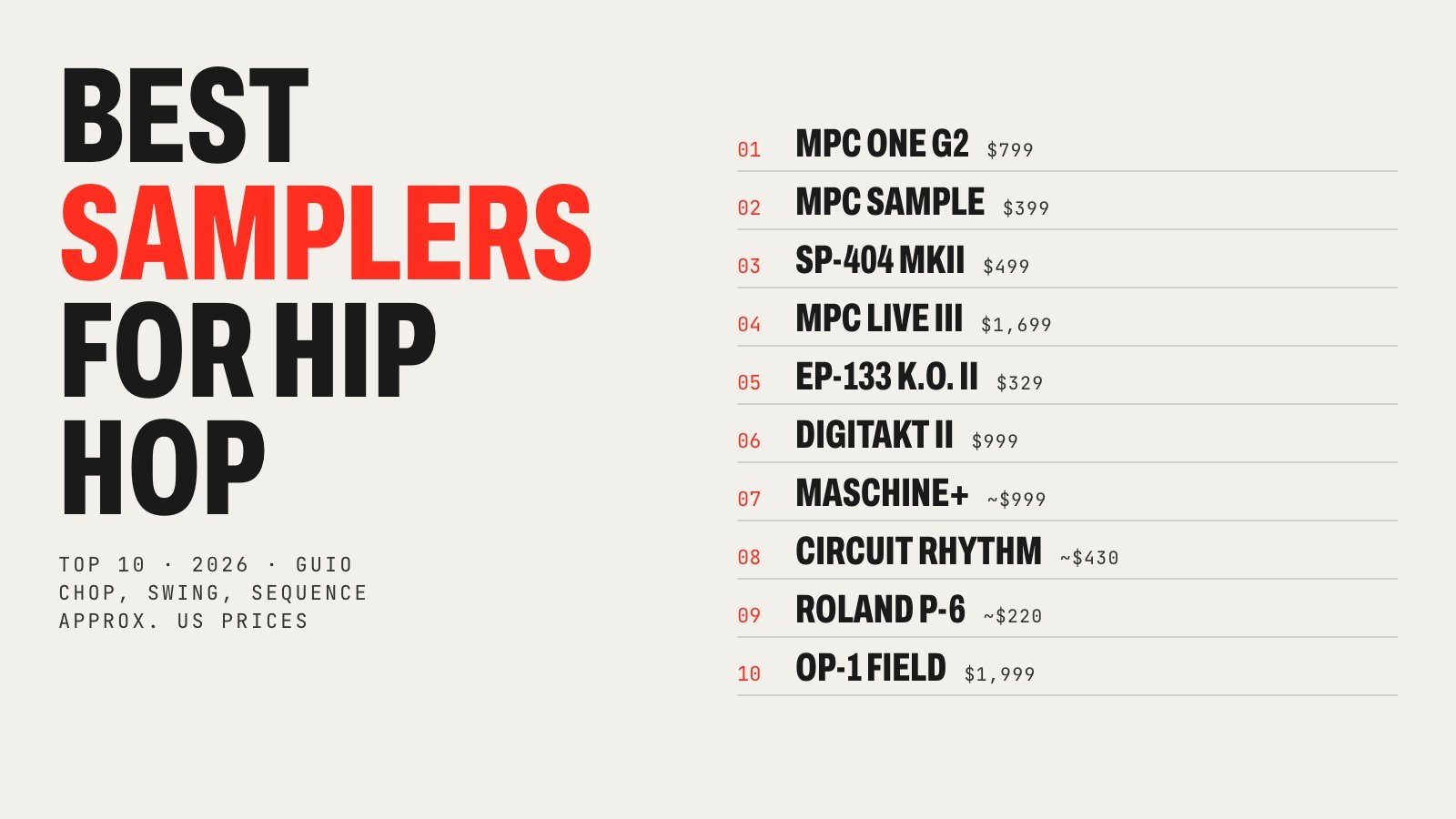
How this list was made: I am a hip hop producer and I make my beats on an MPC Live III, the only sampler on this list I own. The other nine are not personal tests. Those picks come from manufacturers’ spec sheets, US dealer prices and reviews from Sound On Sound, MusicRadar and others, all credited at the end. Prices change often; the buttons show the current price.
The top 10 at a glance
| Sampler | Approx. price | Pads | Memory / storage | Battery | Audio in | Best for | Where to buy (paid links) |
|---|---|---|---|---|---|---|---|
| 1. Akai MPC One G2 | $799 | 16, pressure | 4 GB RAM · 64 GB | No | 2 × ¼" line | Best overall | Check price → |
| 2. Akai MPC Sample | $399 | 16, poly aftertouch | 2 GB RAM · 8 GB | 5–6 h, built in | ¼" line · built-in mic | Best value | Check price → |
| 3. Roland SP-404 MKII | $499 | 16 + sub pad | 16 GB | 6 × AA, 2.5–3.5 h | ¼" line · mic/guitar | Effects and lo-fi | Check price → |
| 4. Akai MPC Live III | $1,699 | 16 MPCe, 3D sensing | 8 GB RAM · 128 GB | 3–4 h, built in | XLR/¼" · phono · built-in mic | Vinyl and live | Check price → |
| 5. Teenage Engineering EP-133 K.O. II | $329 | 12, pressure | 128 MB · 999 slots | 4 × AAA | 3.5 mm · built-in mic | Cheap portable sketching | Check price → |
| 6. Elektron Digitakt II | $999 at launch | 16 trig keys | 400 MB RAM · 20 GB | No | 2 × ¼" line | Deep sequencing | Check price → |
| 7. Native Instruments Maschine+ | ~$999–$1,199 | 16 | 4 GB RAM · 64 GB SD | No | 2 × ¼" line · ¼" mic | Finger drumming, NI sounds | Check price → |
| 8. Novation Circuit Rhythm | ~$430 | 32, velocity | 228 s per pack · microSD | Up to 4 h, built in | L/R sample input | Grid workflow | Check price → |
| 9. Roland P-6 | ~$220–$270 | 6 × 8 banks | 48 samples | About 3 h, built in | 3.5 mm · built-in mic | Pocket and granular | Check price → |
| 10. Teenage Engineering OP-1 field | $1,999 list | 24 keys, no velocity | 256 MB · 160 min | 24 h, built in | 3.5 mm · built-in mic | Portable all-in-one | Official store → |
Specs come from official product pages and the press credited below. “~” marks typical US street prices in November 2026. The Digitakt II figure is its launch price; the OP-1 field figure is its list price.
What to look for in a sampler for hip hop
- Chopping. This is the core of sample-based beats. Look for transient detection, even division by number of slices and manual markers, ideally on a screen that shows the waveform.
- Pads. Sixteen velocity-sensitive pads are the classic layout for playing chops and drums by hand. Aftertouch reads pressure after the hit. Button-based machines like the Digitakt II favor step programming over finger drumming.
- Swing and timing. Boom bap lives in the groove. You want a usable swing setting and a sequencer that lets you play off the grid. See our guide to boom bap on an MPC.
- Sampling input. A turntable needs a phono stage. Only the MPC Live III here has phono inputs built in; the others need a preamp or mixer in between. More in how to sample vinyl.
- Memory and sample time. Long loops and full songs need real memory. See the table below.
- Finishing beats. Song modes, audio tracks and mixing decide whether a machine ends at a loop or at a finished beat.
How much sample time do you need?
Spec sheets rarely put this in musical terms, so we did the math. At 90 BPM, a typical boom bap tempo, one bar of 4/4 lasts 2.67 seconds. A 4-bar loop lasts 10.7 seconds and an 8-bar loop 21.3 seconds. Here is what the published recording limits mean in bars. Slower tempos fit fewer bars.
| Sampler | Longest recording (maker or review figure) | 4-bar loop at 90 BPM (10.7 s)? | Bars at 90 BPM | Where to buy (paid links) |
|---|---|---|---|---|
| Roland P-6 | 5.9 s (44.1 kHz mono) | No, not at full quality | About 2 | Check price → |
| Teenage Engineering OP-1 field | 20 s (stereo engine) | Yes | About 7 | Official store → |
| Novation Circuit Rhythm | 32 s per pad, 228 s per pack | Yes | About 12 | Check price → |
| Teenage Engineering EP-133 K.O. II | 40 s (mono, OS 2.5) | Yes | About 15 | Check price → |
| Elektron Digitakt II | 66 s (direct sampling) | Yes | About 24 | Check price → |
| Roland SP-404 MKII | 16 min per sample | Yes | About 360 | Check price → |
Our calculation from published figures. We found no single fixed limit for the Akai and Native Instruments machines: they work from gigabytes of RAM and storage (see the first table), and the MPC Sample allows up to 128 samples per project. The P-6 can record longer at lower sample rates, such as 11.8 seconds at 22.05 kHz mono, and stereo takes twice the memory.
1. Akai MPC One G2: best sampler for hip hop overall
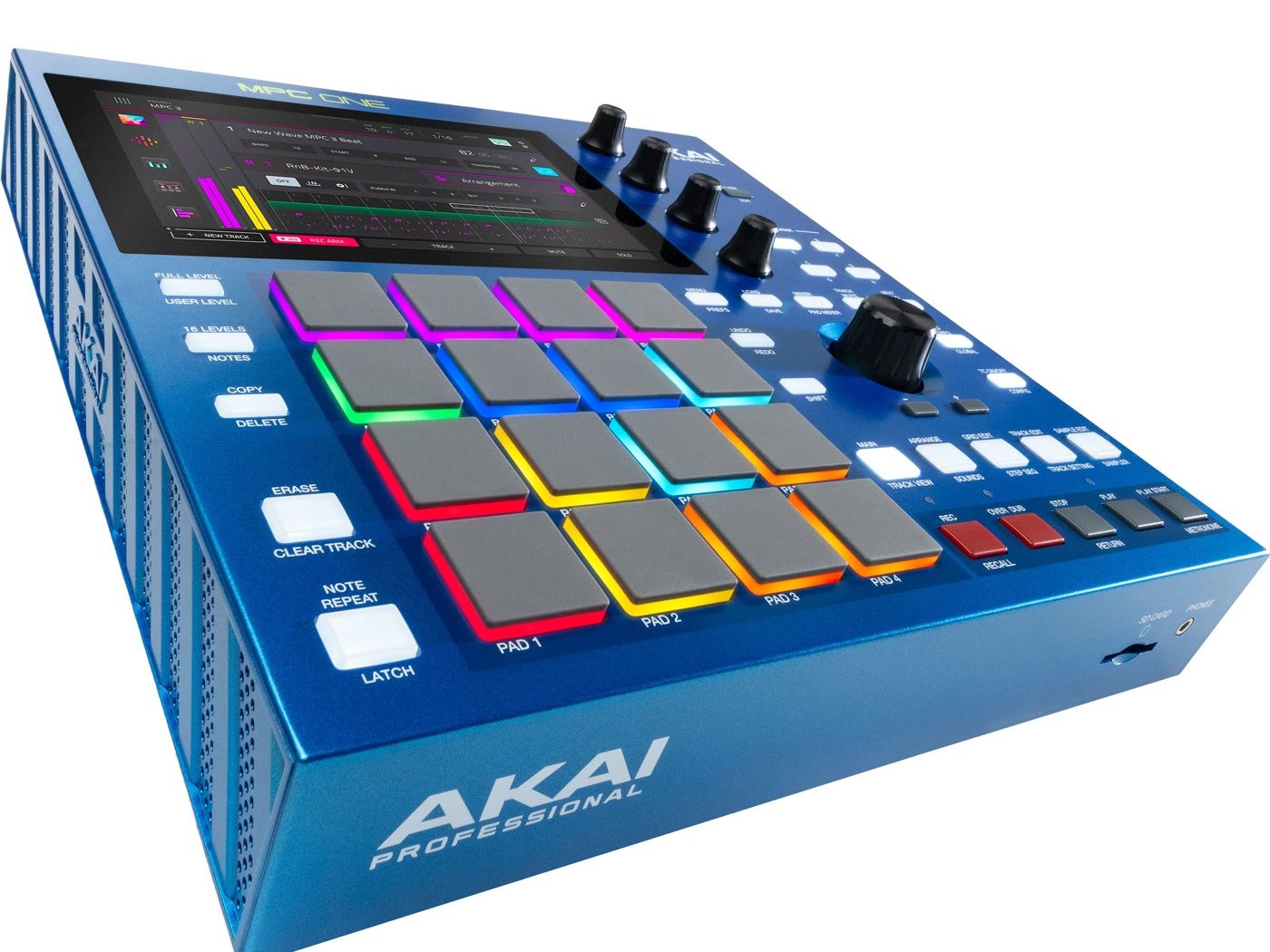
The MPC One G2 (June 2026) is the machine I would point most hip hop producers to, because it does the whole job. It has an 8-core processor, 4 GB of RAM, 64 GB of storage plus an SD slot, a 7-inch multi-touch screen and 16 RGB pads with velocity and pressure. It runs up to 32 plugin instruments and 16 audio tracks, the same track counts as the $1,699 Live III.
You also get MIDI in and out, eight CV/Gate outputs and USB-C audio. The limits: no battery, no speakers and line inputs only, so a turntable needs a phono preamp or DJ mixer. Stem separation and the best time-stretching are in the optional MPC Pro Pack. Our MPC One G2 review has the details, and how to chop samples on an MPC shows the workflow.
Buy it if: you want one studio machine that takes a beat from the first chop to the final bounce.
Where to buyAkai MPC One G2

2. Akai MPC Sample: best value and best sampler for beginners
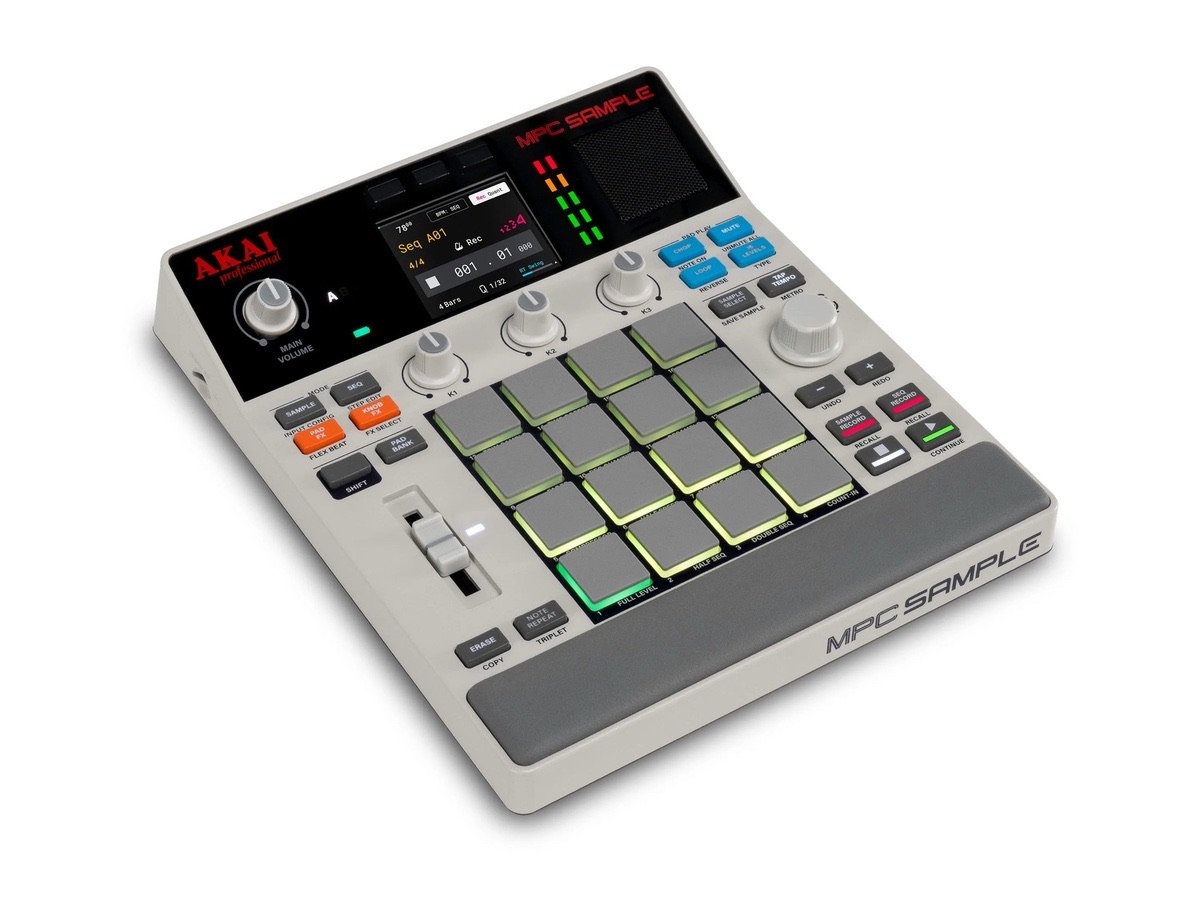
Released in March 2026 at $399, the MPC Sample is the cheapest way into the MPC world. It has 16 RGB pads with polyphonic aftertouch, a 2.4-inch color screen with waveforms, 2 GB of RAM and 8 GB of storage plus microSD, 32 stereo voices, 60 effect types, a built-in mic and speaker, and a rechargeable battery rated at 5–6 hours.
Its song sequencer means you can finish a beat on it, and projects open in MPC software 3.8 and newer, so sketches can move to a bigger MPC later. It has its limits: one performance effect at a time unless you resample, a lighter build and basic time-stretching. Each project holds up to 128 samples. Read the full MPC Sample review.
Buy it if: this is your first sampler, or you want MPC-style chopping on the couch.
Where to buyAkai MPC Sample

3. Roland SP-404 MKII: best for effects and lo-fi hip hop
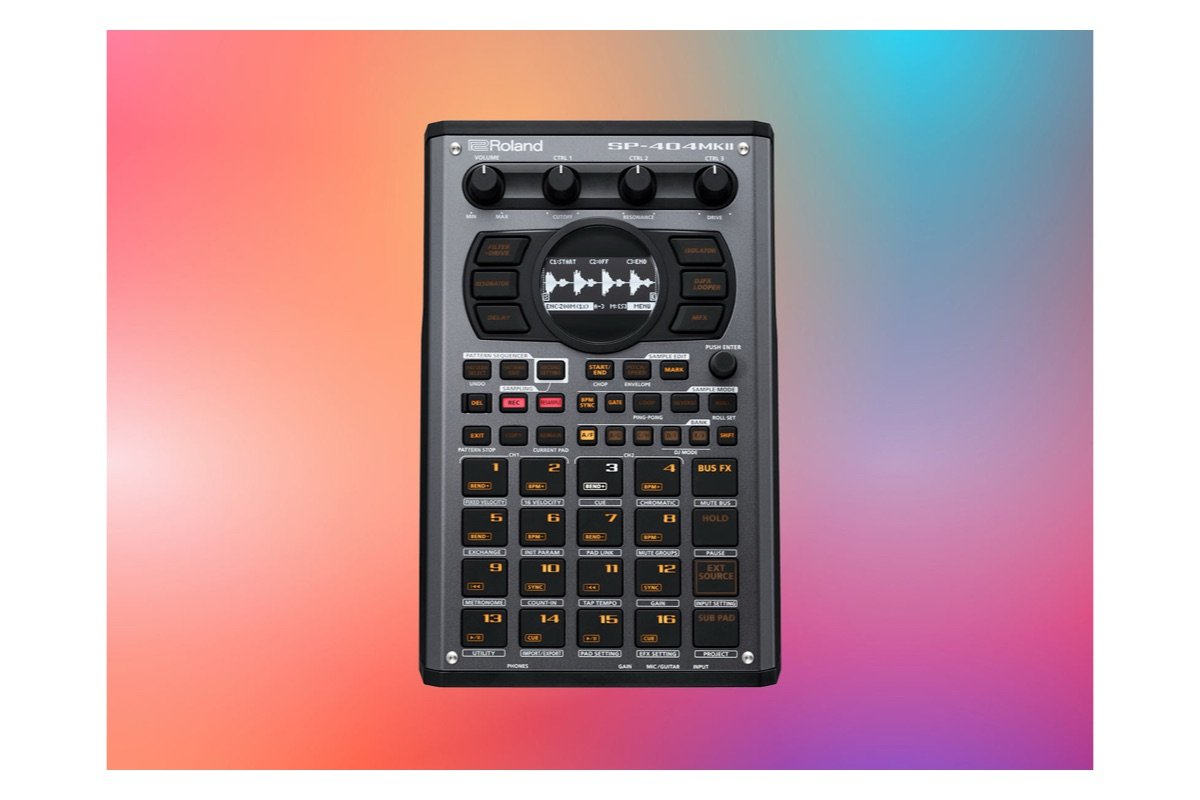
Effects are the reason to buy the SP. The SP-404 MKII has 41 multi-effect types plus 17 input effect types, and that processing is a big part of the dusty, resampled sound it is known for. It has 16 velocity-sensitive pads plus a sub pad, 32 voices and 16 GB of storage, with up to 16 minutes per sample at 16-bit/48 kHz. As Sound On Sound explains, you can chop with manual markers, transient detection or even division, then drop the slices onto the pads you choose.
Roland is still updating it five years on. Firmware 5 added Serato DJ control, and the 5.5 update in April 2026 added side-chain compression and exFAT SDXC card support. It runs on six AA batteries (about 2.5–3.5 hours) or USB-C. The trade-offs: no built-in mic or speaker, a small OLED screen, 160 samples per project and a simple pattern sequencer. MusicRadar notes that many users skip the sequencer and record beats in real time by tapping pads and resampling the result.
Buy it if: your sound comes from effects and resampling, or you perform live and DJ.
Where to buyRoland SP-404 MKII

4. Akai MPC Live III: best for sampling vinyl and playing live
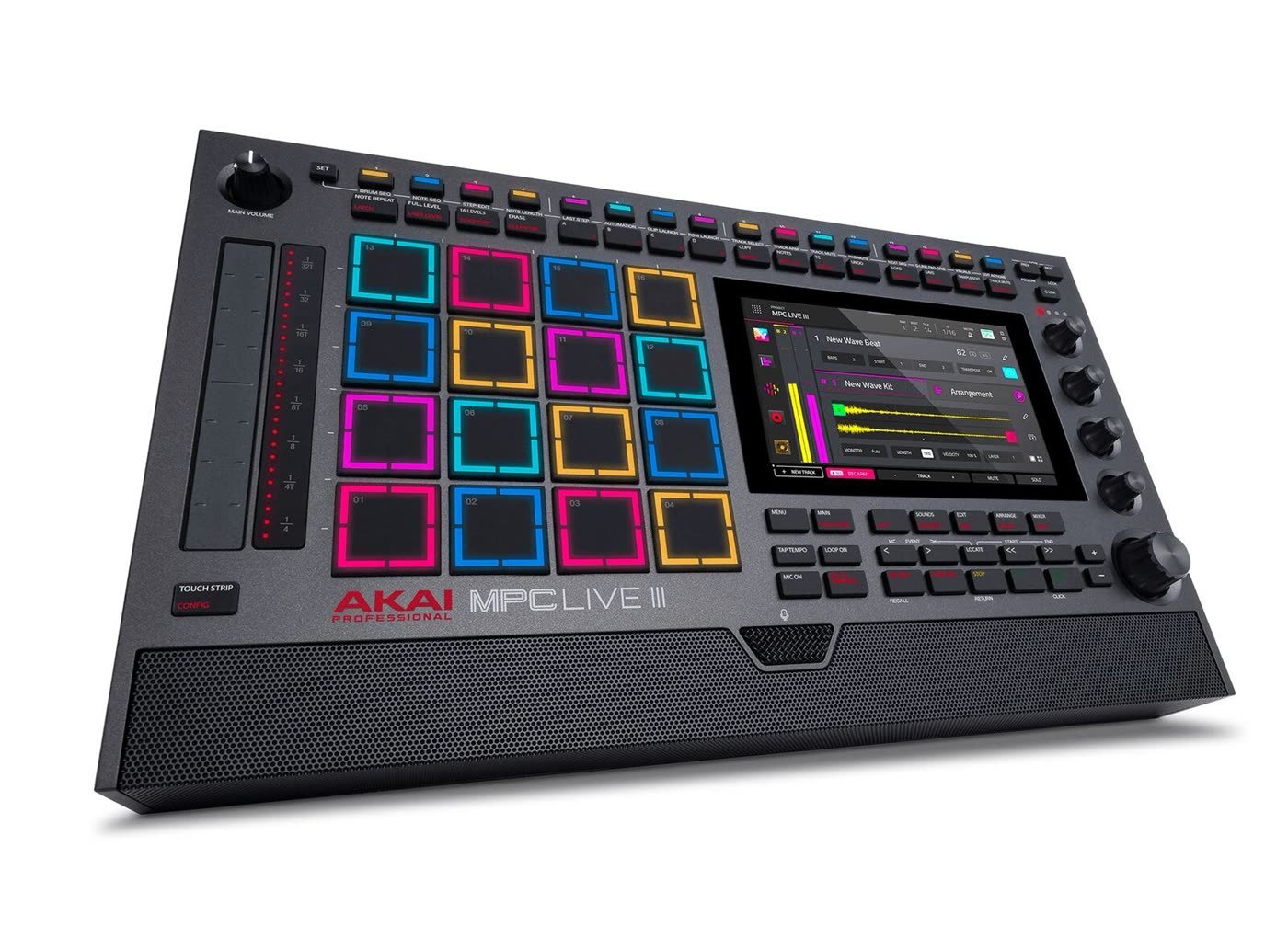
This is what I make my beats on. The MPC Live III has 8 GB of RAM, 128 GB of storage and MPCe pads that read velocity, pressure and where your finger lands, along with 16 step-sequencer buttons, a touch strip and a 6.9-inch screen. Unlike any other sampler here, it takes a turntable straight into its RCA phono inputs. It also has XLR/¼" combo inputs with preamps, a built-in mic, six line outputs, speakers and a battery that Akai rates at 3–4 hours.
The MPC Pro Pack is included. On the other hand, it costs more than twice as much as the One G2, with the same 32 plugin and 16 audio tracks, and weighs 3.9 kg. If you stay at home and own a phono preamp, the One G2 vs Live III comparison may save you $900. Full details are in my MPC Live III review.
Buy it if: you sample records directly, play on stage or want the most complete battery-powered MPC.
Where to buyAkai MPC Live III

5. Teenage Engineering EP-133 K.O. II: best cheap portable sampler
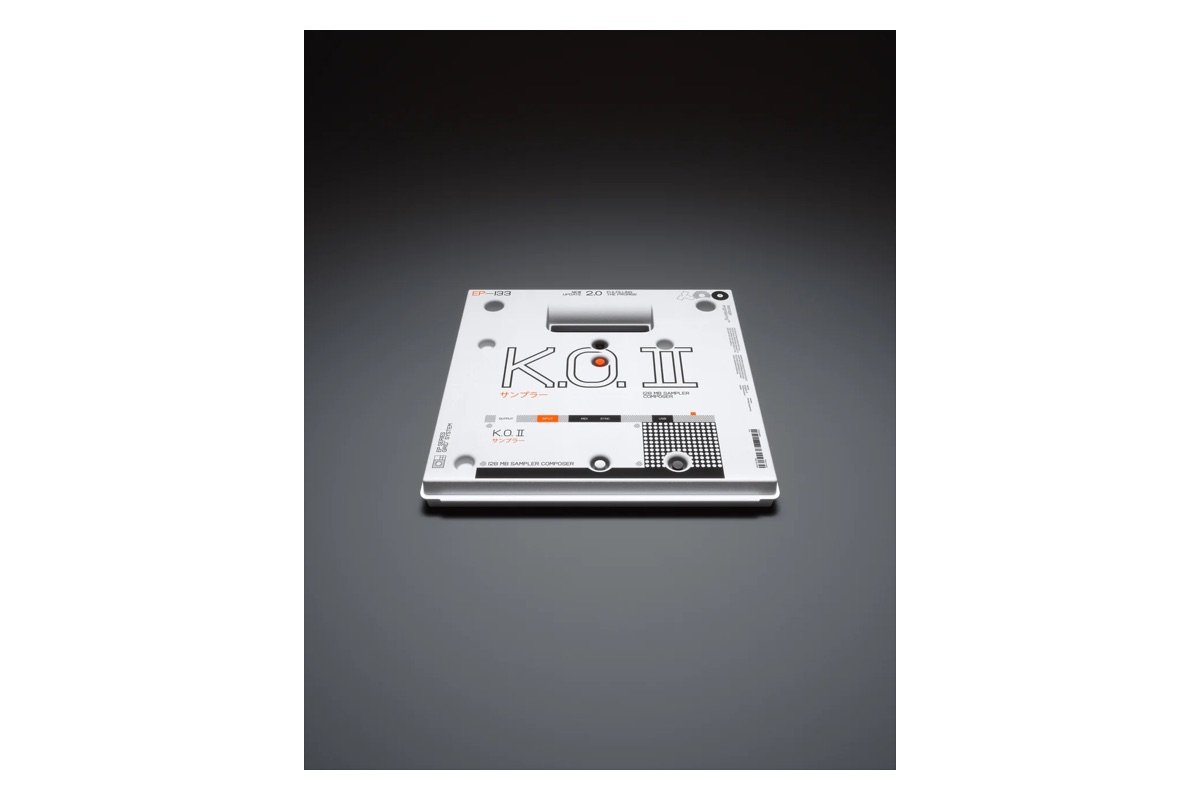
At $329, 16 mm thin and 620 g, the EP-133 K.O. II is the one you actually take everywhere. It has 12 pressure- and velocity-sensitive pads, 128 MB of sample memory with 999 slots (doubled from 64 MB in January 2026), 16 mono or 12 stereo voices, a built-in mic and speaker, and it runs on four AAA batteries or USB-C.
Free updates have changed it a lot. OS 2.0 added resampling, song mode, side-chain and more polyphony. OS 2.5 (June 2026) added stereo USB audio, reverse playback, an arpeggiator, equal-length auto-chop, lower sample rates and doubled mono recording to 40 seconds. The limits are a minimal segment display, 12 pads rather than 16, and memory that fills up quickly with long samples.
Buy it if: you want the cheapest serious way to sketch beats away from your desk, or a fun second machine.
Where to buyTeenage Engineering EP-133 K.O. II

6. Elektron Digitakt II: best for deep sequencing
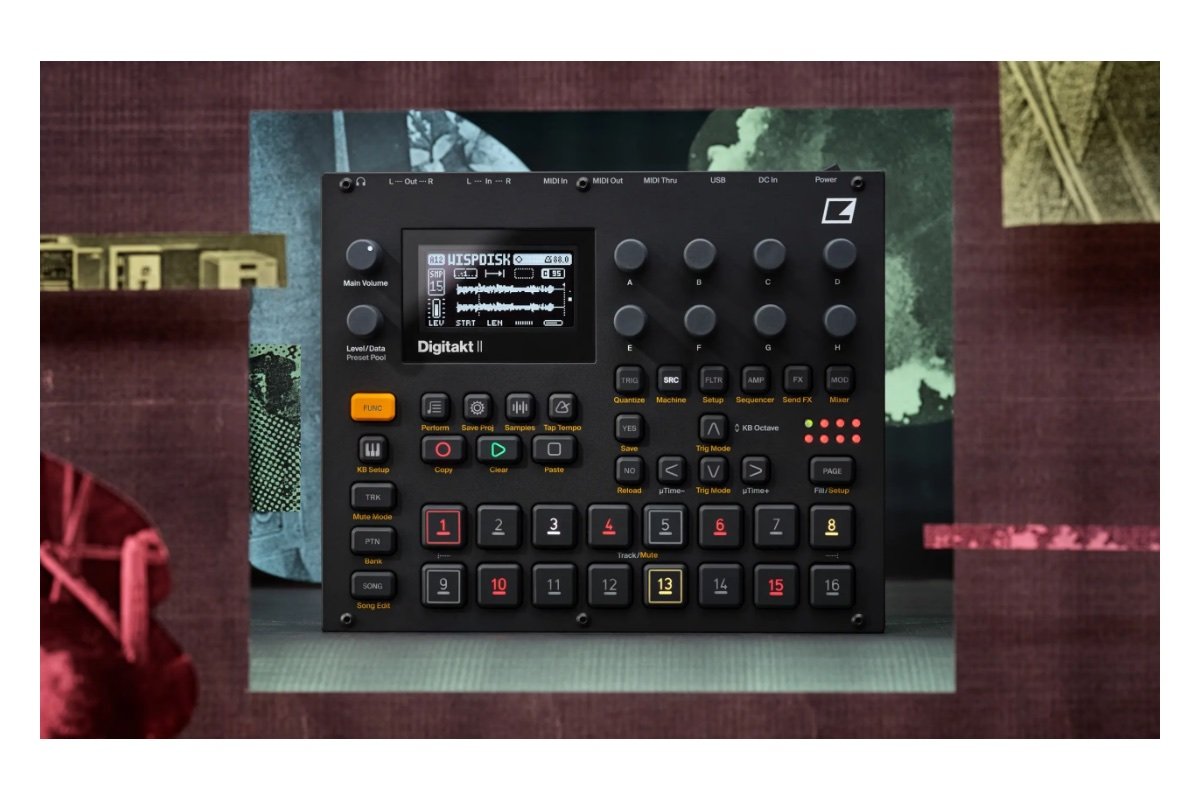
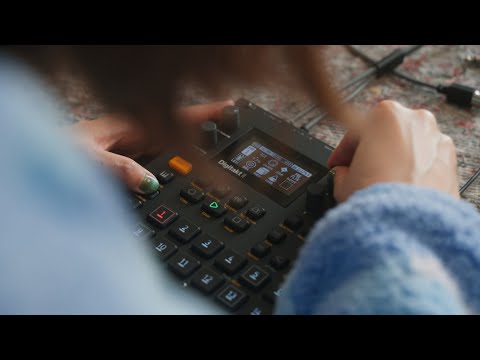
The Digitakt II is a different animal. It has 16 stereo, mono or MIDI tracks, 400 MB of sample memory and a 20 GB +Drive, and it can sample directly for up to 66 seconds, from its inputs, the mix or any single track. Elektron’s sequencer, with parameter locks on every step, is the reason people buy it. It launched at $999, and Sound On Sound called it a big upgrade and still a top contender.
For hip hop, though, know what you are getting. It has 16 trig keys, not MPC-style pads, so it suits step programming more than playing chops by hand, and there is no battery. MusicRadar’s launch review found the SP-404 better at slicing, for less money, and complained about menus. Elektron has since added the Slice Machine in OS 1.15 (June 2025). Sound On Sound also missed a USB host port and being able to pick a single input for sampling.
Buy it if: you think in steps and patterns, and programming detail matters more to you than pad feel.
Where to buyElektron Digitakt II
7. Native Instruments Maschine+: best for finger drumming with NI sounds
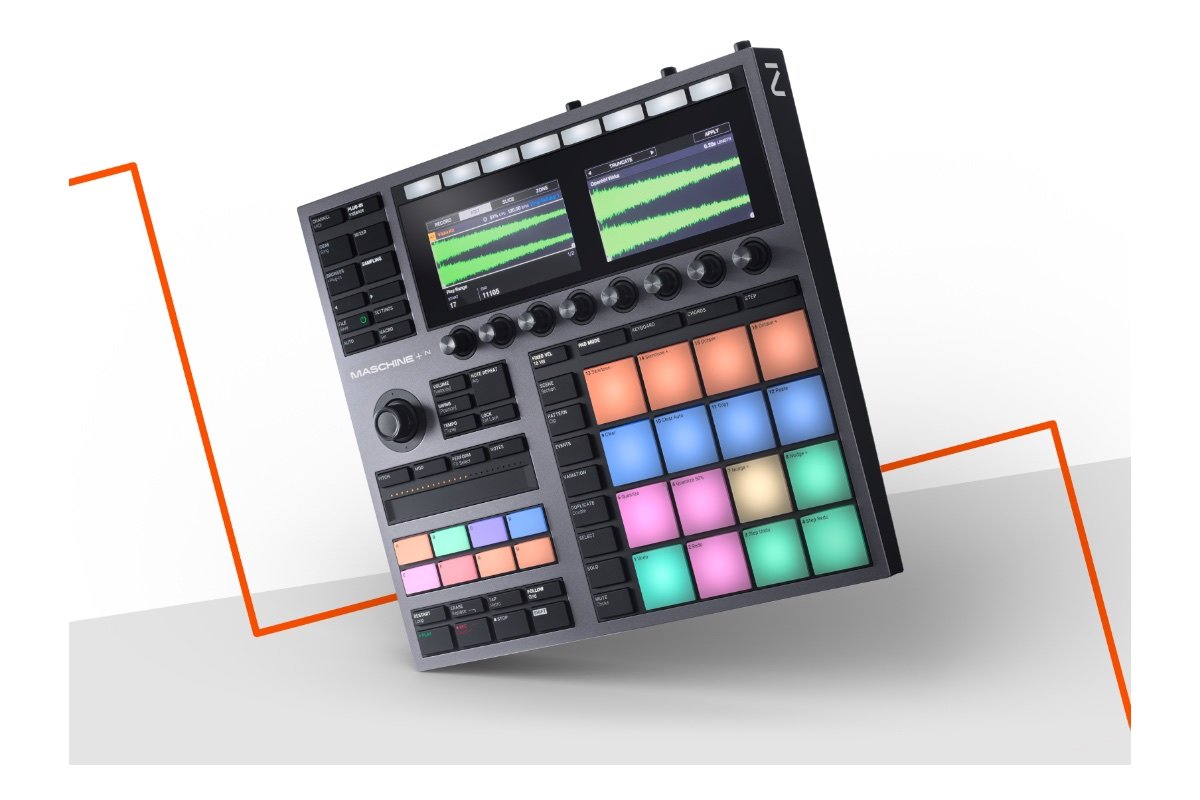
The Maschine+ is the classic alternative to the MPC, running without a computer. It has a quad-core processor, 4 GB of RAM, a 64 GB SD card expandable up to 1 TB, two high-resolution displays, an aluminium top and bottom, a Smart Strip and 16 expressive pads. It includes 18 instruments and 37 effects, among them Massive, FM8 and Monark, and connects with two ¼" line inputs, a ¼" dynamic mic input, MIDI, Wi-Fi and Ableton Link. It also doubles as a Maschine controller with a computer.
Two cautions. It has no built-in battery and it is an older design than the G2 MPCs. Also, its future is less clear: inMusic, Akai’s parent company, agreed to buy Native Instruments in May 2026. We found no announcement that Maschine hardware is being discontinued, and NI’s product page now sends buyers to retailers. NI’s store has shown $999 and $1,199, so check the current price.
Buy it if: you already know Maschine or love NI’s sound library, and you find a good price.
Where to buyNative Instruments Maschine+

8. Novation Circuit Rhythm: best grid workflow on a budget
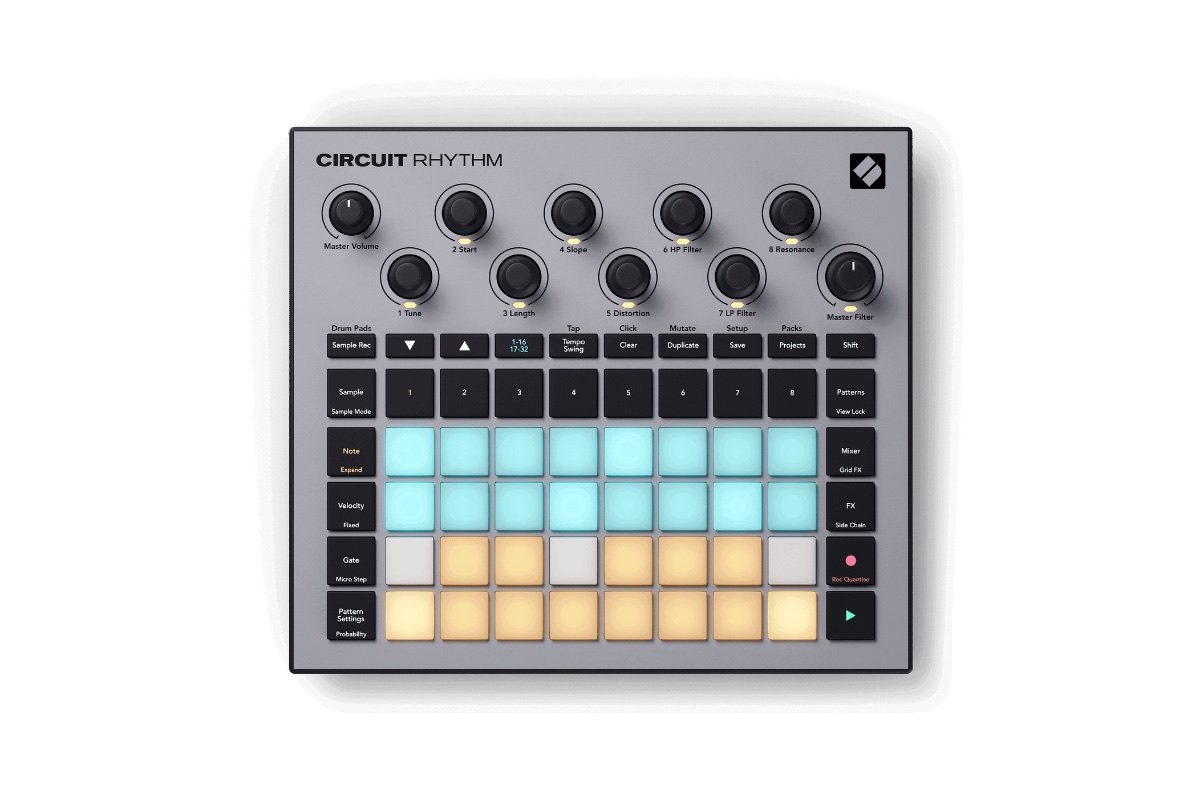
The Circuit Rhythm swaps the 16-pad layout for 32 RGB velocity-sensitive pads and eight sample tracks. You record directly to the hardware through its L/R input, then slice, reverse, loop or play samples chromatically, with up to 32 seconds per pad and 228 seconds per pack. There are 32 packs (one internal, 31 on microSD), so storage grows cheaply. Novation rates the built-in battery at up to four hours.
The Grid FX are its most hip hop-friendly feature: Vinyl Sim, Beat Repeat, Filter, Gater and Digitiser under your fingers, plus side-chain and a master compressor. It also has three full-size MIDI ports and sync out. The limit is the 228-second pack: that is enough for a beat, but long samples use it up. At about $430 it costs about as much as the MPC Sample, so the choice really comes down to grid or MPC layout.
Buy it if: you like performing patterns on a grid and want a battery-powered sampler for around $400.
Where to buyNovation Circuit Rhythm

9. Roland P-6: best pocket sampler and for granular sounds
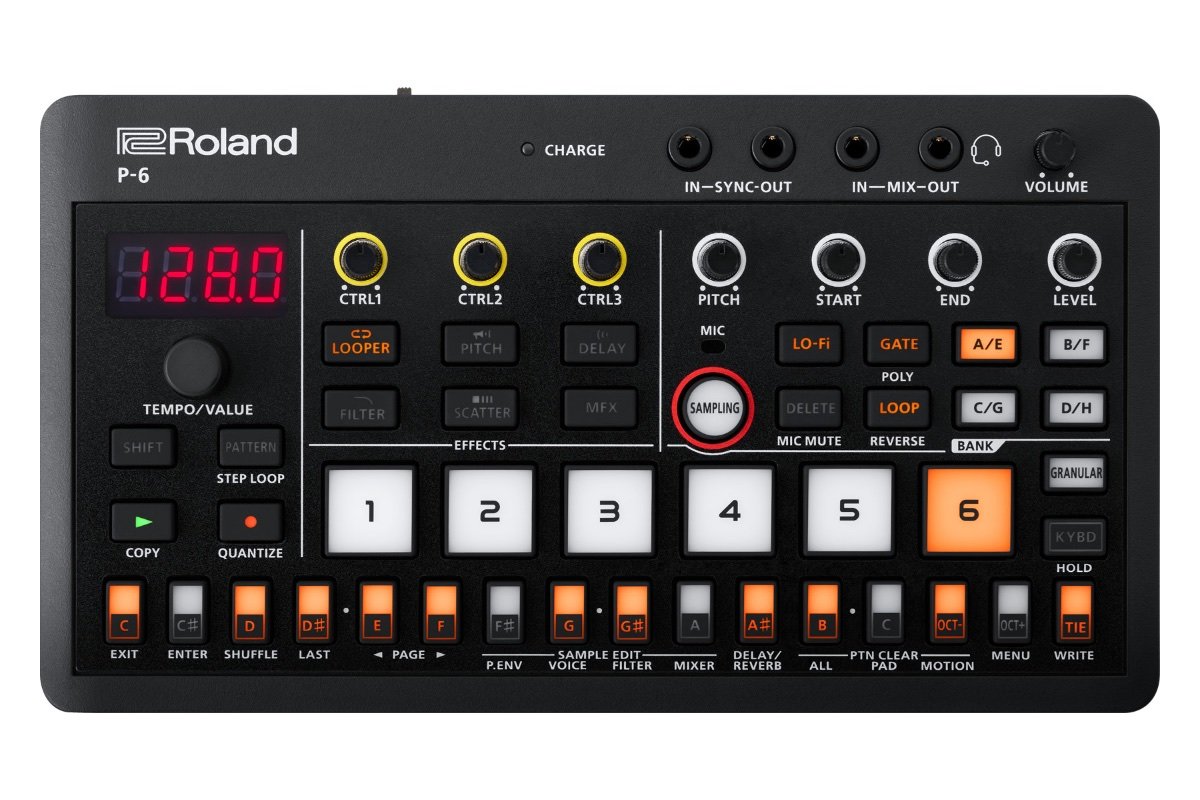
At 305 g, the P-6 is the smallest here and the cheapest, usually about $220–$270. It stores 48 samples (six pads across eight banks), plays 16 voices or four granular voices, and has a 64-step sequencer, 20 multi-effect types plus delay and reverb sends, a built-in mic, 3.5 mm audio in and out, MIDI, sync and a rechargeable battery rated at about three hours.
The big limit is time: 5.9 seconds at 44.1 kHz mono, half that in stereo, or up to 23.7 seconds at 11.025 kHz. At full quality, that is about two bars at 90 BPM, so it suits drum hits, short stabs and grainy textures rather than long soul loops. Its granular engine and Step Loop are the fun part. The pads are rubber and the screen is a small numeric display.
Buy it if: you want a cheap pocket idea machine or a texture box next to your main sampler, not your only one.
Where to buyRoland P-6

10. Teenage Engineering OP-1 field: best portable all-in-one (if money is no object)
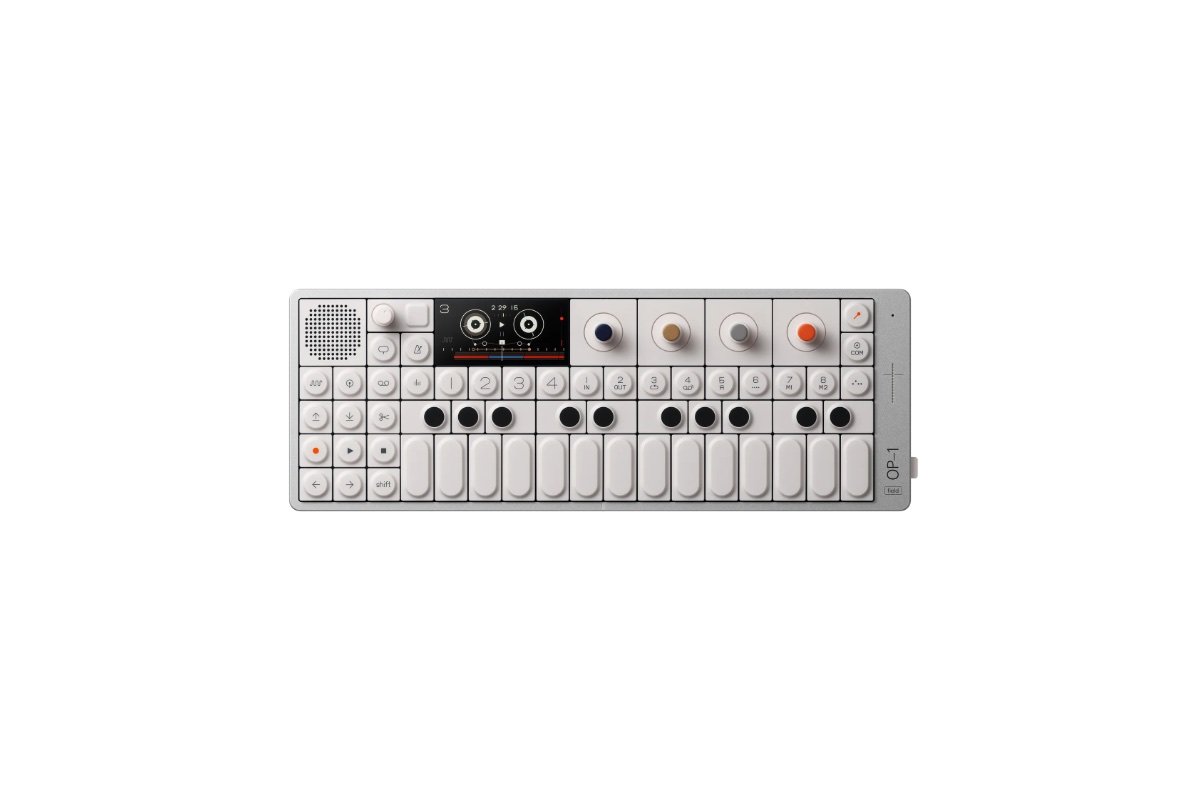
The OP-1 field is less a sampler than a tiny studio: synth engines, a sampler, drum kits, a tape recorder, a 24-hour battery, Bluetooth MIDI, a built-in mic and speaker and an FM radio, all in 590 g. Its sample engine records in stereo for up to 20 seconds, with 256 MB of memory and over 160 minutes of sample storage. Sound On Sound found slice editing simple, which it says suits classic beat chopping.
The same review points to the catch for beatmakers: the keys are not velocity-sensitive, so drums respond to velocity only from an external MIDI controller. At a $1,999 list price you could buy an MPC One G2 and an SP-404 MKII and still have change. MusicRadar notes that street prices have been lower at times. It is a wonderful instrument, but it is the last machine here I would buy purely for hip hop sampling.
Buy it if: you want to write whole tracks anywhere and the price does not scare you.
Where to buyTeenage Engineering OP-1 field
Not among the top Amazon US results when checked on November 3, 2026, so this button goes to the maker’s page (no affiliate link).

What about the Ableton Move?
You will see the Ableton Move in many of these comparisons, and it is great if Ableton Live is your DAW. It has 32 velocity-sensitive pads with polyphonic aftertouch, 64 GB of storage, a battery rated at up to four hours and a built-in mic and speaker, and it now has audio tracks and sampling over USB-C. It launched at $449 and Sweetwater lists it at $549. We left it out of the top 10 because sampling is not its main strength: slicing started as equal divisions, and MusicRadar says that for dedicated sampling it is not on the level of the SP-404.
Where to buyAbleton Move
What is the best sampler for beginners?
The Akai MPC Sample. It shows you the waveform while you chop, has a speaker and mic so you can start without any other gear, and teaches the 16-pad MPC layout that most hip hop tutorials use. If $399 is too much, the EP-133 K.O. II is a friendly start at $329. Then learn the craft with our guides on chopping samples and making boom bap beats.
Which sampler for which kind of hip hop?
- Boom bap and chopped soul: MPC One G2 or MPC Sample. Chop, swing, sequence, done. With a turntable, MPC Live III.
- Lo-fi and beat tapes: SP-404 MKII. The effects are the sound.
- Trap and melodic beats: MPC One G2. Its plugin instruments and audio tracks do more than sampling alone.
- Experimental and glitchy: Digitakt II for parameter locks, Roland P-6 for granular textures.
- On the go: EP-133 K.O. II or MPC Sample.
- Live performance: SP-404 MKII for effects, MPC Live III for a complete rig.
Best sampler for live performance
It depends on what “live” means for you. For beat sets and DJ crossover, the SP-404 MKII is hard to beat, with its effect buses, input effects and Serato DJ control. For a full performance with separate outputs and no laptop, the MPC Live III has six line outputs, a battery and a touch strip. If you play patterns on a grid, look at the Circuit Rhythm.
Head-to-head comparisons
Stuck between two machines? We compare MPC Sample vs SP-404 MKII vs EP-133 K.O. II with a section for each pairing, MPC One G2 vs MPC Live III and MPC Live II vs Live III. If you have settled on an MPC, the best Akai MPC guide covers the whole range, including the MPC XL and Key 37 G2.
Verdict: which sampler should you buy?
For most hip hop producers, the Akai MPC One G2 is the safest buy: everything you need to finish beats, at less than half the price of a Live III. If that is too much, the MPC Sample gets you the same pad-and-chop mindset for $399. Choose the SP-404 MKII if effects are your instrument, the MPC Live III if you sample vinyl or play out, and the EP-133 K.O. II if you want a cheap machine that goes everywhere.
Where to buyAkai MPC One G2
Whatever you buy, you will hear your chops better on decent studio monitors or headphones. If you want records to flip, start with our Bob James and Ahmad Jamal crate-digging guides.
Royalty-free samplesSpliceA new sampler comes with little to chop. Fill it with royalty-free drums, loops and one-shots, licensed for commercial releases.
Best samplers for hip hop: FAQ
What is the best sampler for hip hop?
For most hip hop producers, the Akai MPC One G2 at $799: an 8-core standalone MPC with 16 pressure-sensitive pads, 4 GB of RAM, 64 GB of storage and room for 32 plugin instruments and 16 audio tracks, enough to finish a whole beat with no computer. On a tighter budget, get the $399 MPC Sample. For effects and lo-fi textures, the Roland SP-404 MKII.
What is the best sampler for beginners?
The Akai MPC Sample at $399. It has a color screen with waveforms, a built-in mic and speaker, a rechargeable battery and the MPC pad layout most hip hop tutorials assume. The Teenage Engineering EP-133 K.O. II ($329) is even simpler and cheaper, but its minimal display makes chopping less visual.
What are the best samplers in 2026?
The ones most worth your money in 2026 are the MPC One G2 and MPC Sample (both new this year), the Roland SP-404 MKII, the MPC Live III, the EP-133 K.O. II with its 128 MB update, and the Elektron Digitakt II. Which one is best depends on whether you chop, sequence, process with effects or perform.
What is the best hardware sampler for live performance?
The Roland SP-404 MKII if you perform with effects: it has dedicated effect buses, 17 input effect types and can control Serato DJ. The Akai MPC Live III if you want a full standalone setup on stage, with a battery, six line outputs and 3D-sensing MPCe pads.
What is the best portable sampler?
For most people, the Akai MPC Sample: a battery rated at 5–6 hours plus a built-in speaker and mic. The EP-133 K.O. II is the slimmest (16 mm, 620 g), and the Roland P-6 is the smallest (305 g), though it records only 5.9 seconds at full quality.
MPC or SP-404: which is better for hip hop?
An MPC if you build beats by chopping samples, programming drums and arranging songs. The SP-404 MKII if you shape the sound with effects and resampling. It has 16 GB of storage, up to 16 minutes per sample and 41 effect types, but its sequencer is simple and the screen is small.
How much sample time do I need?
At 90 BPM one bar lasts 2.67 seconds, so a 4-bar loop is 10.7 seconds and an 8-bar loop is 21.3 seconds. Anything that records at least 20 seconds handles most loops. Under that, like the Roland P-6 at 5.9 seconds, you are working with short phrases and one-shots.
Can I use a sampler without a computer?
Yes. All ten samplers here can record samples and build patterns on their own. A computer is only needed for backups, transfers or software updates, and some of them also work as audio interfaces or controllers when you do plug one in.
Are hardware samplers legal to use with old records?
The machine is legal, but releasing music with an uncleared sample is a separate question: you may need permission from both the owner of the recording and the owner of the composition. For commercial releases without clearance, use a royalty-free library or replay the part yourself.
Is the Maschine+ discontinued?
As of November 2026, Native Instruments still has a Maschine+ product page, which now points buyers to retailers. inMusic, the parent company of Akai, agreed to buy Native Instruments in May 2026, and we found no announcement that Maschine hardware is being discontinued. Check for stock before you decide.
Next step Put it to work: how to chop samples on an MPC →
Sources
- GUIO Records: MPC One G2 review (specs)
- GUIO Records: MPC Sample review (specs and firmware)
- GUIO Records: MPC Live III review (specs)
- Roland: SP-404MKII specifications
- Roland: SP-404MKII system program notes
- Sound On Sound: Roland SP-404 MkII review
- MusicRadar: Roland SP-404 MKII review
- Roland: P-6 specifications
- Teenage Engineering: EP-133 K.O. II
- Gearnews: EP-133 K.O. II OS 2.5
- Teenage Engineering: OP-1 field
- Sound On Sound: Teenage Engineering OP-1 Field review
- Elektron: Digitakt II
- Sound On Sound: Elektron Digitakt II review ($999, 66 seconds of direct sampling)
- MusicRadar: Elektron Digitakt II review
- Synth Anatomy: Digitakt II OS 1.15 and Slice Machine
- Native Instruments: Maschine+
- Engadget: inMusic will acquire Native Instruments
- Novation: Circuit Rhythm
- Ableton: Move
- MusicRadar: Ableton Move, one year on
Prices are approximate US prices in November 2026 and change often. GUIO Records is not affiliated with any of the brands listed.