This article contains affiliate links. If you buy through them, GUIO Records may earn a small commission at no extra cost to you. As an Amazon Associate I earn from qualifying purchases.
Best Studio Monitors for a Home Studio (2026): Top 10 Picks for Hip Hop Producers
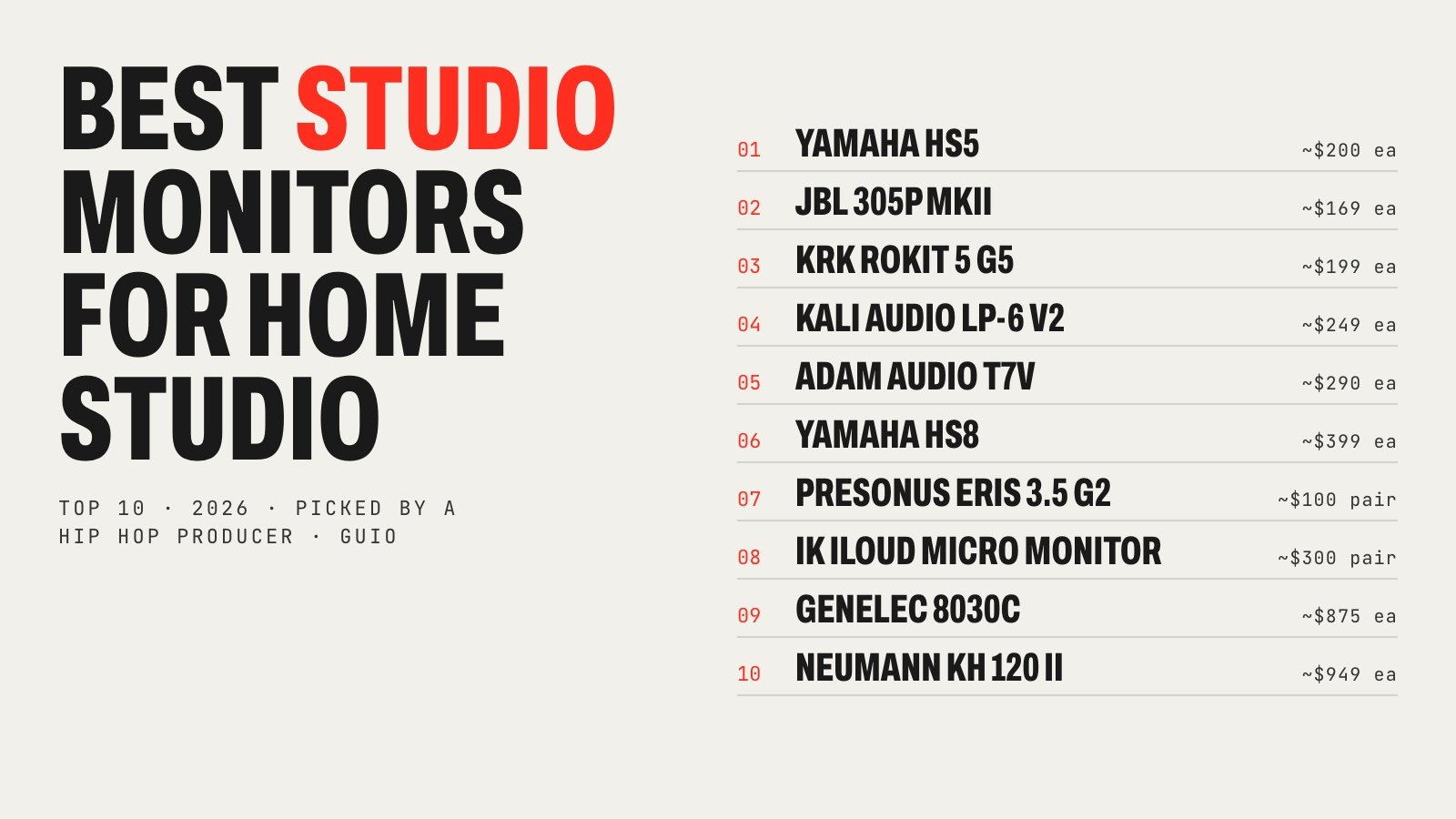
Headphones tell you what is in your beat. Studio monitors tell you how it hits. A good pair shows you if your 808 is too loud, if your vocal sits right and if your mix will still sound good on someone else’s speakers. Here are the 10 best studio monitors for a home studio in 2026, from a $100 desktop pair to the Neumann KH 120 II.
Where to buyYamaha HS5 powered studio monitor
Studio monitors are not hi-fi speakers. Hi-fi speakers are tuned to sound exciting, often with extra bass and sparkle. Monitors are tuned to sound flat and honest, so the decisions you make on them translate to car stereos, earbuds and club systems. Every monitor here is active, which means the amplifiers are built in: you plug them straight into your audio interface.
This guide ranks monitors by what matters in a home studio where hip hop gets made: accurate mids for vocals, low end you can trust for 808s and kicks, tools to tame a small untreated room, and value for money. It is the fourth part of our home studio series, after the best microphones for rap vocals, the best headphones for music production and the best audio interfaces.
How this list was made: I am a hip hop producer working in a home studio, where my monitors are a pair of Dynaudio LYD 48. I have not tested these ten monitors side by side, so the picks combine manufacturer specs, trusted reviews (credited at the end) and what matters when you make beats and mix rap at home. Prices change often; the buttons show the current price.
What actually matters in a home studio monitor
- Size versus room. Bigger woofers go deeper, but a small untreated room cannot handle a lot of bass. In a bedroom, a 5-inch monitor you can trust beats an 8-inch monitor that booms.
- Low-end numbers. Brands measure bass differently: −3 dB, −6 dB and −10 dB figures are not comparable. In the table we show each brand’s own number and how it was measured.
- Room controls. Switches like Yamaha’s Room Control, JBL’s Boundary EQ or KRK’s DSP tuning cut the extra bass you get when a monitor sits close to a wall or on a desk.
- Sweet spot. Waveguides around the tweeter widen the area where the mix sounds right, which matters when you lean over an MPC or move around the desk.
- Inputs. Balanced XLR or TRS inputs connect cleanly to any audio interface. Desktop models add RCA, 1/8-inch or Bluetooth.
The top 10 at a glance
| Monitor | Woofer | Low end (manufacturer) | Approx. price | Best for |
|---|---|---|---|---|
| 1. Yamaha HS5 | 5" | 74 Hz (−3 dB) | $200 each | Honest, flat mixing on a budget |
| 2. JBL 305P MkII | 5" | 49 Hz (±3 dB) | $169 each | Best value, wide sweet spot |
| 3. KRK ROKIT 5 G5 | 5" | 54 Hz (±3 dB) | $199 each | Beatmakers who want room tuning |
| 4. Kali Audio LP-6 V2 | 6.5" | 47 Hz (±3 dB) | from $229 each | Most bass for the money |
| 5. ADAM Audio T7V | 7" | 39 Hz (−6 dB) | $290 each | Detailed highs, medium rooms |
| 6. Yamaha HS8 | 8" | 47 Hz (−3 dB) | $399 each | Feeling 808s without a sub |
| 7. PreSonus Eris 3.5 2nd Gen | 3.5" | 80 Hz | $100 pair | First pair, tiny desks |
| 8. IK Multimedia iLoud Micro Monitor | 3" | 55 Hz (−3 dB) | $300 pair | Small desks and travel |
| 9. Genelec 8030C | 5" | 54 Hz (±2 dB) | from $875 each | Pro reference for small rooms |
| 10. Neumann KH 120 II | 5.25" | 44 Hz (±3 dB) | from $949 each | Pro accuracy with room alignment |
Low-end figures are the manufacturer’s own and use different tolerances, shown in brackets. The PreSonus figure is the published frequency response without a tolerance. Prices are per monitor unless marked “pair”.
1. Yamaha HS5: best overall for most home studios
The white woofer of the Yamaha HS series is a studio icon, and the reason is honesty. The HS5 is famous for a flat, revealing sound that is not always flattering: if your mix sounds good on HS5s, it usually sounds good everywhere. It is bi-amped with 45 W for the 5-inch woofer and 25 W for the 1-inch tweeter, and Yamaha rates it at 74 Hz to 24 kHz (−3 dB).
On the back you get a Room Control switch (0, −2 or −4 dB below 500 Hz) for when the speakers sit near a wall, and a High Trim (±2 dB). The trade-off is bass: an HS5 will not shake the room, so 808 sub-bass needs a second check on headphones.
Buy it if: you want a mix-translating reference for a small room and you can live without deep sub-bass.
Where to buyYamaha HS5 powered studio monitor
2. JBL 305P MkII: best value
For about $169 each, the 305P MkII gets a lot right. Its Image Control Waveguide, derived from JBL’s flagship M2 Master Reference Monitor, gives a wide sweet spot and a clear stereo image, so the mix does not fall apart when you move your head. JBL rates it at 49 Hz to 20 kHz (±3 dB), deeper than most 5-inch monitors, with 41 W per driver.
The Boundary EQ switch (0, −1.5 or −3 dB at 50 Hz) offsets the extra bass from a desk or a wall, and the HF Trim adjusts the top end. Set the input level switch (+4 dBu or −10 dBV) to match your interface.
Buy it if: you want the best sound per dollar in a 5-inch monitor.
Where to buyJBL 305P MkII powered studio monitor
3. KRK ROKIT 5 G5: the beatmaker classic, now with room tuning
The yellow cones of KRK have sat in hip hop studios for decades. The fifth generation answers the old complaint about hyped bass with a flat mode. The ROKIT 5 G5 has three voicing modes: Mix (flat frequency and phase response), Create (a more inspiring, colored sound for writing beats) and Focus (mid-focused, to check vocals and samples).
Its onboard DSP offers 25 boundary and tuning EQ combinations, and the free KRK Audio Tools app has a real-time room analyzer that recommends settings. KRK rates it at 54 Hz to 30 kHz (±3 dB), with a Kevlar woofer, a front port (easier to place near a wall) and 55 W of Class D power.
Buy it if: you want one monitor for vibing while you make beats and for flat mixing later.
Where to buyKRK ROKIT 5 G5 studio monitor
4. Kali Audio LP-6 V2: the most bass for the money
Kali Audio was started by former JBL engineers, and the LP-6 became a home studio favorite for giving near-pro accuracy for little money. The V2 (“2nd Wave”) brings a new amplifier platform that Kali says has 12 dB less noise, smoother high frequencies and updated boundary EQs.
Its 6.5-inch woofer reaches 47 Hz (±3 dB), with up to 115 dB max SPL. The DIP switches on the back are labeled by where the speaker sits (on a desk, near a wall, in a corner), which makes setup easy even if you have never treated a room. Expect about $229 to $249 each, depending on color and sales.
Buy it if: your room can take a 6.5-inch woofer and you want to hear more of your 808s.
Where to buyKali Audio LP-6 V2 studio monitor
5. ADAM Audio T7V: detailed highs, medium rooms
ADAM is known for its ribbon tweeters, and the T7V brings that technology down to about $290 each. The U-ART folded ribbon tweeter sits in an HPS waveguide borrowed from ADAM’s pricier S Series, so the highs are detailed and spread wide, great for judging hi-hats, vocal sibilance and reverb tails.
The 7-inch woofer reaches 39 Hz (−6 dB), with 50 W + 20 W of Class D power. Low and high shelves (±2 dB) help you adjust to the room. It is a big speaker, so give it a desk or stands with some space.
Buy it if: you have a medium-size room and care about detail in the top end.
Where to buyADAM Audio T7V studio monitor
6. Yamaha HS8: for when you need to feel the 808
The HS8 has the same honest Yamaha voicing as the HS5, with an 8-inch woofer and 120 W of power (75 W + 45 W). Yamaha rates it at 47 Hz to 24 kHz (−3 dB) and 38 Hz at −10 dB, enough low end that many producers skip the subwoofer.
The catch is the room. In a small, untreated bedroom, an 8-inch woofer can create more boom than detail. Use the Room Control switch, keep the speakers off the back wall and consider some bass treatment first.
Buy it if: you work in a medium or large room and you want full-range bass without a sub.
Where to buyYamaha HS8 powered studio monitor
7. PreSonus Eris 3.5 2nd Gen: the cheapest real start
At about $100 a pair on PreSonus’s own store, the Eris 3.5 2nd Gen is the cheapest way to get monitors made for music work instead of computer speakers. The 3.5-inch woven composite woofers and silk-dome tweeters are powered by 50 W in total, and the front panel has a headphone output and an aux input.
PreSonus rates the response at 80 Hz to 20 kHz, so most of the 808 is out of reach. Treat them as a first step or a second pair to check how your mix sounds on small speakers, not as your main bass reference.
Buy it if: you are starting out with a tiny budget and a tiny desk.
Where to buyPreSonus Eris 3.5 2nd Gen pair
8. IK Multimedia iLoud Micro Monitor: small desk, serious sound
The iLoud Micro Monitor surprised reviewers when it came out: Sound On Sound measured a −3 dB point of 55 Hz from a 3-inch woofer, which is very low for its size. The pair has 50 W RMS in total, DSP tuning, and switches for desktop placement and for low and high frequencies.
It also has Bluetooth, RCA and 1/8-inch inputs, so it doubles as everyday speakers. At about $300 a pair, it costs more than the Eris 3.5 but goes much deeper.
Buy it if: your desk is small or you make beats on the move.
Where to buyIK Multimedia iLoud Micro Monitor pair
9. Genelec 8030C: the pro reference for small rooms
Genelec monitors are everywhere in professional studios and broadcast rooms, and the 8030C is the compact model many engineers trust. Its aluminium cabinet has a Directivity Control Waveguide for even sound across the desk, and the Iso-Pod stand decouples it from the surface and lets you tilt it toward your ears.
Genelec rates it at 54 Hz to 20 kHz (±2 dB), a stricter tolerance than most brands use, with the −6 dB point at 47 Hz and 50 W + 50 W of Class D power. It is expensive for a 5-inch monitor, but it is built to last for years in serious rooms.
Buy it if: you mix for clients in a small room and want a monitor engineers already know.
Where to buyGenelec 8030C studio monitor
10. Neumann KH 120 II: pro accuracy with room alignment
The original KH 120 was a home studio dream monitor for years. The KH 120 II adds DSP and much more power: 145 W for the woofer and 100 W for the tweeter, a max output of 116.8 dB SPL and a response of 44 Hz to 21 kHz (±3 dB). Neumann builds each one to a tolerance of ±0.5 dB.
The big feature is automatic room alignment with Neumann’s MA 1 measurement microphone (sold separately or in some bundles): the system measures your room and corrects the monitors for it. In an untreated home studio, that can matter more than any spec on this list.
Buy it if: you want a long-term pro monitor and you will use room alignment.
Where to buyNeumann KH 120 II studio monitor
The monitors I use: Dynaudio LYD 48
My own monitors are not on the list above, because they are no longer easy to find new in the US: a pair of Dynaudio LYD 48. They are a step up in design from most picks here. The LYD 48 is a three-way monitor: instead of one woofer doing bass and mids, it has an 8-inch woofer, a separate 4-inch midrange and a soft-dome tweeter, each with its own Class D amplifier (80 W + 50 W + 50 W), split by a DSP crossover at 460 Hz and 5.5 kHz.
For hip hop, the separate midrange is the point: vocals and samples live in their own driver, apart from the 808. The DSP also lets you adjust the low-end extension, the speaker position (free-standing, near a wall) and the overall sound balance. They are big (about 12 kg each) and sold as left and right mirror-image units. If you find a pair used or on clearance, they are worth a look; if not, the Yamaha HS8 or ADAM T7V are the closest picks here in size.
Videos: hear and set up your monitors


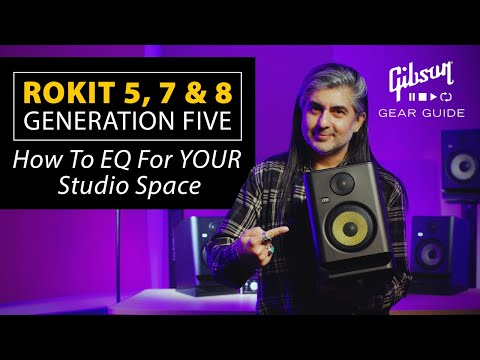

How to set up studio monitors in a home studio
- Make a triangle. Your head and the two monitors form an equilateral triangle, each side the same length.
- Tweeters at ear height. Raise or tilt the monitors so the tweeters point at your ears, not your chest.
- Get them off the desk. Stands or isolation pads stop the desk from vibrating and muddying the bass.
- Mind the walls. Keep them away from the back wall and out of corners when you can. If you cannot, use the room or boundary switches.
- Center the room. Sit on the long wall’s center line, so both speakers see the same room.
- Mix quieter than you think. Around normal conversation level your ears stay fresh and the room causes fewer problems.
Where to buyMonitor isolation pads
Monitors and headphones: use both
In a home studio, the smartest setup is a pair of monitors plus a pair of good headphones. Monitors show you the stereo image and how the beat feels in a room. Headphones show you sub-bass and small details without your room getting in the way. In my studio that means Dynaudio LYD 48 monitors plus OLLO Audio X1 headphones for mixing; for picks at every budget, see our guide to the best headphones for music production.
Connect your monitors to the main outputs of your audio interface with balanced cables. If you make beats on an MPC, the MPC Live III also has its own outputs, and our MPC buying guide covers every current model.
Verdict: which studio monitors should you buy?
For most home studios, start with the Yamaha HS5 or the JBL 305P MkII: 5-inch monitors are the right size for a bedroom, and both translate well to other systems. If you want more bass for hip hop and your room can take it, the Kali Audio LP-6 V2 is the best value, and the Yamaha HS8 lets you feel the 808 without a sub.
When you are ready to invest, the Neumann KH 120 II with room alignment is the long-term answer. But remember the order: placement and room first, then monitors. A $169 pair set up right beats a $2,000 pair pushed into a corner.
Studio monitor FAQ
What are the best studio monitors for a home studio?
For most home studios, the Yamaha HS5 or the JBL 305P MkII. Both are 5-inch monitors at around $170 to $200 each, small enough for a bedroom and accurate enough to mix on. If you want more bass for hip hop, the Kali Audio LP-6 V2 gives you a 6.5-inch woofer for about $230 to $250 each.
What size studio monitors do I need for hip hop?
Match the woofer to your room. In a small bedroom, 5-inch monitors are usually the best choice, because big woofers excite room modes and make the bass harder to judge. In a medium room, 6.5 to 8 inches lets you feel more of the 808. Below about 40 to 50 Hz, even good monitors roll off, so check sub-bass on headphones or add a subwoofer later.
Do I need a subwoofer for making beats?
Not at first. Learn your monitors, check the low end on good headphones and on other systems, and only add a sub if your room is treated well enough to hear it properly. A badly placed sub can make your bass decisions worse, not better.
Are studio monitors better than headphones for mixing?
They do different jobs. Monitors show you the stereo image and how a mix feels in a room; headphones show detail and sub-bass without the room getting in the way. Most producers use both. See our guide to the best headphones for music production.
How do I connect studio monitors to my setup?
Use the main outputs of your audio interface with balanced cables (TRS to TRS, or TRS to XLR, depending on the monitor inputs). Balanced cables reduce hum. Small desktop pairs like the Eris 3.5 and iLoud Micro also accept RCA, 1/8-inch or Bluetooth.
Where should I place my studio monitors?
Make an equilateral triangle: the two monitors and your head at the same distance from each other, with the tweeters at ear height and pointed at you. Keep them away from the wall behind them if you can, put them on stands or isolation pads instead of directly on the desk, and use the boundary or room switches if they have to sit near a wall.
Sources
- Yamaha: HS series brochure (HS5, HS7, HS8)
- JBL Professional: 305P MkII specifications
- Markertek: KRK ROKIT 5 G5 specifications
- Sweetwater: Kali Audio LP-6 V2
- ADAM Audio: T7V
- PreSonus: Eris 3.5 2nd Gen
- Sound On Sound: IK Multimedia iLoud Micro Monitor review
- Full Compass: Genelec 8030C specifications
- Neumann: KH 120 II
- Dynaudio: LYD 48 specifications
- Sound On Sound: ADAM T7V review
Prices are approximate US street prices in October 2026 and change often. GUIO Records is not affiliated with any of the brands listed.