Akai MPC Live II vs MPC Live III: Is It Worth Upgrading?
This article contains affiliate links. If you buy through them, GUIO Records may earn a small commission at no extra cost to you. As an Amazon Associate I earn from qualifying purchases.
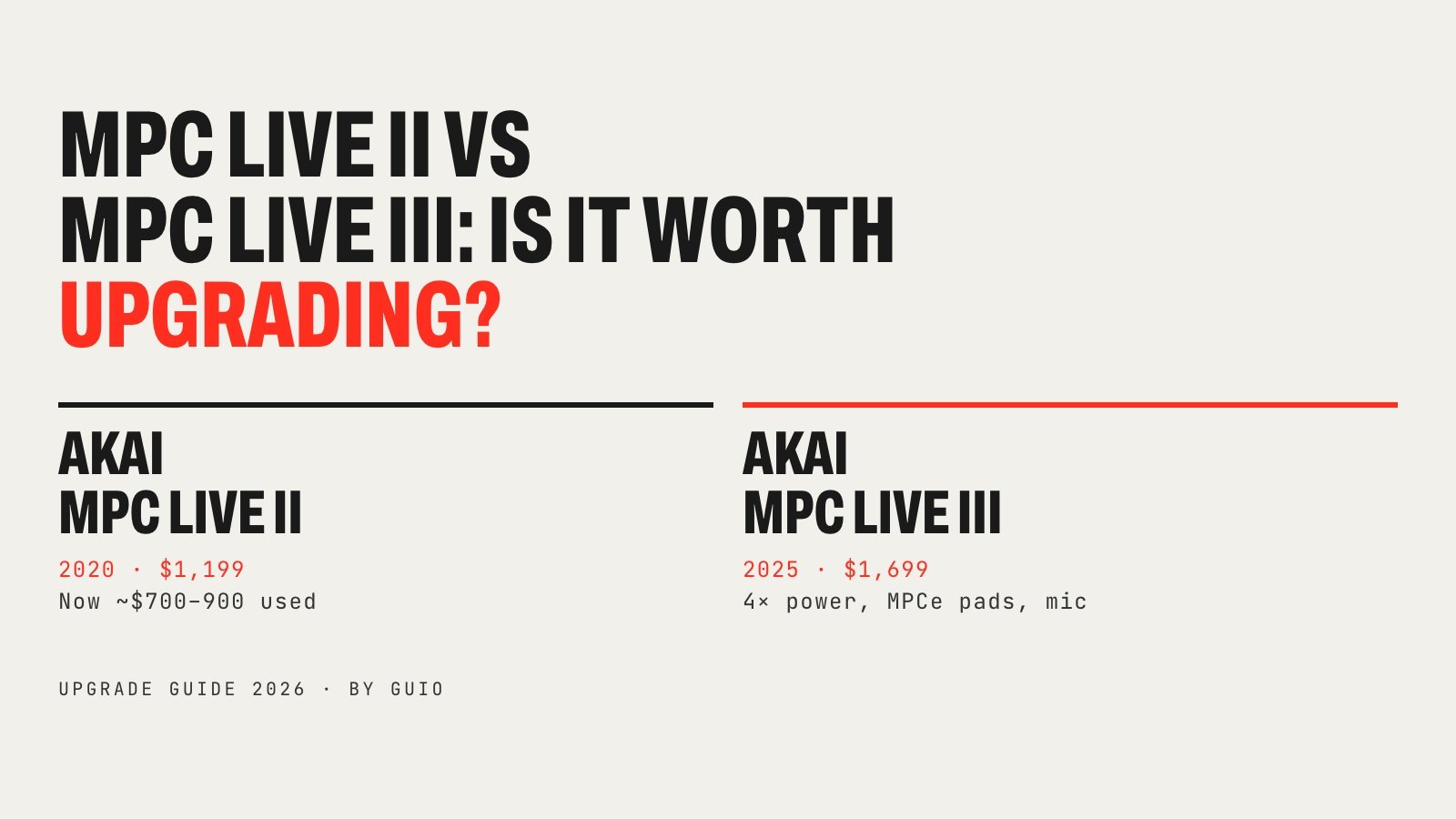
The MPC Live II was the portable MPC for five years. The Live III replaced it with four times the power and a new kind of pad. If you own a Live II, or you are looking at a cheap used one, here is what actually changed and when the upgrade pays off.
Where to buyAkai MPC Live III
The MPC Live II arrived in May 2020 at $1,199 and added the one thing the first Live lacked: built-in speakers. For five years it was the MPC you could carry to a couch, a tour bus or a park. The MPC Live III launched on October 2, 2025 at $1,699. Same idea, same screen size, same six outputs and turntable inputs, but a completely different engine inside and new pads on top.
The short version: the Live III is not a small refresh. It moves from Akai’s first-generation hardware to the second, and every limit Live II owners complain about (plugin count, audio tracks, voices, RAM) goes up by two to four times.
How this comparison was made: I make my beats on an MPC Live III, so that side comes from daily use. I have not owned a Live II; that side is based on Akai’s official specifications and support pages, the MPC 3.9.1 release notes, Sound On Sound’s review and the used listings credited at the end.
MPC Live 2 vs 3 specs, side by side
| Akai MPC Live II | Akai MPC Live III | |
|---|---|---|
| Released / US price | May 2020 · $1,199 | October 2, 2025 · $1,699 |
| Status in October 2026 | Discontinued at major US retailers; used market | Current flagship (also in a gray Retro edition) |
| Processor | Gen 1 quad-core ARM (1.8 GHz) | Gen 2 8-core (Akai: 4× the power) |
| RAM / storage | 2 GB / 16 GB · SD slot · SATA bay | 8 GB / 128 GB · SD slot · 2.5" SATA bay |
| Plugin instruments (standalone) | Up to 8 plugin programs | Up to 32 |
| Stereo audio tracks | 8 | 16 |
| Polyphony | 64 stereo voices | 256 stereo voices |
| Pads | 16 RGB, velocity + pressure | 16 MPCe: velocity, pressure + 3D position |
| Step buttons / touch strip | No / no | 16 step buttons / touch strip |
| Screen | 6.9" multi-touch | 6.9" multi-touch |
| Inputs | 2 × ¼" TRS line · RCA phono/line pair | 2 × XLR/¼" combo with preamps and phantom · RCA phono pair · built-in mic |
| Outputs | 6 × ¼" (3 stereo pairs) · ¼" phones | 6 × ¼" · ¼" phones |
| MIDI / CV | 2 in, 2 out (5-pin) · 8 CV/Gate outs | 2 in, 2 out · 8 CV/Gate outs |
| Computer connection | USB-B (USB 3.0) · 2 × USB-A | USB-C with 24-channel audio · 2 × USB-A |
| Stem separation | Standard MPC Stems | Pro Stems (needs the 8-core CPU) |
| Battery (Akai figure) | Up to 5 hours | Up to 3 hours with typical use |
| Speakers | Yes, built-in stereo monitors | Yes |
| Size | 41.2 × 24.4 × 4.6 cm (16.2 × 9.6 × 1.8 in) | 43.6 × 25.6 × 6.7 cm (17.2 × 10.1 × 2.6 in) |
| Weight | 3.38 kg (7.45 lb) | 3.9 kg (8.6 lb) |
| Where to buy (paid links) | Check price → | Check price → |
What is the difference between the MPC Live 2 and Live 3?
Akai’s own FAQ for the Live III lists the jumps. The processor goes from a 1.8 GHz quad-core chip to an 8-core one with four times the power. RAM goes from 2 GB to 8 GB and internal storage from 16 GB to 128 GB. In standalone mode that means 32 plugin instruments instead of 8, 16 stereo audio tracks instead of 8 and 256 voices instead of 64.
Then there is the hardware that the Live II simply does not have:
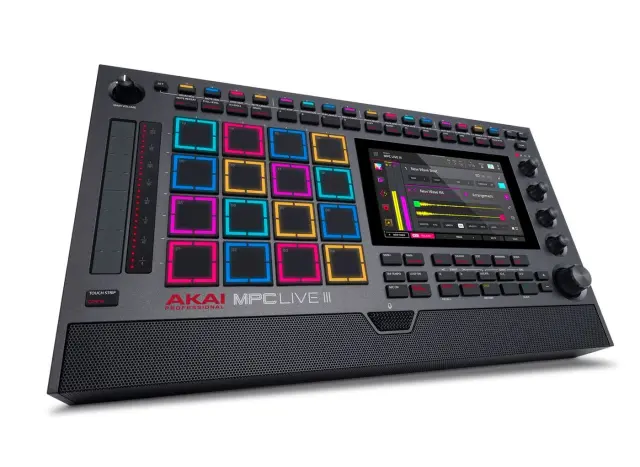
- MPCe pads. They read where your finger lands, so one pad can blend sample layers or move a filter as you play. Articulations such as rolls and flams make hi-hats feel played.
- 16 step buttons and a touch strip for TR-style programming, with clip launching in the software.
- Two XLR/¼" inputs with mic preamps and phantom power, plus a built-in mic. The Live II has line inputs only.
- USB-C with 24 channels of audio to a computer, so it works as an audio interface for your DAW.
- Pro Stems, the desktop-grade stem separation. Akai says it needs the new 8-core CPU, so it will never come to the Live II.
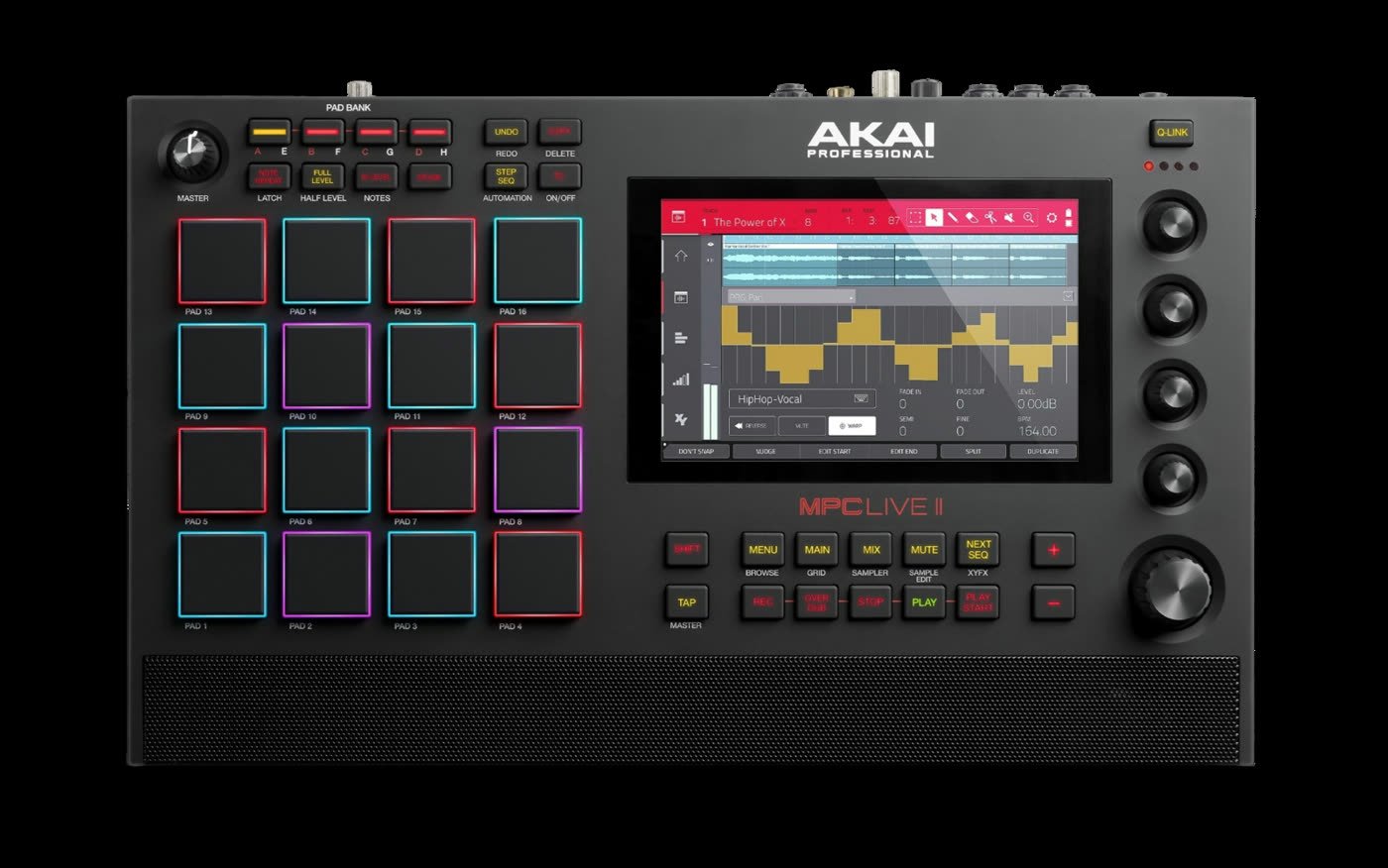

MPC Live 2 vs 3 size and weight
The Live III is bigger. Akai lists it at 17.2 × 10.1 × 2.6 inches and Sound On Sound gives 3.9 kg (8.6 lb). The Live II is 16.2 × 9.6 × 1.8 inches and 3.38 kg (7.45 lb). An inch wider makes room for the touch strip; the extra 0.8 inch of height is the part you notice in a backpack. Neither is pocketable, and a case cut for the Live II will be too small for the Live III.
What the Live II still does well
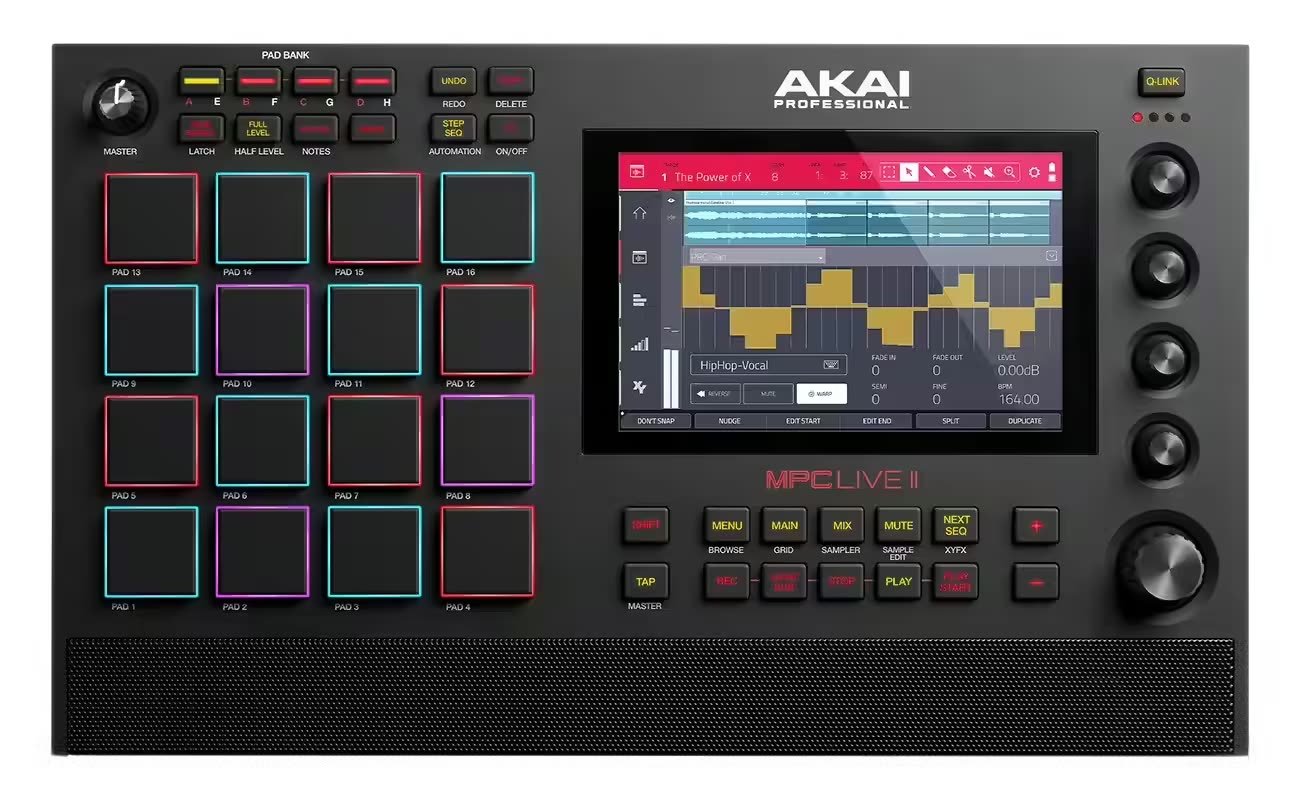
More than its age suggests. The Live II has the same 6.9-inch touchscreen, the same six outputs, two MIDI ins and outs and eight CV/Gate outputs as the Live III. Its RCA inputs take a turntable straight in (a rear switch picks phono or line), so sampling vinyl works the same way. It has a battery Akai rates at up to 5 hours, against up to 3 hours of typical use for the Live III, and built-in speakers.
It also still gets software. Akai’s MPC 3.9.1 release notes list the Live II among the supported machines, so you get the same Arrange Mode tools and sequencing features as newer MPCs, within the Gen 1 limits. The classic workflow (chop a sample, program drums with swing and Note Repeat, sequence, bounce) is the same on both.
Where the Live II hits its limits
The ceiling is the engine. Akai’s support page caps first-generation MPCs, the Live II included, at 8 plugin programs in standalone mode, and only one DrumSynth Multi instance. With 2 GB of RAM and 64 voices, big sample libraries, long audio tracks and heavy effects chains fill it fast, and the Live III has four times as much of each.
If you make trap or melodic beats with several synth plugins, or record vocals and instruments into the MPC, those limits show up in almost every session. If you make sample-based beats with drums and a couple of instruments, you may never see them.

Is the MPC Live 3 worth it? Who should upgrade
- You freeze or resample tracks just to keep working. Four times the plugins and twice the audio tracks remove most of that.
- You finger-drum. MPCe pads and articulations are the biggest change in how an MPC feels in years.
- You record vocals, guitar or keys into the MPC. Mic preamps, phantom power and the built-in mic replace an external interface.
- You work with a DAW. USB-C with 24 channels of audio makes the Live III part of your computer setup.
- You use stems. Pro Stems gives cleaner separations than the standard engine on older MPCs, and only runs on the new CPU.
- You perform live. Clip launching and the step sequencer turn it into a performance instrument, with the MPC Pro Pack included.
Where to buyAkai MPC Live III
Who should keep the Live II
- Boom bap and sample-based producers who chop, program drums and add a bass line. Eight plugins and eight audio tracks are plenty for that.
- Anyone who values battery life. Akai’s up-to-5-hours rating beats the Live III’s up-to-3 hours.
- Producers who already use an interface and a DAW. The mic inputs and USB-C audio of the Live III would duplicate gear you own.
Selling a Live II for around $750 and buying a Live III at $1,699 puts the real cost of the upgrade near $950. If what you want is mostly more power at a desk, the $799 MPC One G2 has the same 32-plugin and 16-track limits as the Live III, without the battery, MPCe pads or mic inputs (see our One G2 vs Live III comparison).

Is the MPC Live 2 discontinued? Buying a used one in 2026
In practice, yes. On October 22, 2026, Sweetwater lists the Live II as no longer available, and a search for it on Amazon US returns the Live III, the Live III Retro and the One G2 instead. Akai keeps the product page online and still supports it in MPC 3.
Used, it is one of the best-value MPCs around. Sweetwater’s Gear Exchange sold Live IIs in excellent condition for $750 and $787.50 in 2026, and US listings on Reverb in October 2026 start around $700. A gray Retro edition of the Live II also exists and asks for more. When you buy one, check:
- Battery: ask how long it lasts unplugged now. Batteries lose capacity after years of charging.
- Pads and Q-Links: every pad should trigger evenly at soft and hard hits, and the knobs should not skip values.
- Storage: a SATA drive already installed is worth paying a bit more for, because 16 GB fills up fast.
- Firmware: update it to the latest MPC 3 before you trust it with projects.
- Power adapter: it uses a 19 V, 3.42 A center-positive supply; make sure it is included.
Where to buyAkai MPC Live II · used
Compared with a new MPC One G2 at $799, a used Live II costs about the same and gives you a battery, speakers, phono inputs and six outputs, but a quarter of the processing power and no warranty. If you need power, buy the G2; if you need portability on a budget, a good Live II is still a smart buy. For the whole range, see our best Akai MPC guide.

Verdict
The MPC Live III is a generational jump, not a refresh. Four times the processing, four times the RAM, four times the plugin instruments and new pads make it a different instrument, not just a faster Live II. It is the MPC I make my beats on.
Still, an upgrade only makes sense if you feel the Live II limits. If your Live II finishes your beats without freezing tracks, it is still a capable, portable MPC that gets updates. Keep it, buy records with the $950, and upgrade when the projects outgrow it.
Where to buyAkai MPC Live III
Royalty-free samplesSpliceWhichever MPC you keep, load it with royalty-free drums, loops and one-shots, licensed for commercial releases.
MPC Live 2 vs Live 3 FAQ
Is the MPC Live 3 worth it if I already own a Live 2?
It is worth it if you hit the Live II limits: more than 8 plugin instruments, more than 8 audio tracks, slow or crashing big projects, or if you want MPCe pads, a step sequencer, mic inputs or USB-C audio. If your beats are mostly samples and drums and the Live II never runs out of steam, keep it and spend the money elsewhere.
What is the difference between the MPC Live 2 and Live 3?
The Live III has an 8-core CPU with four times the power, 8 GB of RAM instead of 2 GB, 128 GB of storage instead of 16 GB, 32 plugin instruments instead of 8, 16 audio tracks instead of 8, 256 voices instead of 64, 3D MPCe pads, 16 step buttons, a touch strip, a built-in mic, two mic preamps, USB-C audio, Pro Stems and clip launching.
Is the MPC Live 3 bigger than the Live 2?
Yes. The Live III measures 17.2 × 10.1 × 2.6 inches and weighs 3.9 kg (8.6 lb). The Live II measures 16.2 × 9.6 × 1.8 inches and weighs 3.38 kg (7.45 lb), so the new one is an inch wider and almost an inch thicker.
Is the MPC Live 2 discontinued?
Yes, in practice. Sweetwater lists it as no longer available, and on Amazon US a search for it now returns the Live III. Akai still keeps its product page and supports it with MPC 3 updates, but in 2026 you will mostly find it used.
How much is a used MPC Live 2 worth in 2026?
Roughly $650 to $900 in the US, depending on condition and extras. Sweetwater’s Gear Exchange sold units in excellent condition for $750 and $787.50 in 2026. Units with a large SATA drive, a case or the gray Retro finish ask for more.
Can the MPC Live 2 run MPC 3.9?
Yes. Akai’s MPC 3.9.1 release notes list the MPC Live II among the supported devices. The Gen 1 hardware limits stay the same, and features that need the 8-core CPU, such as Pro Stems, are not available on it.
Will my MPC Live 2 projects open on the Live 3?
Yes. Akai says the Live III opens projects made with the MPC 2 and MPC 3 software, plus older formats such as .PGM, .PRJ, .SEQ and .MID. Copy your projects and samples to an SD card, a USB drive or the SATA drive and load them on the new machine.
Does the MPC Live 2 battery last longer than the Live 3?
On paper, yes. Akai quotes up to 5 hours for the Live II and up to 3 hours of typical production use for the Live III, which pushes a far more powerful processor. Real battery life depends on screen brightness, speakers and how heavy the project is.
Sources
- Akai Professional: MPC Live II technical specifications
- Akai Professional: MPC Live III
- Akai support: MPC Live III FAQ (Live II comparison, battery, Pro Stems, projects)
- Akai support: how many plugin programs can I use?
- Akai: MPC 3.9.1 release notes (supported hardware)
- Sound On Sound: Akai MPC Live III review
- Attack Magazine: Akai announces the MPC Live II (May 2020, $1,199)
- Sonic State: Sonic LAB, Akai MPC Live II
- Sweetwater: MPC Live II (no longer available)
- Sweetwater Gear Exchange: used MPC Live II sold for $750 (April 2026)
Prices are US launch prices and used prices seen on October 22, 2026; they change often. GUIO Records is not affiliated with Akai Professional.