
Akai MPC Live III Review: Specs, Price, MPCe Pads and Is It Worth It?
Four times the power, pads that feel where your finger lands, and the first MPC with a step sequencer and clip launching built in. The MPC Live III is Akai’s strongest argument yet for leaving the laptop at home.
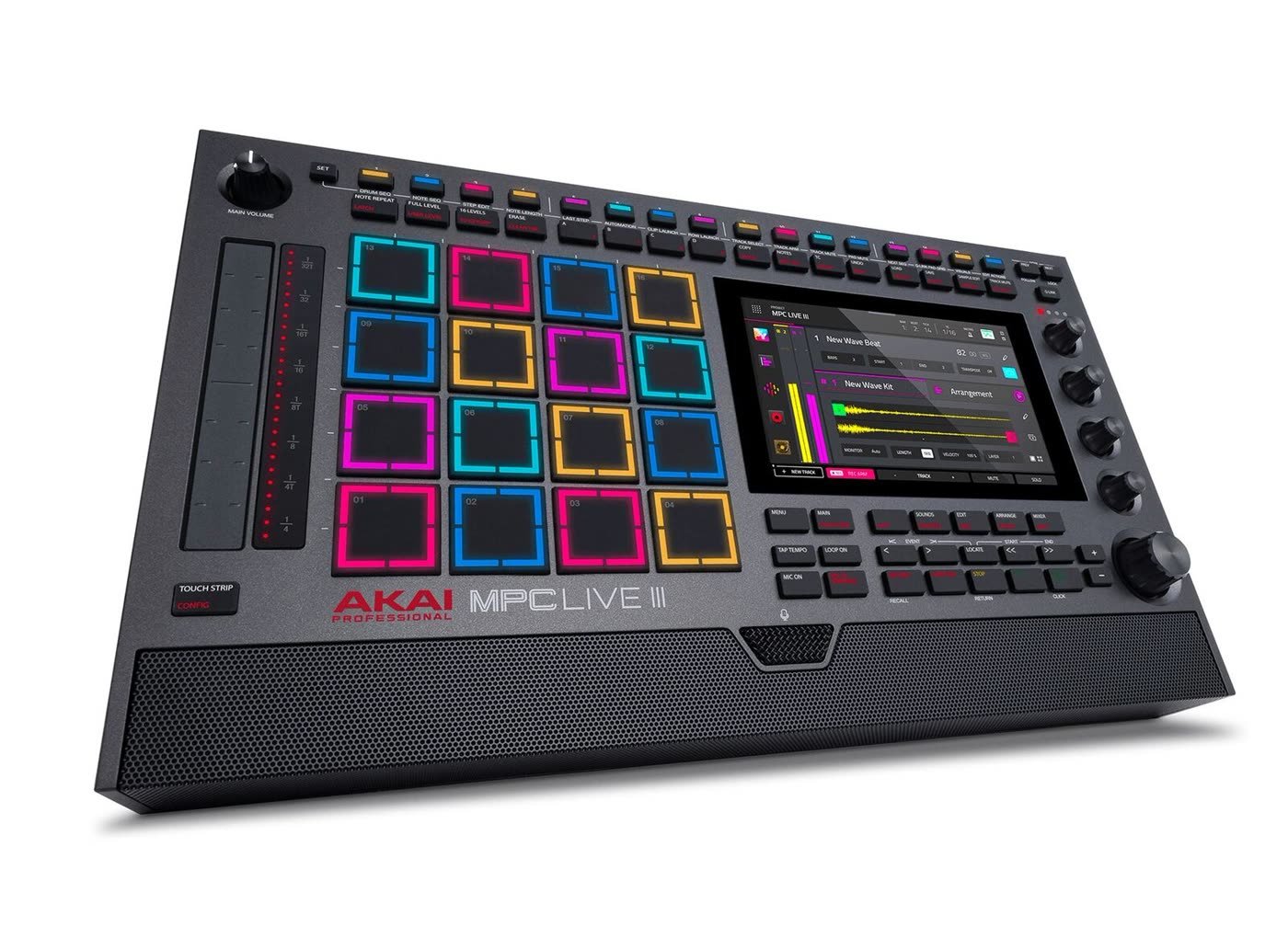
The Akai MPC Live III is the third generation of Akai’s portable flagship, launched on October 2, 2025 at $1,699. Akai calls it the most powerful all-in-one standalone music production center it has ever made, and on paper that is hard to argue with: an 8-core processor, 8 GB of RAM, 128 GB of storage, new MPCe pads with 3D sensing, a 16-step sequencer, clip launching, a built-in mic, speakers and a battery.
If you own an MPC Live II, or you are deciding between this and a smaller box like the MPC Sample, here is everything you need to know.
What is the Akai MPC Live III?
The MPC Live III is a standalone sampler, sequencer and music production workstation. It runs Akai’s MPC3 operating system on its own, so you can sample, chop, program drums, play instruments, record audio, arrange and mix a full song without a laptop. It also includes the MPC Pro Pack as standard, with studio-grade time-stretch, clip launching, expanded CV control and pro plugins.

MPC Live III specs
| Processor | 8-core ARM CPU (the fastest ever in an MPC) |
|---|---|
| RAM / storage | 8 GB RAM · 128 GB internal · SD card slot · 2.5" SATA drive bay |
| Pads | 16 MPCe pads: velocity, pressure and 3D (X/Y) sensing · 8 pad banks |
| Tracks | Up to 32 plugin instrument tracks and 16 audio tracks |
| Polyphony | 256 stereo voices |
| Display | 6.9" (7-inch class) full-color multi-touch screen |
| Controls | 4 touch-sensitive Q-Link knobs · touch strip · 16-step sequencer buttons · 60 backlit buttons |
| Audio I/O | 2 combo XLR/¼" inputs with mic preamps and phantom power · 2 RCA phono inputs · 6 balanced ¼" outputs · ¼" headphones |
| MIDI / CV | 2 × MIDI in · 2 × MIDI out · 4 stereo 3.5 mm CV/Gate outputs |
| USB | USB-C with 24-channel audio interface and 32 MIDI channels · 2 × USB-A host |
| Wireless | Wi-Fi and Bluetooth |
| Built-in | Condenser microphone · stereo speakers · rechargeable battery (Akai quotes 3–4 hours) |
| Converters | 24-bit at 44.1, 48 or 96 kHz |
| Size / weight | 435.9 × 256 × 67.1 mm (17.2 × 10.1 × 2.6 in) · 3.9 kg (8.6 lb) |
| Price | $1,699 / £1,399 / €1,649 at launch |
MPCe pads: the classic MPC pad, reimagined
The biggest change is under your fingers. The new MPCe pads sense velocity and pressure like before, but also where you touch the pad. That opens up X/Y control on each pad: blend between sample layers depending on the corner you hit, morph a sound by sliding your finger, or drive filters and effects while you play.
Akai adds articulations on top: rolls, flams, ratchets and paradiddles assigned to pads, which makes hi-hat and snare programming feel far more human. For anyone who plays drums by hand, this is the feature that makes the Live III feel different from every MPC before it.
Step sequencer, clip launching and a real arranger
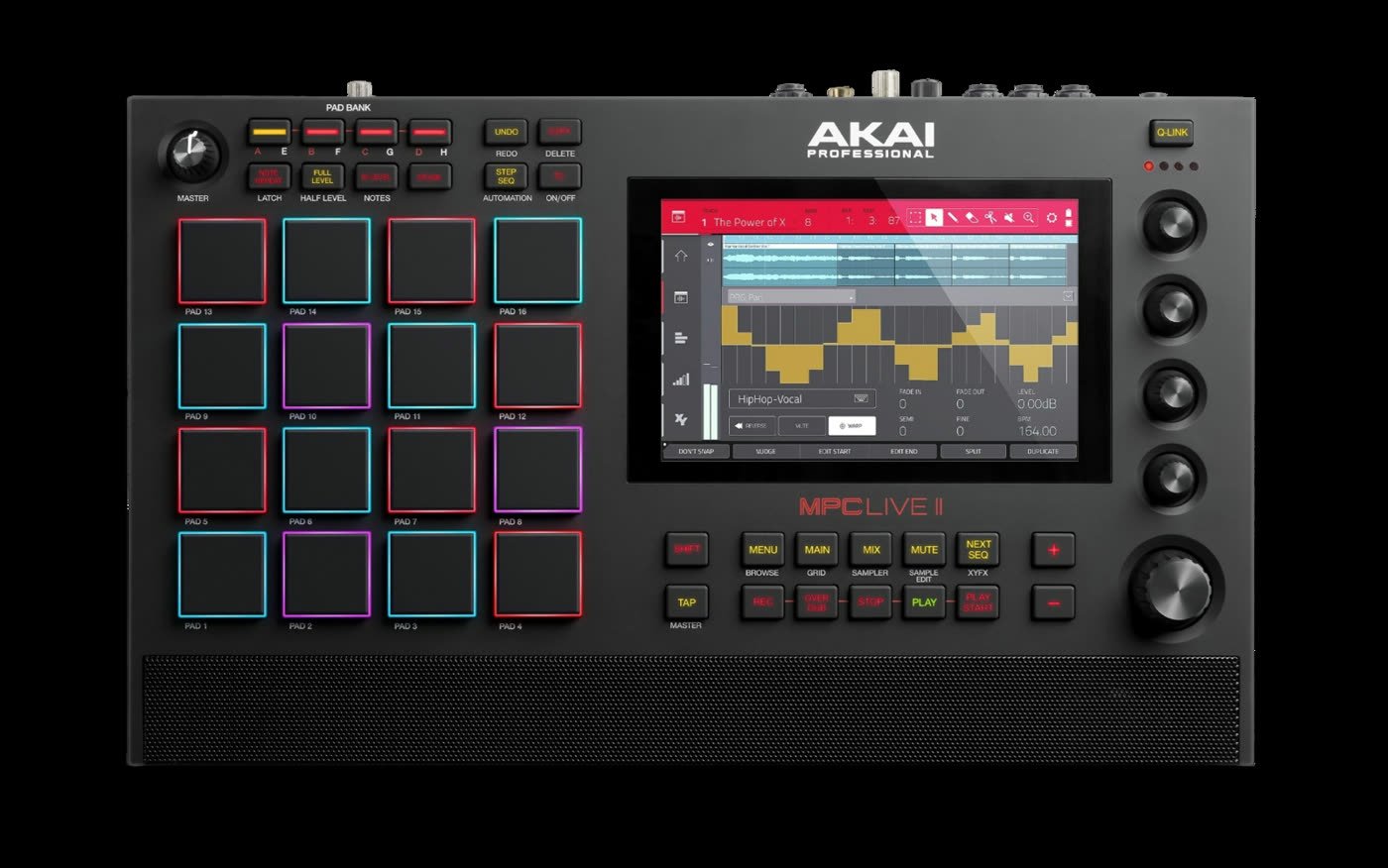
For the first time on an MPC, there is a row of 16 dedicated step buttons for TR-style programming, with probability and polyrhythm options. It is perfect for drums, basslines and for sequencing external synths.
The Clip Matrix brings Ableton-style clip launching to the MPC: trigger loops and scenes that land on the one, then record your performance into the arrangement. A linear arranger with automation lets you finish songs on the device instead of exporting to a DAW. The MPC 3.9 update (June 2026) added cut, copy, paste and duplicate tools in Arrange Mode, per-sequence time signatures and a built-in oscillator engine that turns the MPC into a synth.
Sampling, Pro Stems and time-stretch
Sampling is where the MPC started, and the Live III covers every source: a built-in condenser mic, two XLR/¼" combo inputs with preamps and phantom power, phono inputs for turntables, and direct sampling from a phone or computer over USB-C.
Pro Stems separates a sample into drums, bass, vocals and melodic parts on the device, using the same higher-quality engine as the desktop MPC software. Reviewers note it takes its time, but the results are cleaner than the lighter version on older MPCs. A new high-quality time-stretch mode keeps loops sounding natural when you change tempo.

Built for studio and stage
The Live III doubles as a hub for the rest of your setup: two MIDI ins and two MIDI outs, four stereo CV/Gate outputs for modular and analog gear, six line outputs for separate mixes, and a 24-channel USB-C audio interface with 32 MIDI channels to work with your DAW. It can also act as a controller for Ableton Live, and Wi-Fi and Bluetooth handle wireless file transfer.
The flip side is size. At 3.9 kg (8.6 lb) it is portable, but not pocketable. MusicTech also points out that complex tasks can still be menu-heavy.

Included sounds and plugins
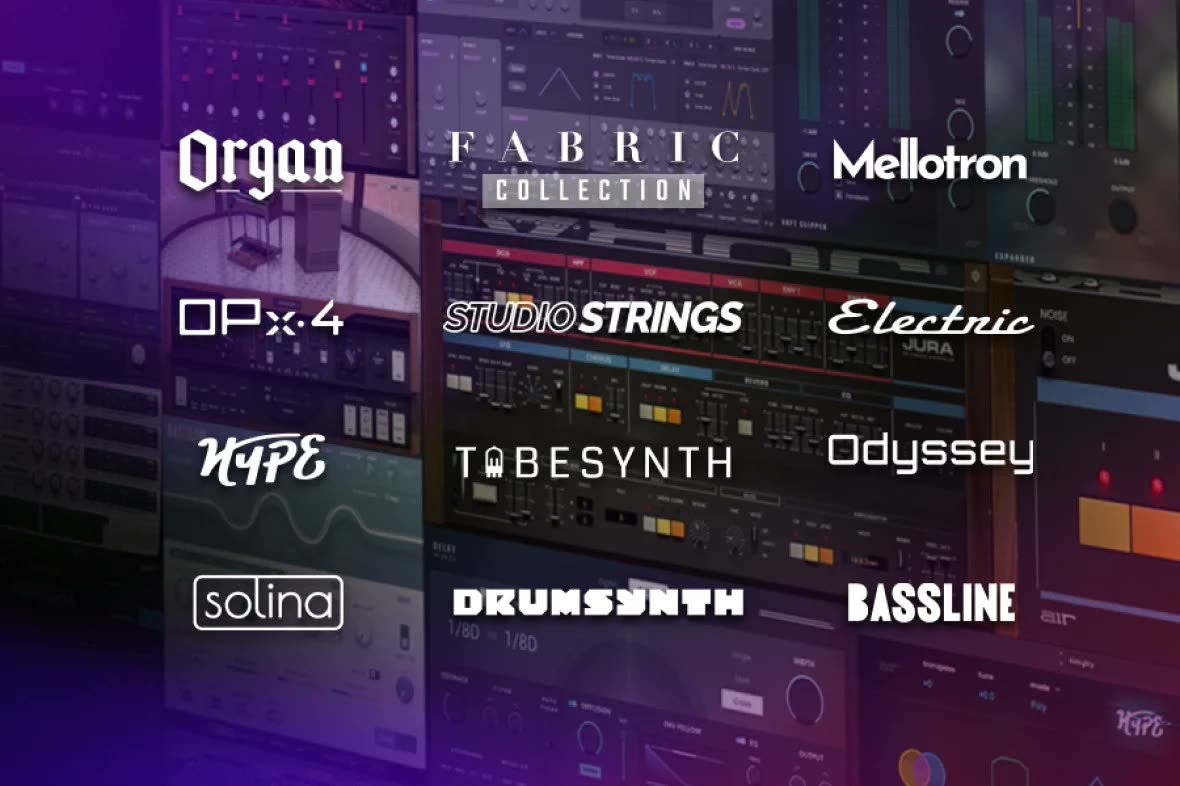
Out of the box you get over 1,000 MPC-ready drum kits and instruments, sound libraries from names like Marco Polo, 91Vocals and ProducerGrind, and a premium plugin collection including Fabric XL, OPx4, Studio Strings, Mellotron, Odyssey, Solina, Tubesynth, Bassline and DrumSynth. The MPC Pro Pack adds AIR Reverb Pro, AIR Visual EQ4, AIR Fabric Select and AIR Utility.
MPC Live III vs MPC Live II
Is it worth upgrading? These are the differences from Akai’s own comparison:
| MPC Live III | MPC Live II | |
|---|---|---|
| CPU | 8-core | 4-core |
| RAM | 8 GB | 2 GB |
| Storage | 128 GB | 16 GB |
| Plugin tracks | 32 | 8 |
| Audio tracks | 16 | 8 |
| Max polyphony | 256 stereo voices | 64 stereo voices |
| MPCe 3D pads | Yes | No |
| Step sequencer buttons | Yes (16) | No |
| Touch strip | Yes | No |
| Built-in mic | Yes | No |
| Inputs | XLR/¼" combo with preamps | Line only |
| USB-C audio interface | Yes (24 channels) | No |
| Stem separation | Stems Pro | Stems efficient |
| Time-stretch | High-quality FFT “Super” mode | Standard |
If your Live II hits its limits with plugins, audio tracks or stems, the upgrade is huge. If you mostly chop samples and program drums, the Live II or the $399 MPC Sample will still serve you well.
MPC Live III Retro edition
In 2026 Akai released the MPC Live III Retro: the same internal specs with a classic gray color scheme and the original Akai Professional logo, a nod to the late-’80s and early-’90s machines that defined sample-based hip hop. Gearnews lists it at €1,599.
Pros and cons
Pros
- Four times the RAM and processing power of the Live II
- Expressive MPCe pads with 3D sensing and articulations
- Step sequencer, clip launching and a proper arranger
- Mic preamps, phono inputs, CV/Gate and 24-channel USB audio
- Battery, speakers and mic for truly standalone work
- MPC Pro Pack and a big sound library included
Cons
- $1,699 is a serious investment
- Heavy (3.9 kg) for a “portable”
- Steep learning curve and some menu-heavy tasks
- Pro Stems is slow to process
- Battery life of around 3 hours in real use
Verdict: is the MPC Live III worth it?
For producers who want one box that can take a beat from the first sample to a finished song, the MPC Live III is the most complete MPC Akai has ever made. The MPCe pads alone change how you program drums, and the step sequencer and clip launcher finally cover the workflows that used to send people back to a DAW.
From a beatmaker’s point of view, the question is not whether it is powerful, but whether you need all of it. If your music lives on sampling and swing, a simpler MPC might be enough. If you want a studio you can carry, this is the one to beat.
MPC Live III FAQ
How much does the Akai MPC Live III cost?
The MPC Live III launched in October 2025 at $1,699 in the US (£1,399 in the UK and €1,649 in Europe). The Retro edition, released in 2026, is listed at €1,599.
What is new in the MPC Live III compared to the MPC Live II?
It has four times the RAM (8 GB vs 2 GB), an 8-core CPU, 128 GB of storage, 3D-sensing MPCe pads, dedicated step sequencer buttons, a touch strip, a built-in mic, XLR mic inputs, USB-C audio, and four times the plugin tracks (32 vs 8).
How long does the MPC Live III battery last?
Akai’s technical specs quote up to 3 hours with typical use, and its marketing mentions around 4 hours. Plan for 3 hours of real work.
Can the MPC Live III replace a DAW?
For many beatmakers, yes. It records, sequences, arranges, mixes and runs plugins standalone, and it adds clip launching and a linear arranger. Heavy mixing and detailed editing are still faster on a computer, and it can also work as a controller for Ableton Live.
Does the MPC Live III have stem separation?
Yes. It runs Akai’s Pro Stems separation on the device, the same higher-quality engine used in the desktop MPC software. Reviewers note it is slow but clearly better than the lighter version on older models.
What is the MPC Live III Retro?
A 2026 edition with the same internal specs and a classic gray color scheme and vintage Akai logo inspired by late-’80s and early-’90s MPCs.
Sources
- Akai Professional: MPC Live III (features and technical specifications)
- DJ TechTools: MPC Live III launch
- MusicRadar: Akai MPC Live III review
- MusicTech: Akai MPC Live III review
- Sound On Sound: Akai MPC Live III
- Gearnews: MPC Live III Retro review
- Synthtopia: MPC 3.9 update
Product photos and videos: Akai Professional. GUIO Records is not affiliated with Akai Professional.