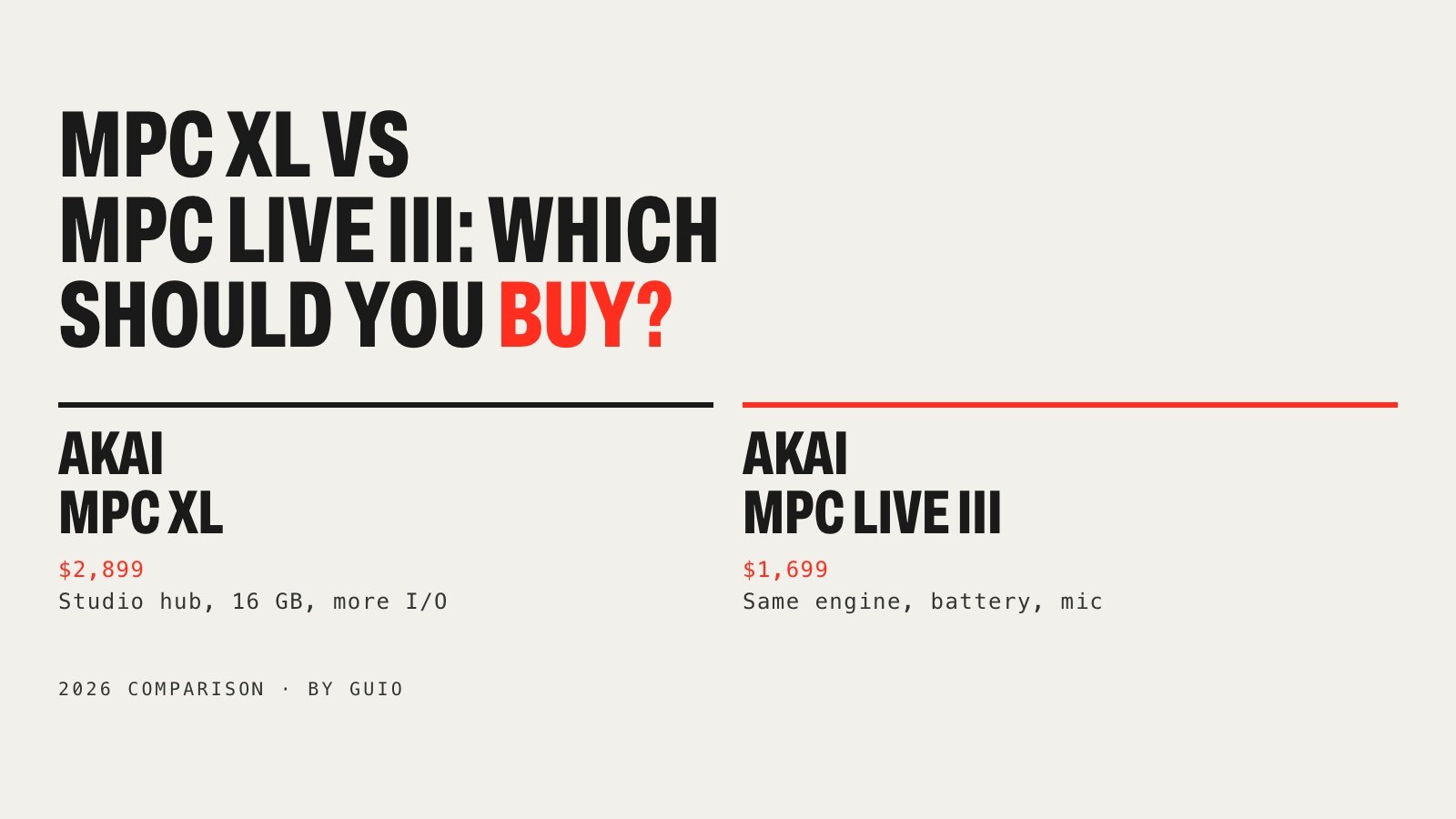
Akai MPC XL vs MPC Live III: Which Should You Buy?
This article contains affiliate links. If you buy through them, GUIO Records may earn a small commission at no extra cost to you. As an Amazon Associate I earn from qualifying purchases. Outside the US, Amazon links open your local Amazon store (UK, Canada, Germany, France, Italy, Spain, Netherlands, Poland or Sweden).
These two MPCs run the same engine, the same pads and the same track limits. The $1,200 between them does not buy more music. It buys a bigger control surface and more connections, and it costs you the battery, the speakers and the mic.
How this comparison was made: I make my beats on an MPC Live III, so that side comes from daily use. I have not used an MPC XL. That side comes from Akai’s official specifications, read side by side on November 5, 2026, and the reviews by Sound On Sound, MusicRadar and Audiofanzine credited at the end.
The MPC Live III launched on October 2, 2025 and the MPC XL followed in January 2026 as the replacement for the MPC X line. Since the XL came second and costs more, it is easy to assume it is simply the stronger machine. On the numbers that decide how big a project can get, it is not. Akai lists the same limits for both.
So this is less a question of which one is better than of where your MPC lives and how much other gear it has to talk to.
MPC XL vs MPC Live 3 specs, side by side
| Akai MPC XL | Akai MPC Live III | |
|---|---|---|
| US price (Sweetwater, Nov 5, 2026) | $2,899 | $1,699 |
| Released | January 2026 | October 2, 2025 |
| Processor | 8-core (Gen 2) | 8-core (Gen 2) |
| RAM / internal storage | 16 GB / 256 GB NVMe SSD | 8 GB / 128 GB |
| Expansion | SD slot · 2.5" SATA bay | SD slot · 2.5" SATA bay |
| Plugin instruments / audio tracks | 32 / 16 | 32 / 16 |
| Polyphony | 256 stereo voices | 256 stereo voices |
| Pads | 16 MPCe with 3D sensing | 16 MPCe with 3D sensing |
| Step buttons / touch strip | 16 RGB / yes | 16 / yes |
| Screen | 10.1" 1280×800 multi-touch, tilting | 6.9" multi-touch |
| Q-Link knobs | 16 touch-sensitive, each with an OLED | 4 touch-sensitive, with column switching |
| Inputs | 2 XLR/¼" combo with mic preamps · 2 ¼" line · 2 RCA phono · 2 ¼" instrument | 2 XLR/¼" combo with mic preamps · 2 RCA phono |
| Footswitch inputs | 2 | None listed |
| Outputs | 8 × ¼" (4 stereo pairs) | 6 × ¼" (3 stereo pairs) |
| Headphone outputs | ¼" and ⅛" | ¼" |
| MIDI (5-pin) | 2 in, 4 out | 2 in, 2 out |
| CV/Gate | 8 stereo ⅛" (16 CV outs) | 4 stereo ⅛" (8 CV outs) |
| USB | 1 USB-C (24 audio, 32 MIDI channels) · 3 USB-A | 1 USB-C (24 audio, 32 MIDI channels) · 2 USB-A |
| Wireless | Wi-Fi and Bluetooth | Wi-Fi and Bluetooth |
| Battery | No | Yes: up to 3 hours of typical use (Akai spec) |
| Speakers / built-in mic | No / no | Yes / yes |
| Size (Akai) | 21.4 × 19.2 × 3.7 in (543 × 488 × 94 mm) | 17.2 × 10.1 × 2.6 in (436 × 256 × 67 mm) |
| Weight | 7.2 kg (15.87 lb) | 3.9 kg (8.6 lb) |
| Where to buy (paid links) | Check price → | Check price → |
What is the difference between the MPC XL and MPC Live 3?
Start with what is the same. Both have an 8-core processor, MPCe pads with 3D sensing, 16 step buttons, a touch strip, Pro Stems, the MPC Pro Pack and 24 channels of audio over USB-C. Both stop at 32 plugin instruments, 16 audio tracks and 256 voices. Chop a sample on one and the workflow carries over to the other, because both run MPC 3.
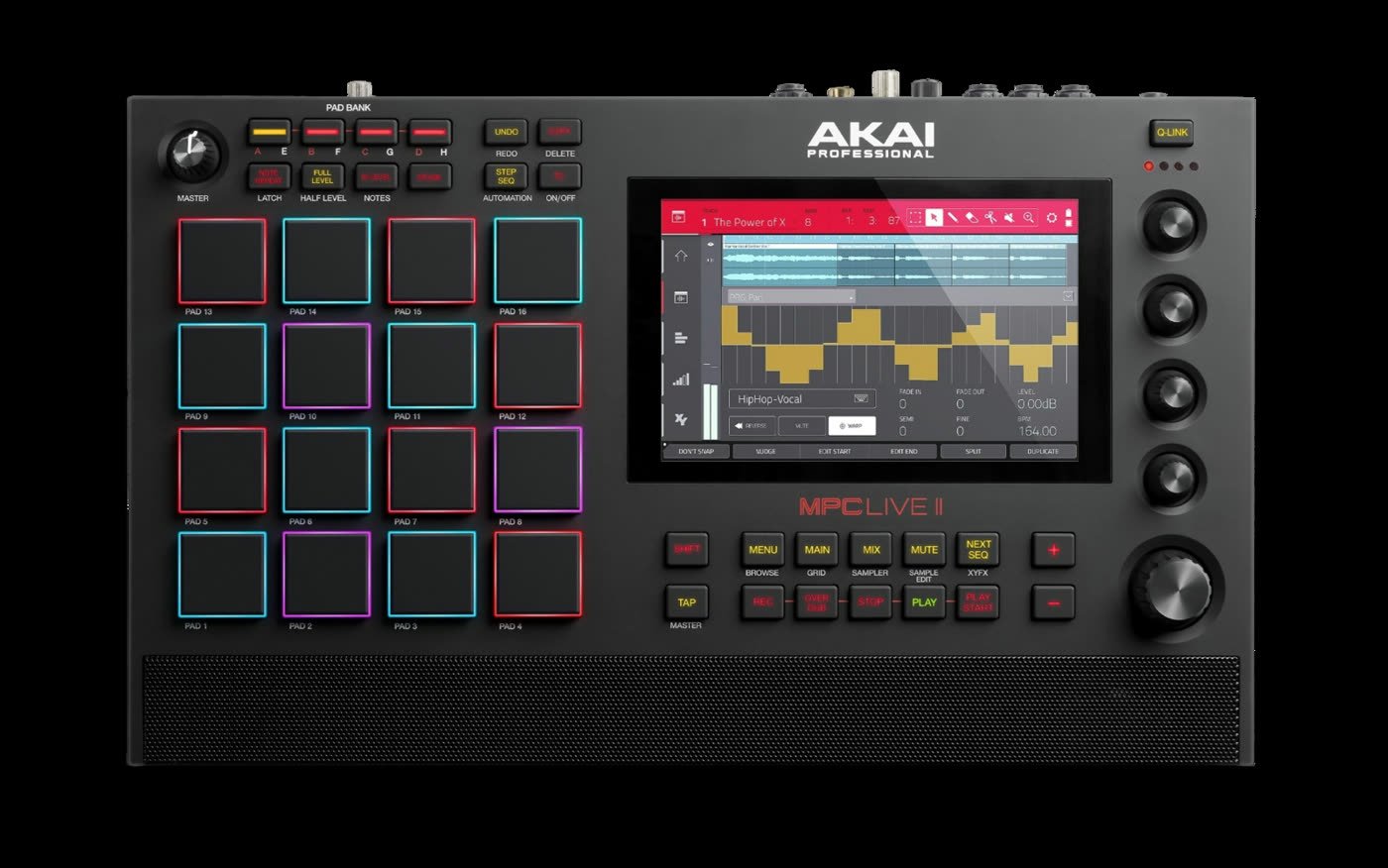
The XL then adds three things: memory (16 GB and 256 GB against 8 GB and 128 GB), hands-on control (a bigger screen and far more knobs and buttons) and connections. The Live III answers with the things that let it leave the room: a battery, stereo speakers and a built-in condenser mic.
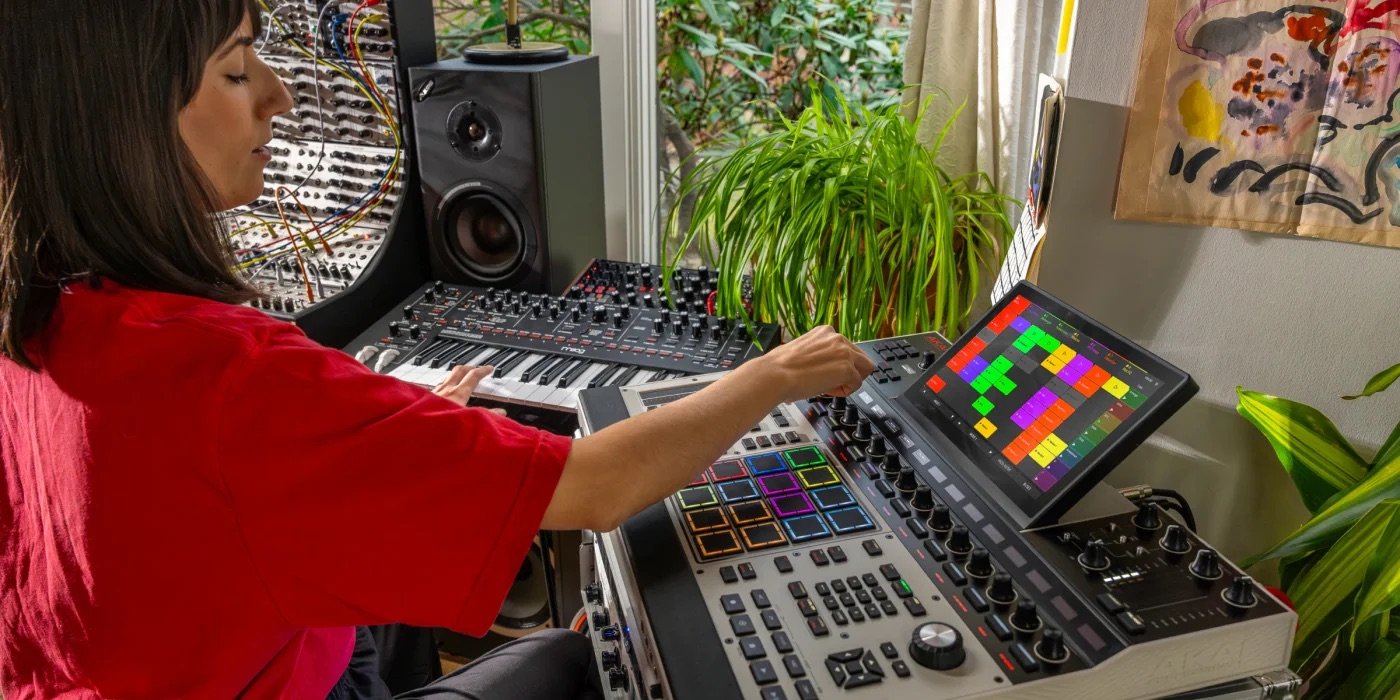
Is the double RAM worth having if the limits do not move? MusicRadar found the identical limits a little disappointing on a machine this size and price. The extra memory should give more room for large sample sets and plugin-heavy sessions, but I could not find a published test that measures how much, so treat it as headroom rather than a feature you can count on.

MPC XL vs MPC Live 3 size and weight
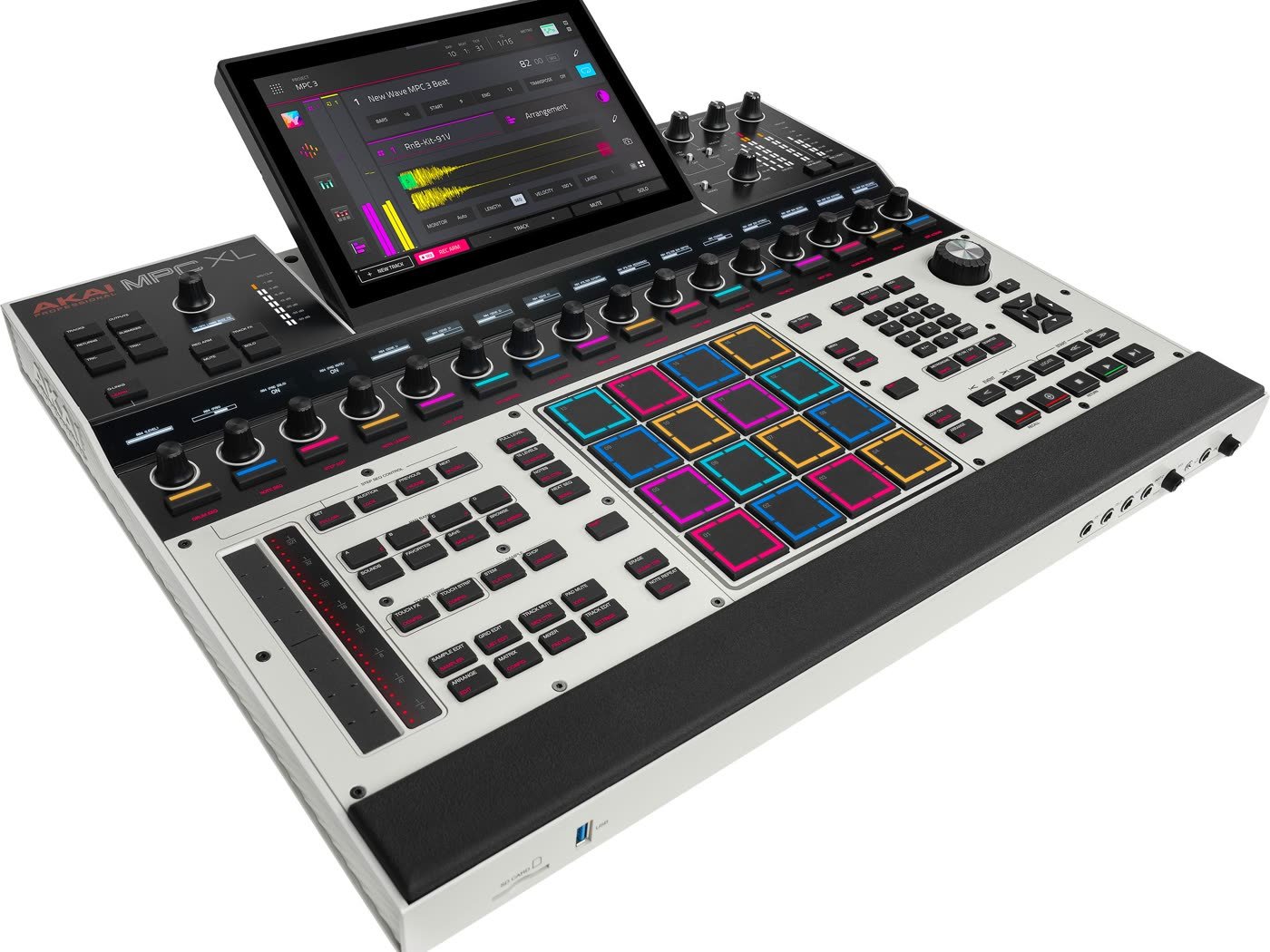
This is the difference you will notice first. Akai lists the XL at 21.4 × 19.2 × 3.7 inches (543 × 488 × 94 mm) and 7.2 kg (15.87 lb). Thomann gives 488 mm as the width and 543 mm as the depth, so the XL is deeper than it is wide. The Live III is 17.2 × 10.1 × 2.6 inches (436 × 256 × 67 mm) and 3.9 kg (8.6 lb).
Do the math and the XL takes up about 2.4 times the desk area and weighs about 1.85 times as much. Measure before you order, especially the depth. A typical 24-inch desk leaves very little room in front of or behind a machine that is over 21 inches deep. MusicRadar’s review points out that this is a unit meant to be installed and left in place, or mounted on a trolley.
Where to buyAkai MPC XL
What the extra $1,200 buys: screen, knobs and connections
The screen and the knobs. The XL has a 10.1-inch tilting touchscreen at 1280×800 against the Live III’s 6.9 inches. Its 16 Q-Links each have their own OLED display, so you can read what each knob does without switching views. The Live III has four touch-sensitive Q-Links, and you page through columns to reach the rest. The XL also adds a Channel Command section for levels, sends and outputs, plus 105 dedicated buttons against 60, which puts tools like sample chopping one press away.
Sound On Sound praises the new layout, and the extra buttons are a clear win if you hate menus. MusicRadar warns that moving the Q-Links above the pads may annoy anyone with years of MPC muscle memory.

The connections. This is the real reason to buy an XL:
- Eight outputs instead of six, for sending more drums and instruments to a console or to separate processors.
- Four MIDI outs instead of two, so each synth or drum machine can have its own port.
- 16 CV outs instead of 8, if you run a modular rack or analog gear.
- A second stereo input pair on ¼" jacks, switchable to the RCA phono inputs, on top of the two combo inputs.
- Two instrument inputs for guitar and bass, which Sound On Sound notes are still unique to the X tier.
- Two footswitch inputs, a second headphone jack and a third USB-A port.
If you read that list and your studio is a Live III, a pair of monitors and an interface, none of it solves a problem you have. If you read it and thought of the cable mess behind your desk, the XL starts to make sense.
Does the MPC XL sound better? Akai’s audio specs compared
Most comparisons stop at the port count. Akai also publishes measured figures for each input and output, and they show a real difference. These are the manufacturer’s numbers, not my measurements, and a spec sheet does not tell you how a beat will feel.
| MPC XL | MPC Live III | Why it matters | |
|---|---|---|---|
| Phono input SNR (4 mVrms) | 97 dB | 79 dB | Noise floor when a turntable goes straight in |
| Phono dynamic range | 103.3 dB | 92 dB | Measured at different levels, so read it as a rough guide |
| Mic input SNR | 109.3 dB | 101.8 dB | Cleaner vocal or instrument takes on paper |
| Mic preamp EIN (40 Ω, max gain) | -134 dBu | -131 dBu | Self-noise with quiet sources |
| Line input SNR | 109.4 dB | 98.6 dB | Sampling from a mixer, a preamp or another machine |
| Line input maximum level | +20.1 dBu | +16 dBu | How hot a source can be before it clips |
| Line output maximum level | +20.4 dBu | +12 dBu | More level into a console or outboard gear |
| Line output dynamic range | 116.3 dB | 113.8 dB | A small gap on the way out |
| Headphone power (32 Ω) | 260 mW | 50 mW | The XL drives hard-to-push headphones more easily |
| Headphone dynamic range | 100.6 dB | 111.2 dB | Here the Live III is the cleaner one on paper |
The line that matters most to a sample-based producer is the first one. With a turntable plugged straight in, Akai lists 97 dB of signal-to-noise on the XL and 79 dB on the Live III. That is an 18 dB gap, the kind you may hear in the quiet passages of a record when you boost the sample later. If that worries you, there is a cheap fix on the Live III: use an external phono preamp and come into the line inputs, where it is rated at 98.6 dB. Our guide on how to sample vinyl explains phono versus line levels.
Audiofanzine’s review compares the same figures and also notes that the XL drives demanding headphones more easily, while the Live III is slightly cleaner on that output. If you already mix on a good interface, like the Apollo Twin X in my studio, the outputs matter less than they do for someone working straight from the machine.
What the MPC Live 3 does that the XL can’t
- Run without a wall socket. Akai’s spec sheet rates the battery at up to 3 hours of typical use, though its product page says 4. Plan for 3.
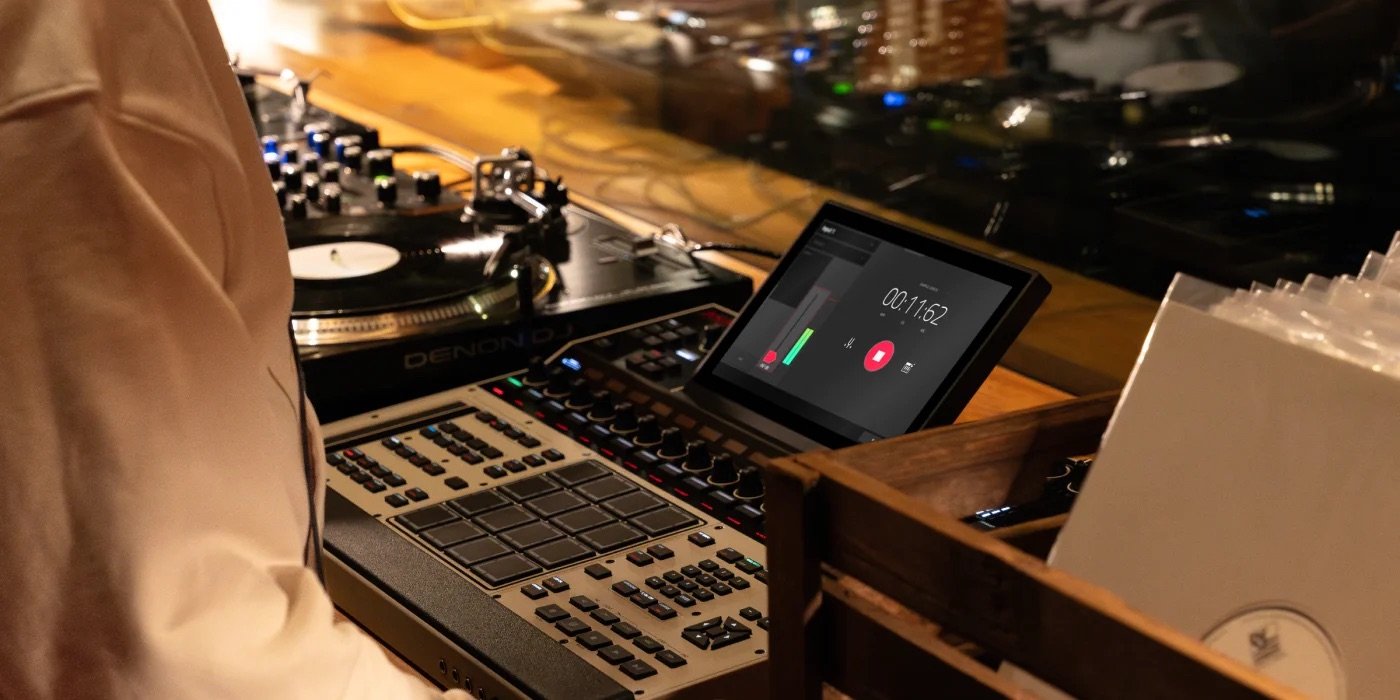
- Make noise on its own. With built-in speakers you can sketch a beat without turning on monitors. MusicRadar’s reviewer says they still miss that on the XL.
- Sample the room. The built-in condenser mic grabs a sound the moment you hear it.
- Travel. At 8.6 lb it fits a bag. The XL is furniture by comparison.
- Click its main dial. On the Live III you push the dial to confirm. Sound On Sound, MusicRadar and Audiofanzine all note that the XL’s main data dial does not click, so you confirm with a separate button.

How the MPC Live III works in my studio
I make boom bap and soulful, sample-based beats on my Live III. The rest of my studio is an Apollo Twin X and a pair of Dynaudio LYD 48 monitors. Most of what I do on it is chopping samples and programming drums on the pads. That work uses the engine, the pads and the MPC 3 screens, and those are shared with the XL.
I also don’t record vocals, so I can’t speak to either machine’s mic preamps from my own use, and I don’t own a turntable right now, so the phono comparison above comes only from the published figures. For sample-based work like mine, the reason to pay for the XL would have to be gear outside the MPC.
Is the MPC XL worth it? Who should buy it
- You run a hardware studio. Several synths, drum machines or a modular rack, each needing MIDI or CV.
- You send stems out to a console or outboard gear. Eight outs and the hotter +20.4 dBu output level suit that setup.
- You record guitar or bass often. The instrument inputs save you a DI box.
- You want everything on the surface. A big screen, 16 labeled knobs and fewer menus.
- It will never leave the desk, and you have the desk for it.
Akai’s XL page also lists two Native Instruments plugins as included, Analog Dreams and Lone Forest (MPC Editions), which its Live III page does not mention. It is a nice bonus, not a reason to spend $1,200.
Where to buyAkai MPC XL
Who should buy the MPC Live III
- You make beats mostly inside the machine. Samples, drums and a few plugins never need more than six outputs.
- You move around. Couch, tour bus, a friend’s studio or the stage.
- You perform live. It has the same Clip Matrix and pads as the XL in a box you can actually carry.
- You already own a good interface. The XL’s extra inputs and better published audio figures matter less to you.
- You would rather spend $1,200 on records, monitors or a turntable for sampling.
Where to buyAkai MPC Live III
And if you never leave the desk but the XL is too much, the $799 MPC One G2 has the same plugin and audio track limits, without MPCe pads, step buttons, battery or phono inputs. Read our One G2 vs Live III comparison or the full best Akai MPC guide.
MPC XL price vs MPC Live 3 price
On November 5, 2026, Sweetwater lists the MPC XL new at $2,899 and the MPC Live III new at $1,699, a gap of exactly $1,200. Launch prices elsewhere were £2,499 and €2,899 for the XL, and £1,399 and €1,649 for the Live III, though European street prices have dropped since.
The same day, Sweetwater had a certified open-box XL at $2,609.10, and its Gear Exchange showed used Live IIIs from $1,400. Those listings change quickly, and Black Friday may move prices too, so check before you buy.

Verdict
For most beatmakers, the MPC Live III is the better buy. You get the same engine, pads and track limits, plus a battery, speakers and a mic, for $1,200 less. It is also the machine I make my beats on, so weigh that as you read this.
The MPC XL is not a bigger, better Live III. It is a different idea: as MusicRadar puts it, “a machine worthy of building your whole workflow around”. Sound On Sound rates it highly as a studio centerpiece, and Audiofanzine gives it 9/10. If your setup has outgrown two MIDI outs and six outputs, it is the MPC built to solve that. If it hasn’t, you’d be paying for ports you don’t plug anything into.
Where to buyAkai MPC Live III
Royalty-free samplesSpliceWhichever MPC you choose, load it with royalty-free drums, loops and one-shots, licensed for commercial releases.
MPC XL vs MPC Live 3 FAQ
What is the difference between the MPC XL and MPC Live 3?
They share the same 8-core processor, MPCe pads, step buttons, touch strip, 32 plugin instruments, 16 audio tracks and 256 voices. The MPC XL adds double the RAM and storage, a 10.1-inch tilting screen, 16 Q-Links with OLED displays, 8 outputs, 4 MIDI outs and 16 CV outs. The MPC Live III adds a battery, speakers and a built-in mic.
Is the MPC XL worth it over the MPC Live 3?
Only if your MPC will stay on a desk and run other gear. It costs $1,200 more and does not raise the track limits. If you need the extra outputs, MIDI ports, CV, line and instrument inputs, or the bigger screen and knobs every day, it can earn that price. If you mostly make beats inside the machine, the Live III does the same work.
Is the MPC XL more powerful than the MPC Live 3?
It has the same processor and the same limits on plugin instruments, audio tracks and voices. The difference is 16 GB of RAM instead of 8 GB and 256 GB of storage instead of 128 GB. Akai does not publish a higher track count for the XL.
What are the MPC XL dimensions?
Akai lists the MPC XL at 21.4 × 19.2 × 3.7 inches (543 × 488 × 94 mm) and 7.2 kg (15.87 lb). Thomann lists the 488 mm figure as the width and 543 mm as the depth, so it is deeper than it is wide.
How much bigger is the MPC XL than the MPC Live 3?
The MPC Live III measures 17.2 × 10.1 × 2.6 inches and weighs 3.9 kg (8.6 lb). By those figures the XL covers about 2.4 times the desk area and weighs about 1.85 times as much.
Does the MPC XL have a battery or speakers?
No. It runs from its included 19 V power adapter and has no built-in speakers or built-in microphone. The MPC Live III has all three, with a battery Akai rates at up to 3 hours of typical use.
Which is better for sampling vinyl, the MPC XL or MPC Live 3?
Both take a turntable straight into RCA phono inputs. Akai’s published figures favor the XL: 97 dB of phono signal-to-noise against 79 dB. With either machine you can also use an external phono preamp and go into the line inputs.
Does the MPC XL have Pro Stems and clip launching?
Yes, like the MPC Live III. Both run the higher-quality stem separation in standalone mode, and both include the MPC Pro Pack with clip launching, the higher-quality time-stretch and expanded CV control.
Next step Put it to work: how to chop samples on an MPC →
Sources
- Akai Professional: MPC XL features and technical specifications
- Akai Professional: MPC Live III features and technical specifications
- Sound On Sound: Akai MPC XL review
- MusicRadar: Akai MPC XL review
- Audiofanzine: Akai MPC XL review
- Thomann: MPC XL product data (width and depth)
- Sweetwater: MPC XL (new and certified open-box prices)
- Sweetwater: MPC Live III (new and Gear Exchange prices)
US prices were seen on November 5, 2026, and change often. The audio figures are Akai’s published specifications, not independent measurements. GUIO Records is not affiliated with Akai Professional.