Technics SL-1200MK7 vs Pioneer DJ PLX-1000: Which to Buy for Scratching and Sampling?
This article contains affiliate links. If you buy through them, GUIO Records may earn a small commission at no extra cost to you. As an Amazon Associate I earn from qualifying purchases. Outside the US, Amazon links open your local Amazon store (UK, Canada, Germany, France, Italy, Spain, Netherlands, Poland or Sweden).
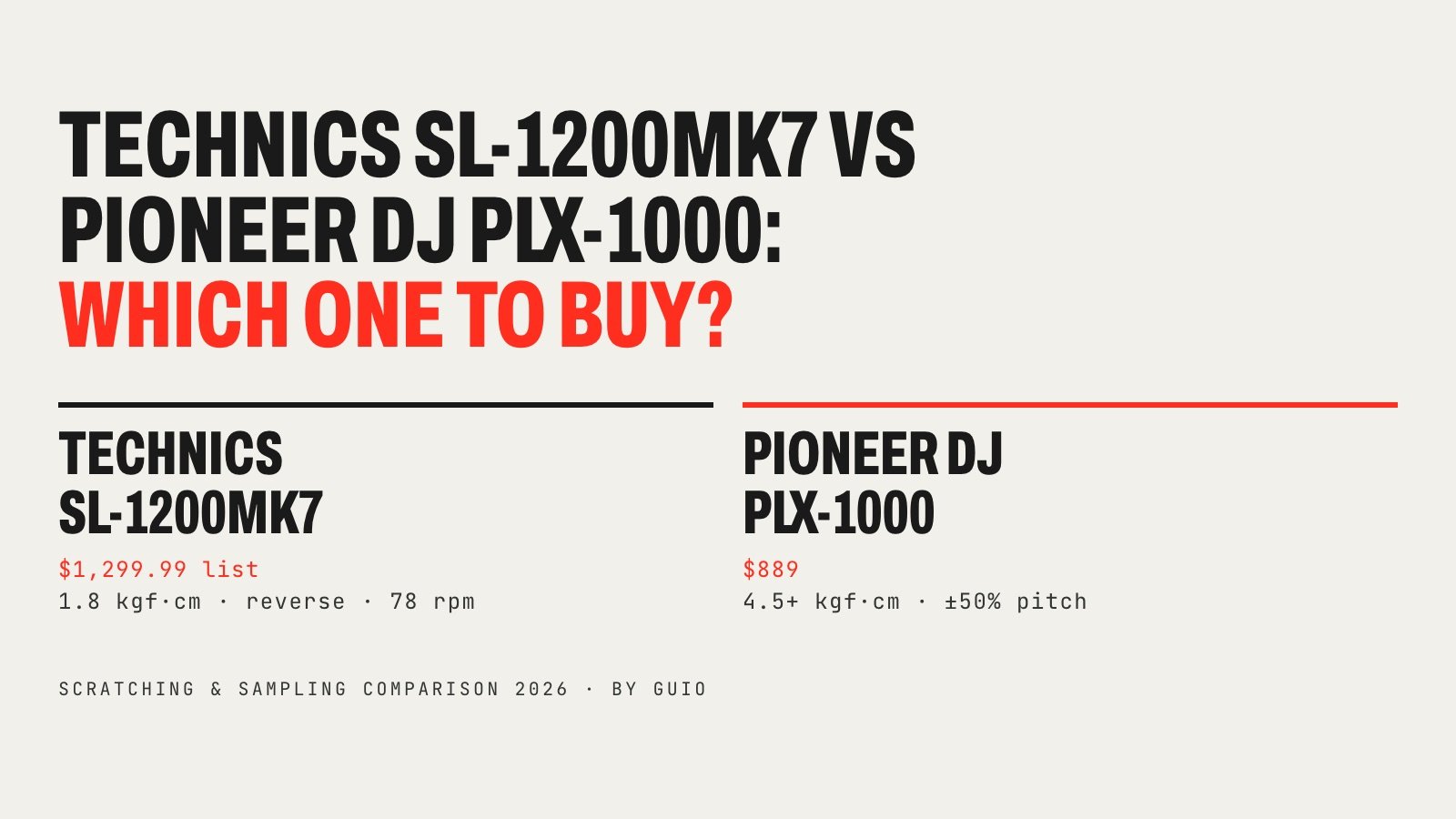
The Technics SL-1200 is the turntable hip hop was built on. The Pioneer DJ PLX-1000 is the deck that took its place in many DJ booths while Technics was gone. In 2026 both are still on sale, about $400 apart. Here is how they really differ for scratching and for sampling records into an MPC.
How this comparison was made: I am a hip hop producer and I sample every day on my MPC Live III, which takes a turntable straight into its phono inputs. I don’t own either of these decks, so this is not a hands-on test. The numbers come from Technics’ official MK7 specification sheet and Pioneer’s official PLX-1000 manual, prices from the Technics US store, Sweetwater and Amazon on October 29, 2026, and the reviews and announcements credited at the end.
PLX-1000 vs Technics 1200 MK7 specs, side by side
| Technics SL-1200MK7 | Pioneer DJ PLX-1000 | |
|---|---|---|
| Released | 2019 (announced at CES in January) | 2014 (announced July 17) |
| US price, October 2026 | $1,299.99 list ($1,297.99 at Sweetwater) | $889 |
| Motor | Coreless direct drive, digital control | Servo direct drive, 3-phase brushless DC |
| Starting torque | 1.8 kgf·cm (0.18 N·m), adjustable in 4 levels | 4.5 kgf·cm or more (fixed) |
| Start-up to 33⅓ rpm | 0.7 s | 0.3 s |
| Brake | Adjustable in 4 levels | Electronic brake (fixed) |
| Speeds | 33⅓, 45, 78 rpm | 33⅓, 45 rpm |
| Pitch ranges | ±8%, ±16% | ±8%, ±16%, ±50% + reset button |
| Reverse play | Yes | No |
| Wow and flutter | 0.025% WRMS | 0.1% or less WRMS (JIS WTD) |
| Platter | Aluminum die-cast, 332 mm | Aluminum die-cast, 332 mm |
| Tonearm | S-shaped, static balance, 230 mm effective length | S-shaped, static balance, gimbal bearing, 230 mm |
| Cartridge weight range | 5.6–12 g | 2.5–12 g |
| Cartridge included | No (headshell included) | No (headshell included) |
| Output | Phono RCA jacks + ground terminal (detachable cable) | Phono RCA jacks + ground (detachable cable, gold-plated) |
| Power cable | Detachable | Detachable |
| Dimensions (W × H × D) | 453 × 169 × 353 mm (17.8 × 6.7 × 13.9 in) | 453 × 159 × 353 mm (17.8 × 6.3 × 13.9 in) |
| Weight | 9.6 kg (21.2 lb) | 14.6 kg (32.2 lb) |
| Where to buy (paid links) | Official store → | Check price → |
Wow and flutter figures use different measuring standards (Technics WRMS, Pioneer WRMS JIS WTD), so treat that row as a guide, not a lab result.
What is the difference between the PLX-1000 and the Technics 1200?
On the deck itself, less than you would think. Both have a 332 mm aluminum die-cast platter, a 230 mm S-shaped tonearm with 15 mm of overhang, a 0–4 g counterweight, a pitch fader on the right, a strobe and a pop-up stylus light. Both have phono outputs on RCA jacks with a ground terminal, and both use detachable cables (the old MK2 had them hardwired, which is why the PLX-1000’s removable cables were a selling point in 2014). They are the same width and depth, so they fit the same cases, coffins and booth cut-outs.
The differences are in the motor and the extras:
- Torque: the PLX-1000 is rated at 4.5 kgf·cm or more and reaches speed in 0.3 seconds. The MK7 is rated at 1.8 kgf·cm and 0.7 seconds, but you can change its torque in four levels.
- Pitch: the PLX-1000 switches between ±8, ±16 and ±50% and has a reset button. The MK7 offers ±8 and ±16%.
- Reverse and 78 rpm: only the MK7 has them.
- Weight: the PLX-1000 weighs 14.6 kg; the MK7 9.6 kg. Pioneer uses a heavy zinc die-cast chassis with damping material at the base to fight vibration.
- Price: about $410 less per deck for the PLX-1000, or around $820 less for a pair.
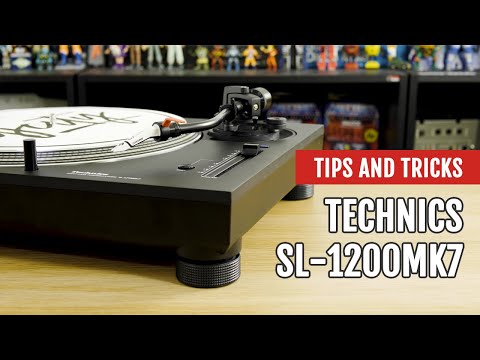
Technics SL-1200MK7: the 1200 feel, updated
Technics stopped making the SL-1200 in 2010 and brought the DJ model back with the MK7, announced at CES in January 2019. It keeps the layout DJs know by heart but uses a new coreless direct-drive motor, which removes the “cogging” of a motor with an iron core and gives smoother rotation. Technics rates its wow and flutter at 0.025% WRMS.
The MK7 also added things the classic MK2 never had: reverse play, 78 rpm, and digital motor control that lets you set the torque and the brake speed in four levels each. Out of the box the starting torque is 1.8 kgf·cm, a little firmer than the old MK2 (rated at 1.5), so it pulls and stops the way most scratch DJs learned. If you want a stronger pull, raise it.
In practice, the MK7 is the one to buy if you learned on 1200s, if you play in places where 1200s are the house decks, or if you want the turntable that hip hop history was cut on. It comes with a headshell, slipmat and dust cover, but no cartridge.
Where to buyTechnics SL-1200MK7 · $1,299.99
Not sold new on Amazon US (checked October 29, 2026), so this button goes to the official Technics store (no affiliate link). Technics showed it as sold out that day; Sweetwater listed it at $1,297.99.
Pioneer DJ PLX-1000: more torque, less money
Pioneer announced the PLX-1000 on July 17, 2014, when there was no new Technics to buy. It copied the 1200 layout on purpose and went harder on the motor: 4.5 kgf·cm or more of starting torque and 0.3 seconds to reach 33⅓ rpm. The pitch has three ranges, ±8, ±16 and ±50%, and a reset button that snaps it back to 0% without moving the fader.
The build is heavy. Pioneer uses a die-cast zinc chassis, an 8 mm resin layer and 9 mm of damping material at the base, and a rubber-insulated arm to reduce howling (feedback) in loud rooms. It weighs 14.6 kg, five kilos more than the MK7. The RCA and power cables are detachable and the RCA jacks are gold-plated.
What it does not have: no reverse, no 78 rpm, and no torque or brake adjustment. Like the MK7, it ships with a headshell and no cartridge. At $889 it has been the default “1200 alternative” for over a decade, and DJ TechTools compared the two side by side when it came out (video below).
Where to buyPioneer DJ PLX-1000

Technics 1200 MK7 torque vs PLX-1000: what you feel when you scratch
Starting torque is how hard the platter pulls back to speed after you hold, push or drag the record. More torque feels tighter: the record snaps back faster and fights your hand a bit more. Less torque feels softer and more forgiving.
On paper the PLX-1000 has well over twice the MK7’s default figure. But torque is a matter of taste, not a score. A lot of scratch DJs grew up on the lighter 1200 pull and find very high-torque decks “jumpy.” Others, especially those coming from strong-torque decks like the Reloop RP-7000 MK2, find the default 1200 too soft. The MK7’s four-level torque setting closes some of that gap; the PLX-1000 has one setting.
For scratching, three other things matter as much as the motor: a scratch cartridge with a spherical stylus and enough tracking force, a slippery slipmat (with a slipsheet or wax paper under it) and a correctly set arm height and anti-skate. A badly set-up 1200 skips more than a well set-up PLX, and the other way around.
Reverse is the other scratch difference. On the MK7 you can play a record backward, which some DJs use for tricks and to find backward phrases. The PLX-1000 can’t do it.
Which is better for sampling vinyl?
For producers, the most important fact is the same for both: they output a phono signal and have no built-in preamp. A phono signal is very quiet and needs RIAA equalization, so you have three options:
- A sampler with phono inputs. The MPC Live III (my machine) and the MPC XL have RCA phono inputs with a ground screw, so either deck plugs straight in.
- A DJ mixer. Its phono channels do the preamp work; take its booth or record output into your sampler or interface.
- A phono preamp between the deck and a line input, which you need for the MPC One G2, MPC Sample, SP-404MKII or any audio interface.
After that, the differences are small but real:
- Speed stability: the MK7’s published wow and flutter is lower (0.025% vs 0.1% or less). On a long held note or a sustained chord, speed wobble is what you hear when a loop repeats, so that is a point for the Technics.
- Pitch range: the PLX-1000’s ±50% lets you pitch a record far up or down before you sample it. The classic trick from the SP-1200 era is to sample a 33 at 45 rpm and pitch it back down in the sampler, which both decks can do with the speed button.
- 78 rpm: only the MK7 plays 78s, if you dig in old shellac.
- Feedback: if you sample in the same room as loud monitors, the heavier PLX-1000 and its damped base help. At bedroom levels it rarely matters.
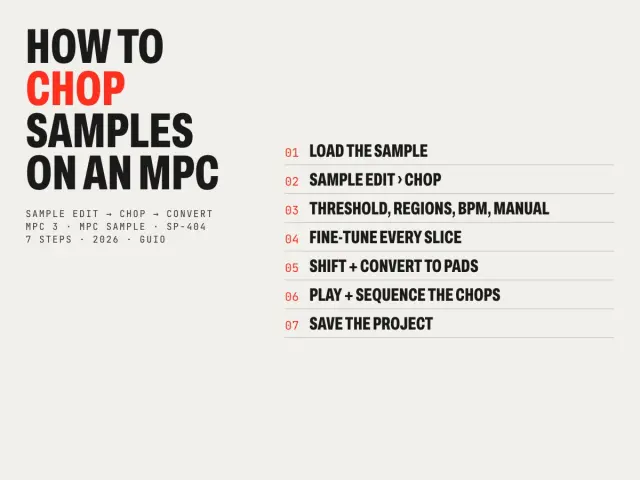
The cartridge changes your samples more than the deck. For sampling, an elliptical stylus sounds more detailed; for scratching, a spherical one stays in the groove. Many producers keep one headshell for each. The full chain, from tonearm setup to levels in the MPC, is in our how to sample vinyl guide, and the next step is chopping the sample on an MPC.
Price: Technics 1200 MK7 vs PLX-1000 in 2026
On October 29, 2026, the SL-1200MK7 lists at $1,299.99 on the Technics US store (shown as sold out that day) and $1,297.99 at Sweetwater. It is not sold new on Amazon US. The PLX-1000 is $889 at Sweetwater and is sold on Amazon. A pair costs about $2,596 for the MK7 and about $1,778 for the PLX-1000.
Neither price includes a cartridge. Add roughly $100–$200 per deck for a DJ cartridge, and a mixer or phono preamp if your sampler has no phono input.
What about the new Technics SL-1210MKX and the 55th Anniversary Edition?
Two Technics releases this fall matter if you are shopping now:
- SL-1200 55th Anniversary Edition (SL-1200M7G). Announced on August 18, 2026 and limited to 12,000 units. It is the MK7 platform (same motor, ±16% pitch, reverse) with gold details, in seven colors. Technics US lists it from $1,499.99 ($1,599.99 in gold). You pay about $200 more than a standard MK7 for the look.
- SL-1210MKX. Announced at Amsterdam Dance Event on October 21, 2026 as a new flagship above the MK7, not a replacement. It adds a ±4% range for fine tempo work and a ±50% range (the PLX-1000’s big advantage), a heavier 11.9 kg body with new insulators against feedback, a reinforced headshell connection, and the MK7’s reverse, 78 rpm and four-level torque and brake. Technics’ US store says “coming January 2027” without a price; European prices were announced at €1,499 and £1,299.
If you want Technics and can wait, the MKX closes most of the PLX-1000’s spec advantages. If you need decks now, the MK7 and the PLX-1000 are both proven choices that will not go out of date: a turntable from 2019 or 2014 plays records exactly as well today.

Who should buy the Technics SL-1200MK7
- Scratch DJs who learned on 1200s and want that exact pull and brake, now adjustable.
- DJs who play in clubs with 1200s and want the same feel at home.
- Anyone who wants reverse or 78 rpm.
- Producers who want the steadiest published speed for long, sustained samples.
Who should buy the Pioneer DJ PLX-1000
- DJs who like a strong, tight pull without changing settings.
- Anyone on a budget: about $410 saved per deck goes to a mixer, cartridges or records.
- Producers who pitch records hard before sampling, thanks to the ±50% range.
- Loud rooms, where the heavy, damped chassis helps against feedback.
If neither fits your budget, the Audio-Technica AT-LP140XP and the Reloop RP-7000 MK2 are real scratch decks for less, and the AT-LP120XUSB has a built-in preamp for line-input samplers. All of them are in our guide to the best turntable for sampling and scratching.
Verdict
The Pioneer DJ PLX-1000 is the better deal: more torque, a wider pitch range, a heavier anti-feedback build and about $410 saved per deck. For most producers who sample and DJs who scratch, it does everything a 1200 does.
The Technics SL-1200MK7 is the better turntable if you value the feel. Reverse, 78 rpm, adjustable torque and brake and the lowest published wow and flutter of the two, in the body every scratch DJ knows. If the price is fine and you want one deck for the next twenty years, buy the Technics. If you would rather put $800 a pair into records and a mixer, buy the Pioneers.
Where to buyPioneer DJ PLX-1000
PLX-1000 vs Technics 1200 MK7 FAQ
Is the PLX-1000 as good as a Technics 1200?
For most DJs and producers, yes. It copies the 1200 layout, has a 230 mm S-shaped arm, an aluminum platter of the same size and more starting torque (4.5 kgf·cm or more vs 1.8). The Technics SL-1200MK7 is smoother on paper (0.025% wow and flutter vs 0.1% or less, measured with different standards) and adds reverse, 78 rpm and adjustable torque and brake. The 1200 feel is still the reference many scratch DJs learned on.
Which has more torque, the Technics 1200 MK7 or the PLX-1000?
The PLX-1000. Pioneer rates it at 4.5 kgf·cm or more of starting torque and 0.3 seconds to reach 33⅓ rpm. Technics rates the SL-1200MK7 at 1.8 kgf·cm and 0.7 seconds, but the MK7 lets you raise or lower the torque in four levels from a switch under the platter.
Which is better for scratching, the MK7 or the PLX-1000?
Both are pro scratch decks. Choose the MK7 if you want the classic 1200 feel, reverse play and adjustable torque and brake. Choose the PLX-1000 if you like a tighter, stronger pull, want ±50% pitch and want to save about $400 per deck. For scratching, the cartridge, slipmat and arm setup matter as much as the deck.
Which is better for sampling vinyl?
Either works, and neither has a built-in phono preamp. Both output a phono signal, so you need a phono input (the MPC Live III and MPC XL have one), a DJ mixer or a phono preamp. The MK7 has lower published wow and flutter and plays 78s; the PLX-1000 has a ±50% pitch range for extreme speed changes. If your sampler has line inputs only and you never scratch, a cheaper deck with a built-in preamp makes more sense.
Does the Technics SL-1200MK7 have reverse?
Yes. Reverse play is one of the things the MK7 added over the old SL-1200MK2, along with 78 rpm and four-level torque and brake adjustment. The PLX-1000 has no reverse.
Does the PLX-1000 come with a cartridge?
No. Pioneer’s manual says the cartridge is not provided; the deck comes with a headshell. The Technics SL-1200MK7 also comes with a headshell and no cartridge. Budget for a cartridge for each deck.
What are the Pioneer PLX-1000 dimensions and weight?
The PLX-1000 measures 453 × 159 × 353 mm (17.8 × 6.3 × 13.9 inches) and weighs 14.6 kg (32.2 lb), according to Pioneer’s manual. The SL-1200MK7 has the same width and depth, is 169 mm (6.7 inches) tall and weighs 9.6 kg (21.2 lb).
Is the Technics SL-1200MK7 discontinued?
No. Technics still lists it at $1,299.99, and dealers such as Sweetwater sell it. On October 29, 2026, Technics’ own US store showed it as sold out. Technics announced the SL-1210MKX on October 21, 2026 as a new flagship above the MK7, shipping in January 2027, and the limited SL-1200 55th Anniversary Edition is built on the MK7.
What is the Technics SL-1210MKX?
A new flagship DJ turntable Technics announced at Amsterdam Dance Event on October 21, 2026. It adds a ±4% and a ±50% pitch range to the usual ±8% and ±16%, a heavier 11.9 kg body, new insulators against feedback, reverse and 78 rpm. Technics’ US store lists it as coming in January 2027; European prices were announced at €1,499 and £1,299.
Can I mix a Technics 1200 with a PLX-1000?
Yes. Both are phono-output direct-drive decks with the same platter size and a similar layout, so they work together on any DJ mixer with phono inputs. The feel is different: the PLX-1000 pulls harder by default, so set the MK7 torque higher if you want them closer.
Sources
- Technics: SL-1200MK7 specification sheet (torque, start-up, wow and flutter, dimensions, weight)
- Technics US: SL-1200MK7 (price and availability)
- Pioneer DJ / AlphaTheta: PLX-1000 operating instructions (specifications, page 18)
- Pioneer DJ: PLX-1000 (chassis, damping, cables)
- Pioneer DJ: “Born again”, PLX-1000 announcement (July 17, 2014)
- DJ TechTools: PLX-1000 details revealed (2014)
- MusicRadar: the SL-1200MK7 announced at CES 2019
- What Hi-Fi: Technics SL-1200/SL-1210 MK7 review
- Technics: SL-1200 55th Anniversary Edition announcement (August 18, 2026)
- Technics US: SL-1210MKX (features, “coming January 2027”)
- Technics press release: SL-1210MKX (October 2026)
- MusicTech: Technics introduces the SL-1210MKX
- Sweetwater: SL-1200MK7 and PLX-1000 US prices
Prices are US prices seen on October 29, 2026; they change often. GUIO Records is not affiliated with Technics, Panasonic, Pioneer DJ or AlphaTheta.