Apollo Twin X vs RME Babyface Pro FS: Which Should You Buy?
This article contains affiliate links. If you buy through them, GUIO Records may earn a small commission at no extra cost to you. As an Amazon Associate I earn from qualifying purchases. Outside the US, Amazon links open your local Amazon store (UK, Canada, Germany, France, Italy, Spain, Netherlands, Poland or Sweden).
They cost the same $999 and they both sit on producers’ desks, but they are built on opposite ideas. The Apollo Twin X puts DSP inside the box so you can record and monitor through classic-hardware plugins. The RME Babyface Pro FS puts its effort into drivers, routing and flexibility. Here is which one fits how you work.

Where to buyUniversal Audio Apollo Twin X DUO Gen 2
Where to buyRME Babyface Pro FS
How this comparison was made: I produce and mix with an Apollo Twin X, next to my MPC Live III and Dynaudio LYD 48 monitors, so that side comes from daily use. I have not owned a Babyface Pro FS. Every spec on both sides comes from the official hardware manuals (Apollo Twin X Gen 2, pages 30–32; Babyface Pro FS, chapters 27 and 28), cross-checked with Sound On Sound and the retailers credited at the end. Prices were checked at B&H on November 12, 2026.
Apollo Twin X vs Babyface Pro FS: side by side
| Universal Audio Apollo Twin X DUO Gen 2 | RME Babyface Pro FS | |
|---|---|---|
| US price (B&H, Nov 12, 2026) | $999 (DUO, Analog Classics bundle) · $1,399 (QUAD) | $999 |
| On sale since | October 2024 (Gen 2) | Late 2019 |
| Connection | Thunderbolt 3 (some newer units ship with a Thunderbolt 4 controller) | USB 2.0 · class compliant |
| Power | External 12 V supply only | USB bus power or optional 12 V supply |
| Channels (analog + digital) | 10 in × 6 out | 12 in × 12 out |
| Analog inputs you can record at once | 2 (mic or line on each channel; Hi-Z on channel 1) | 4 (2 mic/line XLR + 2 line/instrument jacks) |
| Mic preamp gain | +10 to +65 dB (Unison) | −11 to +65 dB (76 dB range, 1 dB steps) |
| Analog outputs | Monitor L/R + line 3–4 + 1 headphone | XLR 1–2 + 2 headphone jacks (one stereo pair) |
| Digital I/O | Optical in only (8 ch ADAT or S/PDIF) | Optical in and out (8 ch ADAT or S/PDIF) |
| MIDI | No | 1 in / 1 out (breakout cable) |
| Onboard processing | UAD DSP: 2 chips (DUO) or 4 (QUAD) for UAD plugins and Unison preamps | TotalMix FX: EQ, low cut, reverb and echo in hardware |
| Monitor tools | Talkback mic, dim, mono, alt speakers, Sonarworks monitor correction* | TotalMix FX mixer, dim, talkback via key commands |
| Monitor / line out dynamic range | 129 dB (A) monitor · 127 dB (A) line | 118 dBA (line out) |
| Mic input | 123 dB (A) dynamic range | 117 dBA SNR |
| Headphone power | 69 mW into 300 Ω | 60 mW (¼") · 90 mW (3.5 mm), at 0.1% THD |
| Works without a computer | No | Yes (stand-alone mode) |
| iPad | No | Yes (class compliant) |
| Size / weight | 160 × 66 × 150 mm · 1.04 kg | 108 × 35 × 181 mm · 680 g |
| Where to buy (paid links) | Check price → | Check price → |
*Apollo Monitor Correction needs Sonarworks SoundID Reference software and a measurement mic. Dynamic range figures are each maker’s own measurements with different methods, so compare them as a rough guide, not to the decibel.
What they have in common
On paper they look alike: two mic preamps with phantom power that reach +65 dB of gain, an instrument input, an optical input for eight more channels from an ADAT preamp, 24-bit recording up to 192 kHz and a desktop mixer app that gives you near-zero-latency monitoring. Both are small enough to live next to a laptop and a drum machine. Both are serious, pro-level interfaces: at this price there is no bad choice, only one that fits your setup better.
The differences are in what each company decided to spend your $999 on.
Apollo Twin X: record and mix through classic gear
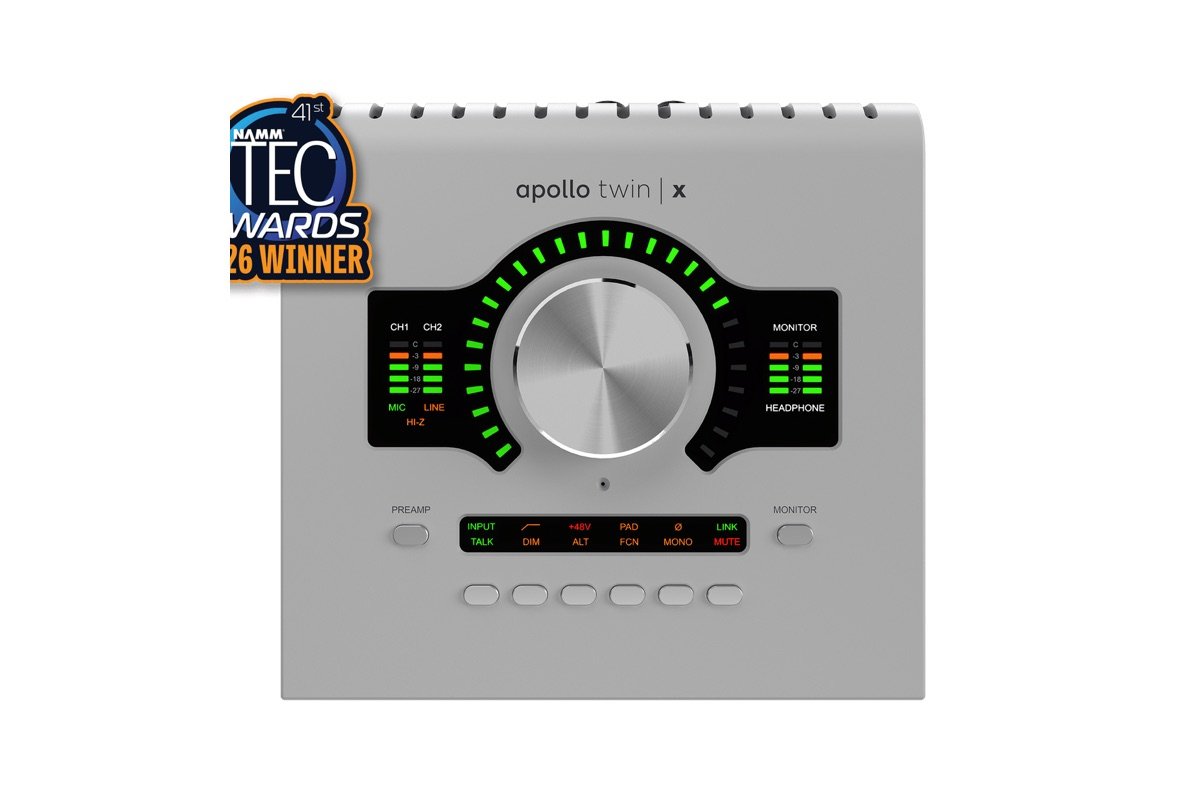
The Apollo’s reason to exist is UAD DSP. The DUO version has two SHARC chips and the QUAD has four. They run UAD plugins inside the interface, so you can track a vocal or a synth through an 1176 or LA-2A and hear the result while you play, without loading your computer. The two Unison preamps go further: load a Neve, API or SSL preamp plugin and the hardware changes its impedance and gain behavior to match. UA’s manual quotes 1.1 ms of analog round-trip latency at 96 kHz, even with four plugins running in UAD Console.
The Gen 2 version, launched in October 2024, added better converters (UA quotes 129 dB of dynamic range on the monitor outputs and −120 dB THD+N), Auto-Gain for the Unison preamps, a built-in talkback mic and support for Apollo Monitor Correction by Sonarworks, which corrects your speakers and headphones from inside the interface. Sound On Sound called the Sonarworks integration probably the deepest it had seen, and its main complaints were small: no Thunderbolt cable in the box and an Auto-Gain that is not fully foolproof.
The limits are just as clear. It needs Thunderbolt and an external power supply, it has no MIDI, the optical port is input only, and although there are mic and line jacks on the back, it records two analog channels at a time. Its single headphone output gives 69 mW into 300 Ω; Sound On Sound noted that a session drummer wanted more volume.
On my desk it is the interface I produce and mix through, with the MPC Live III and the LYD 48 monitors. I am not a vocalist and I do not record vocals with it, so the vocal-tracking points here come from UA’s documentation and the reviews credited below, not from my sessions.
Pick it if: you want UAD plugins and Unison preamps while you record, you mix on speakers and want monitor control in one box, and two inputs at a time is enough.
Where to buyUniversal Audio Apollo Twin X DUO Gen 2

RME Babyface Pro FS: the flexible workhorse
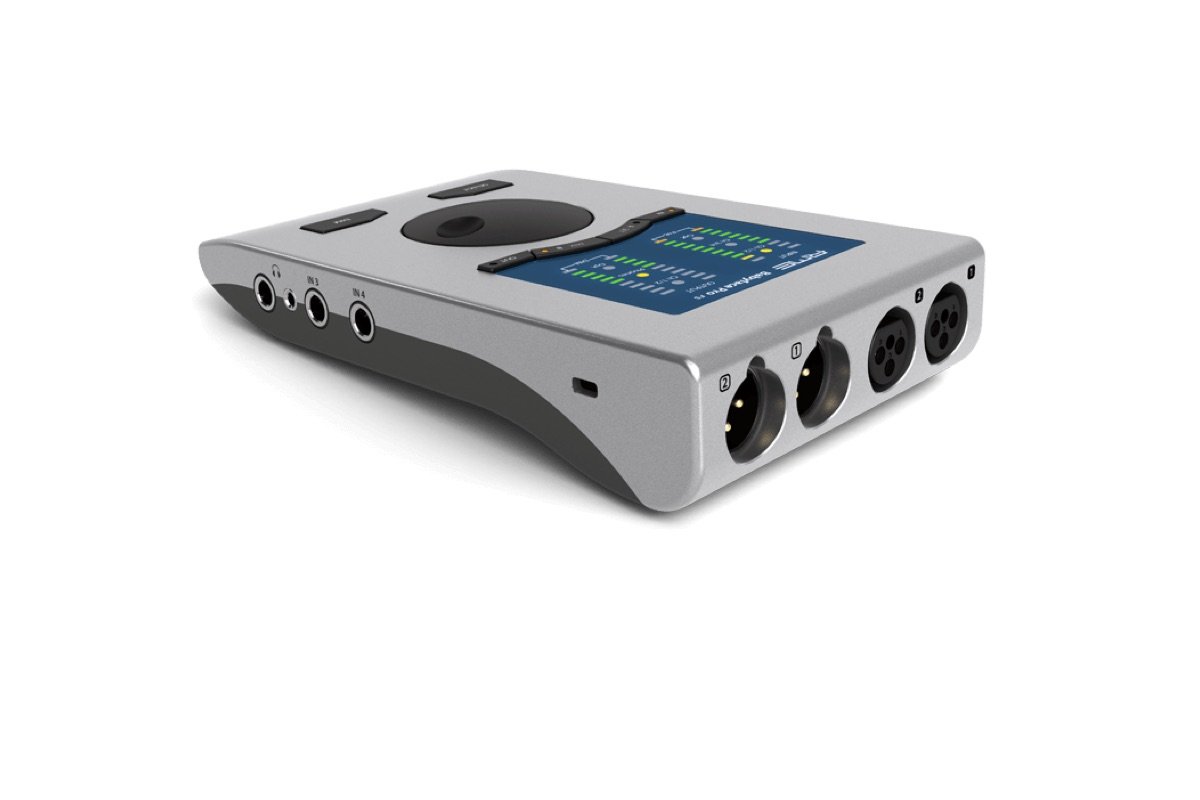
RME’s reputation rests on drivers that stay stable and low-latency year after year, and on TotalMix FX, a 288-channel hardware mixer that can send any input to any output with its own EQ, low cut, reverb and echo. In May 2026 RME released TotalMix FX 2.0 for all its interfaces, with a scalable interface, undo and redo, and a light theme (Sound On Sound). Version 1.991 stays available for older computers.
The FS version, from late 2019, brought RME’s SteadyClock FS clock and new converters with very little delay: 5 samples on the way in and 7 on the way out, about 0.12 ms combined at 96 kHz. On the hardware side it gives you more to plug in: four analog inputs you can record at once (two XLR mic/line, two ¼" line or instrument), balanced XLR outputs, two headphone jacks (one for high-impedance and one for low-impedance headphones, sharing the same mix), ADAT in and out and a MIDI in and out.
It also travels better. It weighs 680 g, runs on USB bus power, works class compliant with an iPad and even runs without a computer as a stand-alone preamp and converter. What it does not have is plugins: TotalMix FX effects help you monitor comfortably, but they will not make a vocal sound like it went through vintage hardware. Its published output specs (118 dBA) are lower than the Gen 2 Apollo’s, though both are far quieter than any home room.
Pick it if: you record more than two sources at once, need MIDI, work on Windows or an iPad without Thunderbolt, move between studios or want the most routing for the money.
Where to buyRME Babyface Pro FS

Latency: which is faster?
For monitoring while you record, both feel instant. The Apollo’s published 1.1 ms round trip at 96 kHz includes running UAD plugins in the path. The Babyface’s converters add about 0.12 ms at 96 kHz, and TotalMix adds about 3 samples, but it has no plugins in that path, so the numbers are not measuring the same thing. When you monitor through plugins in your DAW instead, latency depends on the buffer size and your computer more than on the box. Sound On Sound found the Apollo’s Thunderbolt low-latency performance good, and RME’s USB drivers are the reason many engineers buy it.
Which is better for hip hop producers?
- Beatmaking with an MPC or sampler: the Babyface Pro FS, by a little. You can record the MPC’s stereo out into the line inputs and still have both mic inputs free. On the Apollo the MPC takes both analog channels. If the MPC is your only source, either works, and a Live III can also stream audio over USB.
- Mixing beats on speakers: the Apollo Twin X. The quieter monitor path, monitor controls and Sonarworks correction are made for this.
- Recording rap vocals: the Apollo if you want to track through a preamp and compressor model and hear a finished-sounding vocal; the Babyface if you prefer a clean signal and doing everything in the mix. See how to record rap vocals at home.
- Sampling vinyl: both work through a phono preamp or DJ mixer into the line inputs. Neither has a phono input. Read how to sample vinyl.
- Laptop on the go: the Babyface Pro FS. USB bus power, 680 g and no Thunderbolt requirement.

Apollo Twin X vs Apollo Solo
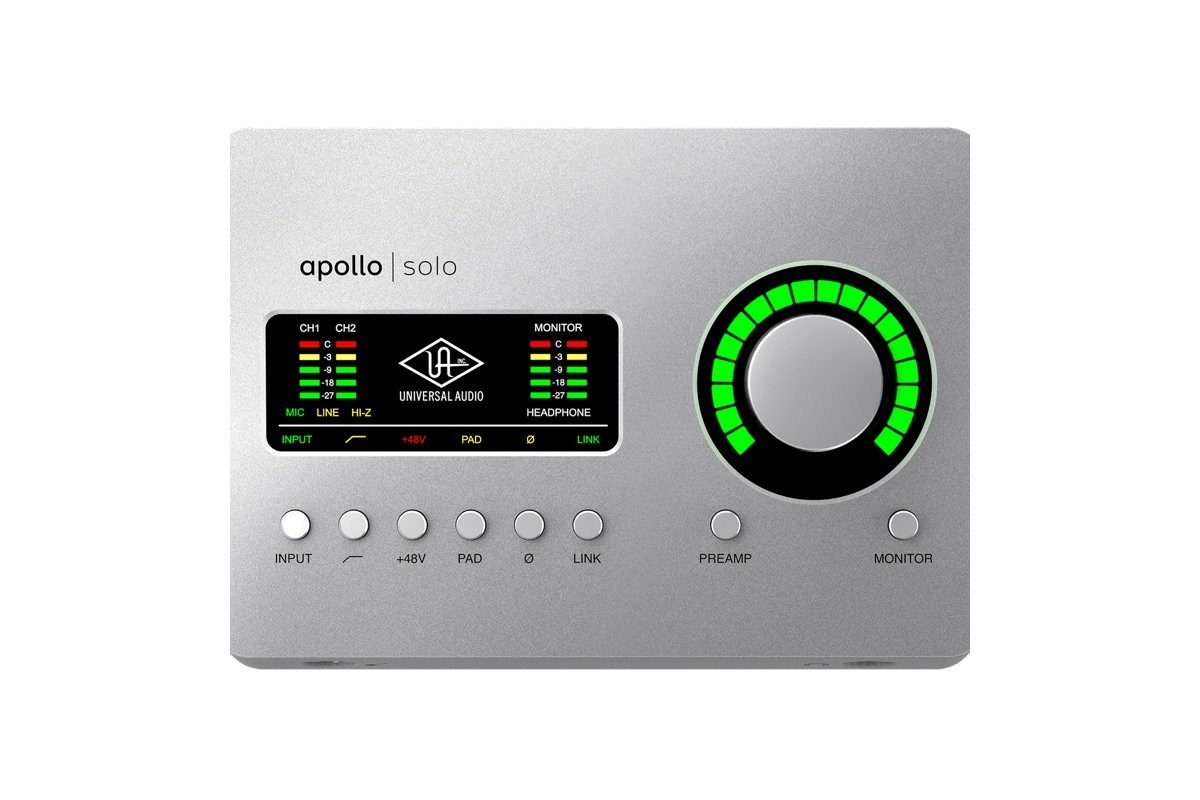
The Apollo Solo is the cheaper way into the same UAD workflow: two Unison preamps, one SOLO DSP chip, 2 inputs and 4 outputs, and USB bus power on the Thunderbolt version. It was about $595 (USB) to $690 (Thunderbolt) at B&H on November 12, 2026. The Twin X adds the Gen 2 converters, two or four DSP chips (so more plugins at once), line outputs 3–4, an optical input for eight more channels and the talkback mic. If you will mostly mix and only track one or two things through plugins, the Solo covers a lot of it.
Where to buyUniversal Audio Apollo Solo
Apollo Twin X vs Scarlett 2i2
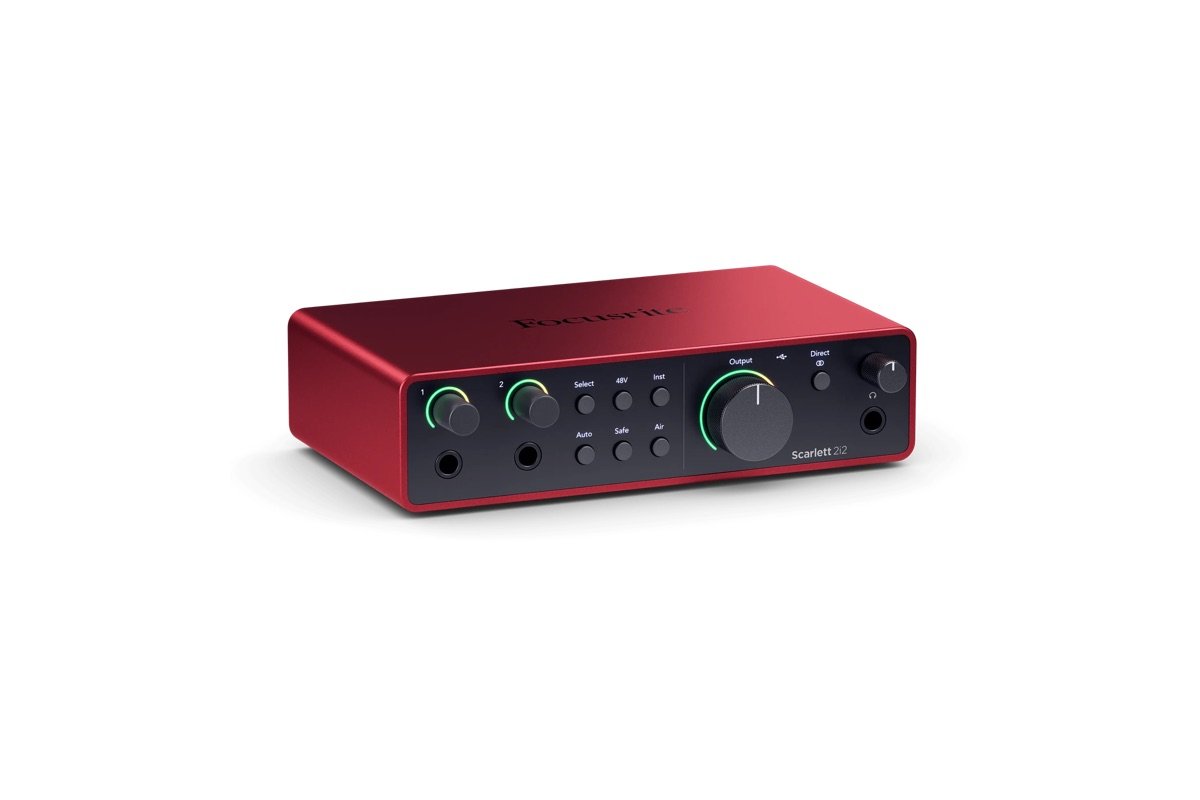
The Focusrite Scarlett 2i2 4th Gen ($224.99 at B&H on November 12, 2026) also records two channels at once and has more preamp gain on paper (69 dB), Auto Gain and Clip Safe. What it lacks is everything the Apollo’s extra money buys: DSP plugins, Unison preamps, an optical input, extra line outputs and monitor controls. For a first interface, the 2i2 is the sensible buy. Move to an Apollo or a Babyface when you know exactly which of those features you will use.
Where to buyFocusrite Scarlett 2i2 4th Gen
Comparing more options, from $139 up? Read our guide to the best audio interface for recording vocals at home. Choosing speakers to go with it? See the best studio monitors for a home studio and the best headphones for music production. Then put it to work in how to mix boom bap drums.

Verdict
If you want your interface to be part of your sound, get the Apollo Twin X. Recording and monitoring through UAD plugins and Unison preamps, with a quiet monitor path and monitor controls for mixing, is something the Babyface cannot do. It is the interface I make beats and mix through, and for a producer working at one desk with a Thunderbolt computer it is a great fit.
If you want your interface to stay out of the way and adapt to anything, get the RME Babyface Pro FS. Four inputs at once, MIDI, ADAT out, bus power, iPad and stand-alone use, and drivers known for stability make it the better tool for multi-source sessions, travel and setups without Thunderbolt.
Where to buyUniversal Audio Apollo Twin X DUO Gen 2
Apollo Twin X vs Babyface Pro FS FAQ
Is the Apollo Twin X worth it?
Yes, if you want to record or monitor through UAD plugins in real time. Its DSP runs Unison preamp models and plugins like the 1176 and LA-2A with 1.1 ms of analog round-trip latency at 96 kHz, according to UA. If you never plan to use UAD plugins, you are paying for DSP you will not use, and a Babyface Pro FS or a cheaper interface makes more sense.
Is the RME Babyface Pro FS better than the Apollo Twin X?
It depends on the job. The Babyface Pro FS has more inputs you can record at once (4 analog vs 2), MIDI, ADAT out, USB bus power, iPad support and a stand-alone mode. The Apollo Twin X Gen 2 has better published converter specs, real-time UAD plugins, Unison preamps, a talkback mic and built-in monitor correction support.
What is the difference between the Apollo Twin X and the Apollo Solo?
The Twin X has better converters, two DSP chips (DUO) or four (QUAD) instead of one, line outputs 3–4, an optical input and a talkback mic. The Apollo Solo is a 2-in, 4-out, bus-powered interface with one DSP chip, two Unison preamps and the same UAD workflow for less money.
Is the Apollo Twin X better than a Scarlett 2i2?
It is a different class. Both record two channels at once, but the Twin X adds UAD DSP and Unison preamps, an optical input for eight more channels, extra line outputs, monitor controls and better published specs. The Scarlett 2i2 4th Gen costs about a quarter of the price and is enough for many home studios.
Does the Apollo Twin X work with Windows?
The Thunderbolt Apollo Twin X works on Mac and on Windows PCs with Thunderbolt. Units with the newer Thunderbolt 4 controller need an Apple silicon Mac, an Intel Mac on macOS Sequoia 15 or later, or a Windows PC with a Thunderbolt 4 port. For PCs without Thunderbolt, UA sells the Apollo Twin X USB, which is Windows only.
Does the RME Babyface Pro FS work with an iPad?
Yes. In class compliant mode it works with an iPad without drivers, and it can be powered from the USB bus or an external supply. TotalMix FX effects are not available in that mode.
Does the Babyface Pro FS have low latency?
Yes. RME quotes 5 samples for the A/D and 7 samples for the D/A, about 0.12 ms combined at 96 kHz, and direct monitoring through TotalMix adds about 3 samples. Latency while running plugins in your DAW depends on the buffer size and your computer.
Can I use either interface with an MPC?
Yes. Connect the MPC’s main outputs to the interface’s line inputs to record it into your DAW. With the Babyface Pro FS you still have both mic inputs free; on the Apollo Twin X the MPC uses both of its analog input channels. Recent MPCs like the Live III can also send audio over USB on their own.
Next step Put the gear to work: how to make boom bap beats on an MPC →
Sources
- Universal Audio: Apollo Twin X Gen 2 hardware manual (specifications)
- Universal Audio: Apollo Twin X (features, FAQ, Thunderbolt 4 note)
- Sound On Sound: Universal Audio Apollo X Gen 2 review
- RME: Babyface Pro FS user’s guide (technical specifications, latency)
- RME: Babyface Pro FS
- Sound On Sound: RME TotalMix FX 2 now available
- RME: TotalMix FX 2.0 overview
- Production Expert: RME announces the Babyface Pro FS (November 2019)
- B&H: Apollo Twin X DUO Gen 2
Prices were checked at B&H on November 12, 2026, two weeks before Black Friday, and change often. GUIO Records is not affiliated with Universal Audio or RME.