A Tribe Called Quest “The Low End Theory” at 35: Samples, Producers, Tracklist & Meaning
This article contains affiliate links. If you buy through them, GUIO Records may earn a small commission at no extra cost to you. As an Amazon Associate I earn from qualifying purchases. Outside the US, Amazon links open your local Amazon store (UK, Canada, Germany, France, Italy, Spain, Netherlands, Poland or Sweden).
Released on September 24, 1991, A Tribe Called Quest’s second album cut hip hop down to vocals, drums and bass, and filled the space with jazz. Thirty-five years later, here is how it was made and what it sampled.
Own the recordThe Low End TheoryA Tribe Called Quest
Thirty-five years ago, on September 24, 1991, A Tribe Called Quest released The Low End Theory on Jive Records. Q-Tip, Phife Dawg and Ali Shaheed Muhammad stripped hip hop down to three things: vocals, drums and bass. Then they filled the space with jazz.
The result is 14 songs and 48 minutes with no filler, an upright bass from one of the most recorded jazz bassists in history, and a closing posse cut that made Busta Rhymes a star. It changed how producers think about the low end, and it still sounds better than most records made today.
Short answer: why The Low End Theory matters
The Low End Theory is the album that proved jazz and hip hop speak the same language. Instead of one loop on repeat, Q-Tip and Ali built each beat from several records at once: a bass line from one, drums from two others, a horn from a fourth. Mixing engineer Bob Power cleaned every piece so the bass could sit loud and round under the drums. Dr. Dre cited it as an inspiration for The Chronic, Kanye West has called it the first album he ever bought, and in 2022 the Library of Congress added it to the National Recording Registry.
Why is it called The Low End Theory?
The title has two meanings. The first is musical: the low end is the bass, and the whole album is built around it, from Ron Carter’s upright on “Verses from the Abstract” to the deep, round kicks that open “Buggin’ Out”. The second is social. Q-Tip has explained that the album was also about Black people being on the low end of the totem pole in American society, a thread you can hear on “Rap Promoter”, “Show Business” and “Everything Is Fair”.
Q-Tip also said that the bass and drive of N.W.A’s Straight Outta Compton pushed him toward a heavier bottom end. So the record that sounds like a jazz club was partly inspired by Compton.

How The Low End Theory was made
Tribe recorded the album between 1990 and 1991, mostly at Battery Studios in Manhattan, with extra sessions at Greene St. and Soundtrack in New York. The group was in a tough spot. Phife had been diagnosed with diabetes after the first album and thought about quitting; he and Q-Tip agreed he would take a much bigger role this time. Jarobi White recorded verses but left during the sessions to study culinary arts, and none of his parts made the final album. Off the mic, the group fired its manager, Kool DJ Red Alert, signed with Russell Simmons’ Rush Artist Management, and spent more than a year negotiating with Jive. That frustration with the business ended up on the record.
Some details from the sessions:
- “Butter” was meant to have a Q-Tip verse, but Phife insisted on rapping it alone. It became his solo showcase, with Q-Tip on the hook, and the moment many fans point to as Phife’s breakout.
- “Show Business” was first recorded as “Georgie Porgie”. Jive rejected that version as homophobic, and it was rewritten into a song about the music industry with Diamond D, Lord Jamar and Sadat X.
- “Jazz (We’ve Got)” started as a beat by Pete Rock. Q-Tip recreated it and thanked him in the outro.
- “Scenario” went through several versions. One included Posdnous of De La Soul and Jarobi; the final one features Leaders of the New School, with Busta Rhymes’ closing verse launching his solo career. Thirty-four years later Busta is still connected to the Tribe family: his 2026 album with J Dilla’s beats is reviewed in DILLAGENCE II.
- Q-Tip had a cold during the vocal sessions and wanted to redo his parts. The rest of the team convinced him he sounded fine.
Who produced The Low End Theory?
A Tribe Called Quest produced the album themselves, with Q-Tip as the main producer and Ali Shaheed Muhammad on co-production and scratches. Bob Power, who said he never remembered which ideas came from whom, called it “a very communal effort” and described Ali as the second cornerstone of the band. The only outside producer credit is Skeff Anselm, who programmed his two tracks at Jazzy Jay’s studio in the Bronx.
| Track | Produced by | Guests and notes |
|---|---|---|
| Excursions | A Tribe Called Quest | — |
| Buggin’ Out | A Tribe Called Quest | — |
| Rap Promoter | A Tribe Called Quest | — |
| Butter | A Tribe Called Quest | Phife Dawg raps alone; Q-Tip sings the hook |
| Verses from the Abstract | A Tribe Called Quest | Ron Carter on upright bass, Vinia Mojica on vocals |
| Show Business | Skeff Anselm with A Tribe Called Quest | Diamond D, Lord Jamar, Sadat X |
| Vibes and Stuff | A Tribe Called Quest | — |
| The Infamous Date Rape | A Tribe Called Quest | — |
| Check the Rhime | A Tribe Called Quest | First single (September 1991) |
| Everything Is Fair | Skeff Anselm with A Tribe Called Quest | — |
| Jazz (We’ve Got) | A Tribe Called Quest (original beat by Pete Rock) | Q-Tip shouts out Pete Rock in the outro |
| Skypager | A Tribe Called Quest | — |
| What? | A Tribe Called Quest | — |
| Scenario | A Tribe Called Quest | Leaders of the New School; Busta Rhymes’ breakout verse |
Credits from the album liner notes as listed on Wikipedia and Discogs.
Ron Carter on “Verses from the Abstract”
For one song, Tribe stopped sampling bass and hired the real thing. Ron Carter, the bassist of Miles Davis’ second great quintet and one of the most recorded bassists in jazz, plays upright on “Verses from the Abstract”. Q-Tip explained they wanted a pure, straight bass sound and went to the best. Bob Power said he mixed the live parts the same way as the samples: the goal was to make them fit the record. It is the clearest statement of the album’s idea: hip hop was not borrowing from jazz, it was continuing it.
Producer’s corner: how Tribe got that low end
This is the part that still matters if you make beats. Most hip hop in 1991 rode a single loop. Bob Power said that Q-Tip and Ali built their beats from many sources at once, and that changed the job in the studio:
- The machines. In a 2009 interview, Q-Tip said he started using the E-mu SP-1200 together with an Akai S950 on this album: the SP for drums, the S950 for loops. Sampling time was tiny. Power remembered having somewhere between three-quarters of a second and a second and a half, so long phrases were sampled in two halves.
- Layered drums. “Buggin’ Out” was the first song where Q-Tip stacked two different drum breaks at the same time. Power added that they doubled kicks and snares with harder sounds for punch, sometimes up to three layers.
- Clean samples, room for the bass. There was no software to remove crackle in 1991, so Power filtered and cleaned each sample by hand, isolating a bass line or a Rhodes part from the rest of the record. On “Excursions”, only the acoustic bass of Art Blakey’s “A Chant for Bu” is used.
- Space and a narrow mix. Power avoided big reverbs because they “wash things out”, kept the stereo image narrow for punch, and thought about every bass choice in relation to the kick. Even with three snares, the album never feels crowded.
How to try it today: on an MPC you can put two breaks on separate pads or tracks and nudge one until the grooves lock, high-pass the loop so the bass has the bottom to itself, and keep reverb off the drums. I produce on an Akai MPC Live III, and that layering trick is the first thing I reach for when a break feels thin. If you are choosing a machine, start with our best Akai MPC guide or the MPC Sample vs SP-404 MKII vs EP-133 comparison, and learn the first step in how to sample vinyl.
The Low End Theory samples: the jazz behind every beat
WhoSampled lists well over a hundred connections for the album once you count drum breaks, vocal snippets and the songs that later sampled it. These are the key records behind each track, from hard bop and soul jazz to Average White Band and Jimi Hendrix:
| Track | Sampled from |
|---|---|
| Excursions | Art Blakey & the Jazz Messengers – “A Chant for Bu” (1973) · The Last Poets – “Time Is Running Out” (1971) |
| Buggin’ Out | Jack DeJohnette’s Directions – “Minya’s the Mooch” (1977) · Lonnie Smith – “Spinning Wheel” (1970) |
| Rap Promoter | The New Birth – “Keep On Doin’ It” (1973) |
| Butter | Gary Bartz – “Gentle Smiles (Saxy)” (1975) · Weather Report – “Young and Fine” (1978) |
| Verses from the Abstract | Heatwave – “The Star of a Story” (1977) · Joe Farrell – “Upon This Rock” (1974) |
| Show Business | Ferrante & Teicher – “Midnight Cowboy” (1969) · The Fatback Band – “Wicki Wacky” (1974) |
| Vibes and Stuff | Grant Green – “Down Here on the Ground” (1970) |
| The Infamous Date Rape | Cannonball Adderley – “The Steam Drill” (1972) |
| Check the Rhime | Average White Band – “Love Your Life” (1976) · Minnie Riperton – “Baby, This Love I Have” (1975) · Grover Washington, Jr. – “Hydra” (1975) |
| Everything Is Fair | Funkadelic – “Let’s Take It to the People” (1976) · Willis Jackson – “Ain’t No Sunshine” (1972) |
| Jazz (We’ve Got) | Jimmy McGriff – “Green Dolphin Street” (1972) · Five Stairsteps – “Don’t Change Your Love” (1968) |
| Skypager | Sly & the Family Stone – “Advice” (1967) · Eric Dolphy – “17 West” (1960) |
| What? | Paul Humphrey – “Uncle Willie’s Dream” (1974) |
| Scenario | Brother Jack McDuff – “Oblighetto” (1970) · Jimi Hendrix – “Little Miss Lover” (1967) |
Key samples per track, based on WhoSampled (checked October 24, 2026). Most tracks use more sources than listed here.
Look at the years: almost everything comes from 1967–1978, and a lot of it from jazz labels like Blue Note, CTI and Prestige. Grant Green, Lonnie Smith, Jimmy McGriff and Cannonball Adderley were a long way from the James Brown breaks most producers used at the time, and this album sent a generation of crate diggers looking for them.
Songs that sampled The Low End Theory
| Low End Theory track | Used in |
|---|---|
| Scenario | Nicki Minaj feat. Eminem – “Roman’s Revenge” (2010) |
| Rap Promoter | JAY-Z – “Encore” (2003) |
| Vibes and Stuff | DJ Shadow – “Midnight in a Perfect World” (1996) |
| Verses from the Abstract | Jay Dee – “Let’s Take It Back” (2003) |
| What? | A Tribe Called Quest – “1nce Again” (1996) |
| Buggin’ Out | Saigon feat. Swizz Beatz – “Come on Baby” (2007) |
| Skypager | U2 – “Daddy’s Gonna Pay for Your Crashed Car” (1993) |
Highlights
- “Excursions”: one bass line, a few drums and Q-Tip remembering his father’s jazz records. The perfect opening statement.
- “Buggin’ Out”: Phife’s shout, two drum breaks stacked into one and a bass line that walks. Pure rhythm.
- “Butter”: Phife’s solo spotlight, smooth and funny over Gary Bartz.
- “Check the Rhime”: Average White Band horns and the best back-and-forth between Q-Tip and Phife on record, plus a famous warning about shady record company people.
- “Scenario”: the posse cut every posse cut is measured against. Busta Rhymes’ last verse is still one of the most quoted moments in rap.
The Low End Theory album cover: who made it?
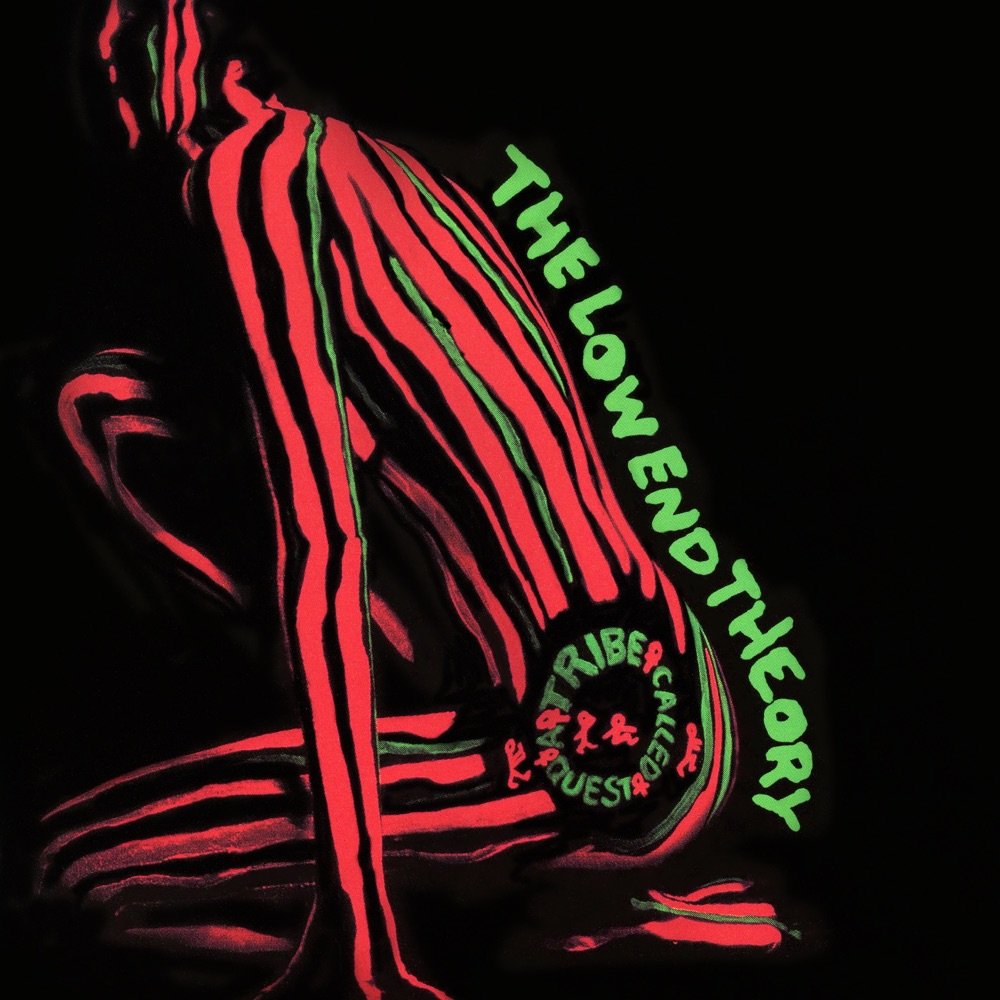
The cover is an altered photograph of a kneeling woman, body-painted in Afrocentric red, black and green. The photo is by Joe Grant and the design is credited to Zombart JK. It became one of the most recognizable images in hip hop: Complex ranked it No. 1 on its list of the 50 greatest hip hop album covers.
Why does The Low End Theory sound so quiet?
Because it was mastered in 1991, years before the “loudness war” pushed albums to be as loud as possible. Next to a modern master it plays at a lower level and keeps more dynamic range, which is why the bass and the kicks still breathe. Turn it up: it was made to be played loud on a good system. On vinyl it sounds especially warm, which is why it sits in our list of the best hip hop vinyl records to own.
Reception and legacy
The Source gave it five mics on release and wrote that there was no sophomore jinx. It debuted and peaked at No. 45 on the Billboard 200, went gold in February 1992 and platinum on February 1, 1995. Later it climbed every list: No. 154 in Rolling Stone’s 500 Greatest Albums in 2003 and 2012, No. 43 in 2020, No. 56 in Pitchfork’s top albums of the 1990s and No. 29 in Apple Music’s 100 Best Albums (2024).
Its influence runs through Dr. Dre’s The Chronic, Nas, Common, D’Angelo, Kanye West and Kendrick Lamar. A few years later Q-Tip and Ali formed The Ummah with a young Detroit producer named Jay Dee, the future J Dilla; read his story in our J Dilla Donuts review. In Los Angeles, Low End Theory (2006–2018), the weekly club night at the heart of the city’s beat scene, took its name from this album.
Bob Power, the engineer who gave the record its sound, died in March 2026 at 73. Phife Dawg died in 2016, months before Tribe released their final album, We Got It from Here… Thank You 4 Your Service, which went to No. 1.
What to hear next
If The Low End Theory is your entry point, the next stop is Midnight Marauders (1993). Bob Power said the group wanted a grittier sound on that one and told him not to worry about cleaning the samples, so the two albums make a great lesson in contrast.
Own the recordMidnight MaraudersA Tribe Called Quest
The Low End Theory tracklist
| # | Track | Length |
|---|---|---|
| 01 | Excursions | 3:55 |
| 02 | Buggin’ Out | 3:37 |
| 03 | Rap Promoter | 2:13 |
| 04 | Butter | 3:39 |
| 05 | Verses from the Abstract (feat. Vinia Mojica & Ron Carter) | 3:59 |
| 06 | Show Business (feat. Diamond D, Lord Jamar & Sadat X) | 3:53 |
| 07 | Vibes and Stuff | 4:18 |
| 08 | The Infamous Date Rape | 2:54 |
| 09 | Check the Rhime | 3:37 |
| 10 | Everything Is Fair | 2:58 |
| 11 | Jazz (We’ve Got) | 4:10 |
| 12 | Skypager | 2:12 |
| 13 | What? | 2:29 |
| 14 | Scenario (feat. Leaders of the New School: Busta Rhymes, Charlie Brown & Dinco D) | 4:10 |
Listen to The Low End Theory
Spotify
Apple Music
Own the recordThe Low End TheoryA Tribe Called Quest

How this was made: written by GUIO, a hip hop producer who works on an MPC Live III, from the album itself, the liner credits and the interviews and sources listed below. Every sample was checked on WhoSampled.
Verdict
The Low End Theory is the rare classic that is also a manual. It teaches you to leave space, to let the bass lead, to layer drums until they feel like a band, and to dig deeper than everyone else. It also has the jokes, the chemistry and the warmth of three friends from Queens at their best.
If you have never heard it, start with “Excursions”, “Check the Rhime” and “Scenario”, then play it front to back. Thirty-five years later, it still sounds like the future of the past.
Own the recordThe Low End TheoryA Tribe Called Quest
The Low End Theory FAQ
When did The Low End Theory come out?
A Tribe Called Quest released The Low End Theory on September 24, 1991, on Jive Records. It was their second album, after People’s Instinctive Travels and the Paths of Rhythm (1990).
Why is it called The Low End Theory?
The title has two meanings: the low end of the sound, meaning the bass that drives the whole album, and the low end of society, the place Q-Tip said Black people were given in America.
Who produced The Low End Theory?
A Tribe Called Quest produced it themselves, with Q-Tip as the main producer and Ali Shaheed Muhammad as co-producer and DJ. Skeff Anselm co-produced “Show Business” and “Everything Is Fair”, Pete Rock made the original beat for “Jazz (We’ve Got)”, and Bob Power mixed it.
What samples are on The Low End Theory?
Mostly 1967–1978 jazz, soul and funk: Art Blakey on “Excursions”, Jack DeJohnette’s Directions on “Buggin’ Out”, Gary Bartz on “Butter”, Average White Band and Minnie Riperton on “Check the Rhime”, Jimmy McGriff on “Jazz (We’ve Got)” and Brother Jack McDuff on “Scenario”, among many others.
Does Ron Carter play on The Low End Theory?
Yes. Jazz bassist Ron Carter plays upright bass on “Verses from the Abstract”, track 5.
How many songs are on The Low End Theory?
14 songs with a running time of about 48 minutes, from “Excursions” to “Scenario”.
Who made The Low End Theory album cover?
The photograph is by Joe Grant and the design is credited to Zombart JK. Complex ranked it the No. 1 hip hop album cover of all time.
Is The Low End Theory jazz rap?
It is the album most often used to define jazz rap, because of its jazz samples and Ron Carter’s bass. The group itself rejected the label; Ali Shaheed Muhammad told Spin they simply made good music.
What equipment did Q-Tip use on The Low End Theory?
Q-Tip has said he used an E-mu SP-1200 for drums together with an Akai S950 for loops on this album, with Bob Power mixing on a Neve console at Battery Studios.
Sources
- Wikipedia: The Low End Theory (recording, credits, charts, certifications, rankings)
- WhoSampled: The Low End Theory samples and songs that sampled it
- The Ringer: The Low End Theory at 30, with Bob Power
- Okayplayer: How Bob Power put the low end in The Low End Theory
- Microchop: the equipment of Q-Tip (SP-1200 and Akai S950)
- Boston Globe: Bob Power dies at 73
- Wikipedia: Low End Theory (Los Angeles club night)
- Apple Music: The Low End Theory
Cover art and videos: A Tribe Called Quest, Jive Records and Legacy Recordings. Used for review purposes.