Roland TR-808: History, Famous Songs and How to Get the 808 Sound Today
This article contains affiliate links. If you buy through them, GUIO Records may earn a small commission at no extra cost to you. As an Amazon Associate I earn from qualifying purchases. Outside the US, Amazon links open your local Amazon store (UK, Canada, Germany, France, Italy, Spain, Netherlands, Poland or Sweden).
The Roland TR-808 was a flop when it came out in 1980. Roland made about 12,000, stopped in 1983, and the used ones went for under $100. That cheap price is exactly why hip hop got hold of it. Here is the real history, the records that made it famous, and the 808s you can actually buy in 2026.
How this was made: I am a hip hop producer and I program my drums on an MPC Live III. I don’t own an original 808 or any of the machines below, so this is a history and buying guide, not a hands-on review. The history comes from Roland and from the reporting collected on Wikipedia’s TR-808 article (Slate, The New Yorker, Fact, Music Technology); prices are US prices from Sweetwater and Roland on October 29, 2026.
Roland TR-808 history: from flop to the sound of hip hop
In the 1960s and ’70s, drum machines were preset rhythm boxes for home organs. Ikutaro Kakehashi ran one of those companies, Ace Tone, and became curious about the American organist and engineer Don Lewis, who was hacking an Ace Tone machine to make his own rhythms. Kakehashi founded Roland in 1972 and brought Lewis in to help design drum machines. In 1978 Roland’s CR-78 let users write and save their own patterns.
The TR-808 was meant for professionals making demos. Memory chips were too expensive to play recorded drum samples, so chief engineer Tadao Kikumoto proposed a “drum synthesizer”: every sound is made by analog circuits, with tuning, decay and level controls. Kakehashi deliberately bought faulty transistors to get the 808’s sizzling noise.
It went on sale in 1980 at $1,195, pitched against the Linn LM-1, which played samples of real drums. Next to the Linn, the 808 sounded fake, and that is what most studios wanted to avoid. Fewer than 12,000 were sold. When better semiconductors made those faulty transistors impossible to buy, Roland ended production in 1983 and launched the TR-909.
Then the market did what Roland could not. Used 808s dropped below $100, and young producers in the Bronx, Miami, Detroit and Manchester bought them. By 2019 DJ Mag called it probably the most used drum machine of the previous 40 years.

What makes the 808 sound like an 808
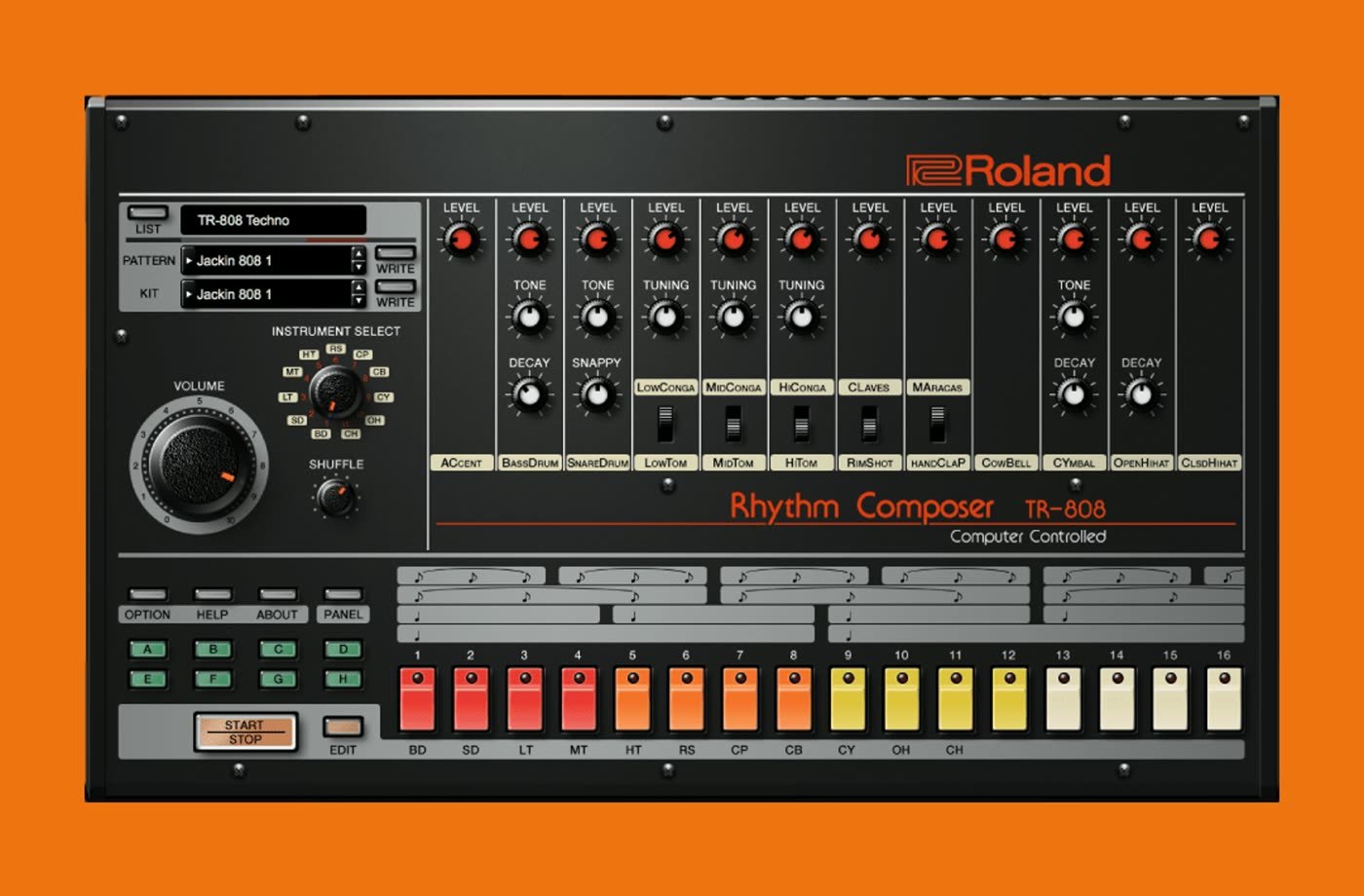
The 808 has 16 sounds: bass drum, snare, low/mid/high toms or congas, rimshot, claves, hand clap, maracas, cowbell, cymbal and open and closed hi-hats. None of them sound like real drums; writers have called them clicky, robotic and toy-like. The famous one is the bass drum: a sine oscillator, a low-pass filter and an amplifier. Turn up its decay and the kick rings out into a deep tone that bends slightly flat as it fades. That long kick is what rap now calls “an 808.”
It was also the first drum machine that let you program a whole song from start to finish, with breaks and rolls: a 16-step sequencer, 32 patterns, up to 768 measures chained, accents on any step, separate outputs for each sound and DIN sync to lock to other gear.
Roland TR-808 famous songs
| Year | Record | Why it matters |
|---|---|---|
| 1980 | Yellow Magic Orchestra, “1000 Knives” (live at the Budokan) | Roland lent YMO an 808 before release; one of its first public uses |
| 1980 | Ryuichi Sakamoto, “Riot in Lagos” (B-2 Unit) | Took the 808 into clubs |
| 1982 | Marvin Gaye, “Sexual Healing” | The first US hit single built on the 808 |
| 1982 | Afrika Bambaataa & the Soulsonic Force, “Planet Rock” | Made the 808 the sound of electro, Miami bass and early hip hop |
| 1984 | Strafe, “Set It Off” | The kick pushed to sound like an underground blast |
| 1986 | Beastie Boys, “Paul Revere” (Licensed to Ill) | A reversed 808 recording; Rick Rubin era |
| 1987 | Whitney Houston, “I Wanna Dance With Somebody (Who Loves Me)” | The 808 at the top of the pop charts |
| 2008 | Kanye West, 808s & Heartbreak | The 808 on every track of the album |
Hip hop got the most out of it. Run-DMC, LL Cool J and Public Enemy built records on the 808; Rick Rubin popularized tuning the long kick to different notes so it played the bass line; and Hank Shocklee of the Bomb Squad said it is not hip hop without that sound. When East Coast producers moved to samplers like the SP-1200 and MPC in the ’90s, the 808 stayed central in Southern rap, and from there it became the backbone of trap.
TR-808 vs TR-909
The 909 followed in 1983. It kept analog circuits for the kick, snare and toms but was Roland’s first drum machine to use samples, for its hi-hats and cymbals. Its kick is shorter and punchier, and it became the sound of house and techno. Roughly: 808 for hip hop, electro and trap; 909 for house and techno. Many producers use the 808 kick with 909 hats.
How to get the 808 sound today
An original 808 is a collector’s item now, and old units need servicing. These are the realistic options in 2026, from cheapest to most expensive. Every one of them can sync to an MPC or a DAW by MIDI. Comparing them with samplers and grooveboxes too? See our ranking of the best drum machines for hip hop.
| Machine | Type | Released | US price (Oct 2026) | Best for | Where to buy (paid links) |
|---|---|---|---|---|---|
| Behringer RD-8 | Analog recreation, 16 sounds, 64-step sequencer, 11 outputs | 2019 (MKII now) | $319 (MKII) | Real analog 808 on a budget | Check price → |
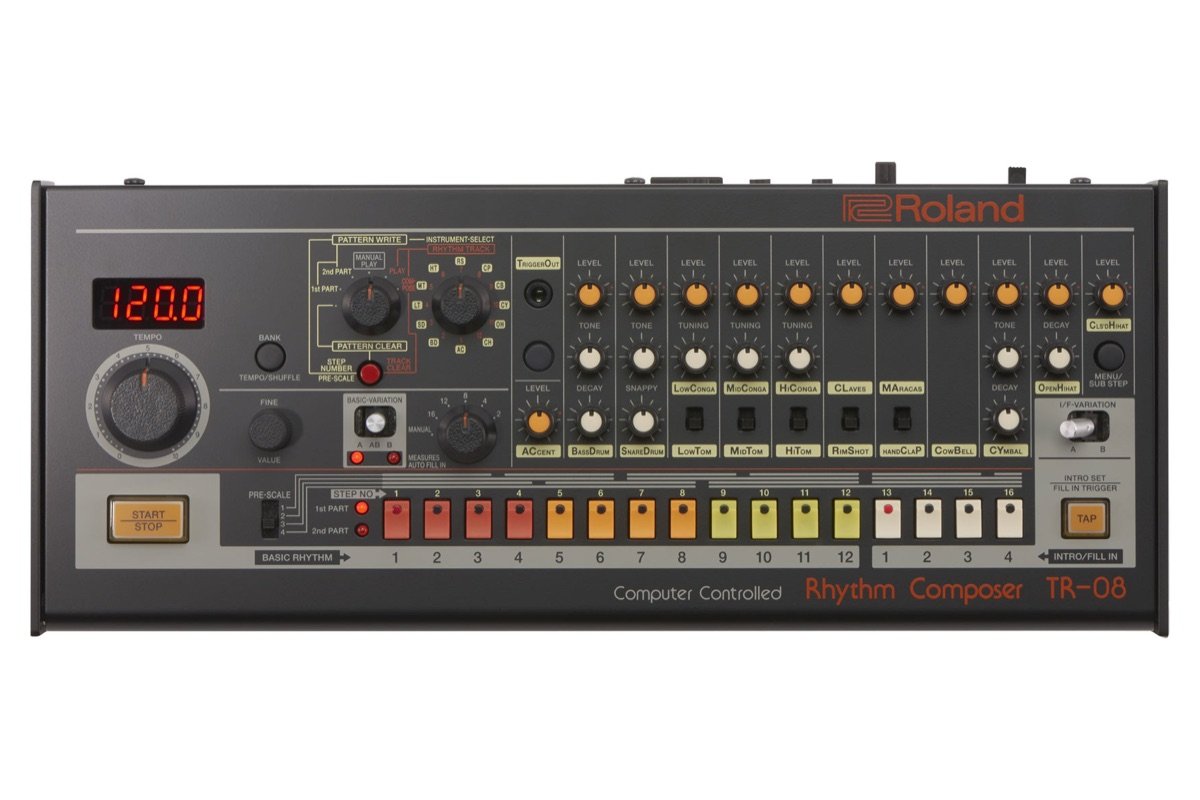
| Roland TR-08 | Roland Boutique, ACB modeling of every 808 voice, speaker, batteries | 2017 | $494.99 | Official 808 layout, small and portable | Check price → |
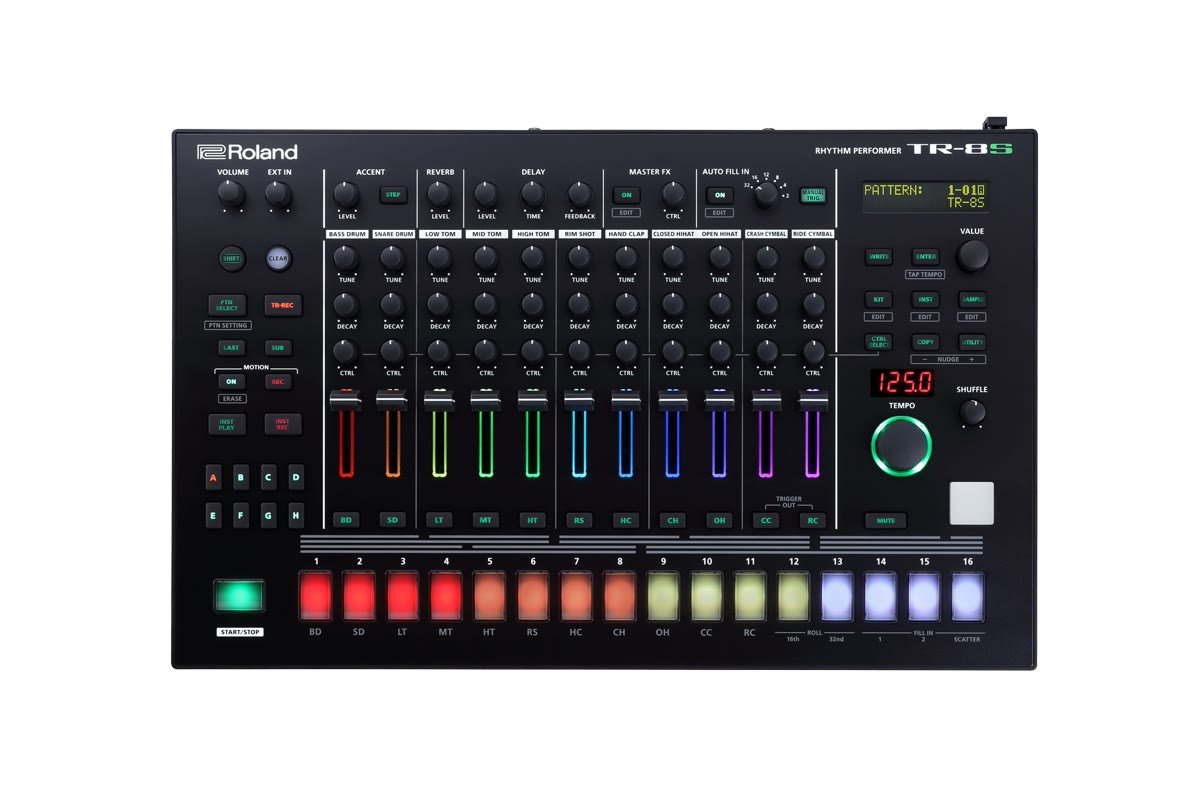
| Roland TR-8S | ACB models of the 808, 909, 707, 606, 727 and CR-78 + samples | 2018 | $899.99 | One box for every classic Roland kit | Check price → |
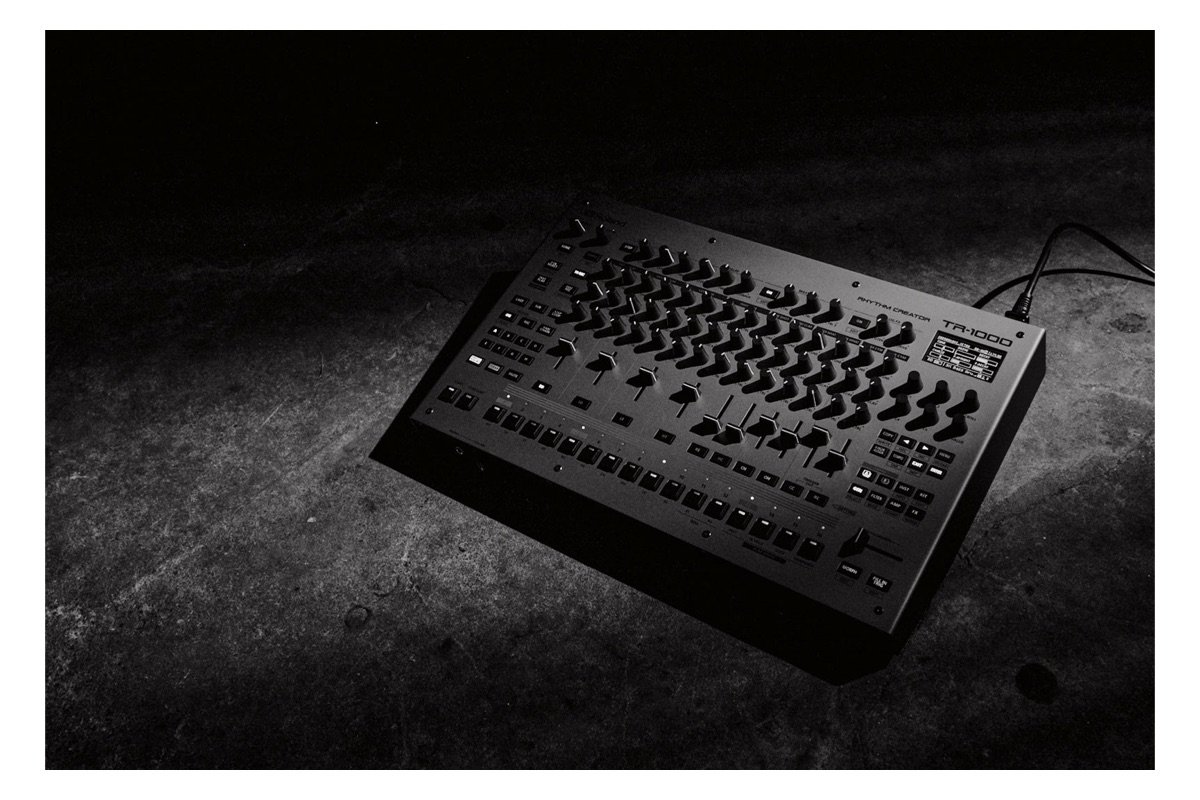
| Roland TR-1000 | 16 analog circuits recreated from the 808 and 909 + ACB, FM, PCM, sampling | October 2025 | $2,699.99 | Roland’s flagship: real analog 808 and 909 | Check price → |
Behringer RD-8: analog 808 on a budget
Behringer’s RD-8 (2019) recreates the 808 with real analog circuits, 16 sounds and a 64-step sequencer, and adds a stereo analog filter, a “Wave Designer,” 11 separate outputs, USB and MIDI. The current MKII adds a V662 OTA sound chip for a more authentic 808 sound, according to Sweetwater’s listing, which prices it at $319. It is an unlicensed recreation, not a Roland product.
Where to buyBehringer RD-8
Roland TR-08: the official 808, shrunk
Roland’s TR-08 (2017) keeps the 808 panel in the small Boutique format. It models every 808 circuit with Roland’s Analog Circuit Behavior (digital, not analog), has a 16-step sequencer with sub-steps for rolls, MIDI, ten outputs over USB audio, a built-in speaker and runs on four AA batteries or USB. Sweetwater lists it at $494.99.
Where to buyRoland TR-08
Roland TR-8S: every classic Roland kit
The TR-8S (2018) is the performance machine: ACB models of the 808, 909, 707, 606, 727 and CR-78, your own samples, effects and separate outputs. If you want an 808 and a 909 in one box, this is the practical choice at $899.99. The smaller TR-6S ($469.99) uses the same engine with six tracks.
Where to buyRoland TR-8S
Roland TR-1000: analog again
On October 1, 2025, Roland announced the TR-1000 Rhythm Creator, its first drum machine with true analog voices in over 40 years. It has 16 analog circuits recreated from the original 808 and 909 designs, plus 21 circuit-bent ACB models, FM and virtual-analog tones, a PCM library and stereo sampling with slicing and time-stretch. At $2,699.99 it is a flagship, not a first drum machine.
Where to buyRoland TR-1000

808 pluginD16 Nepheton 2A third-party alternative to Roland’s own software: D16’s plugin recreation of the TR-808, for making 808 patterns inside a DAW.
Or use the 808 you already have
You don’t need a drum machine for 808s. Roland sells official TR-808 software through Roland Cloud (its first official software 808 and 909 came out in 2018), and every MPC and DAW includes 808 kits. On an MPC, load an 808 kick on a pad, turn up the decay, and play it chromatically or tune it to your sample’s key: that is the trap and Southern bass line in one sound. Our guide to chopping samples on an MPC covers the sample side, and the best Akai MPC guide helps you choose the machine.

Roland TR-808 FAQ
When was the Roland TR-808 released?
Roland launched the TR-808 Rhythm Composer in 1980 with a US list price of $1,195. Yellow Magic Orchestra used one on stage that year before it was in stores.
Who invented the TR-808?
It was built by Roland, the company Ikutaro Kakehashi founded in 1972. The design team was led by chief engineer Tadao Kikumoto, with Hiro Nakamura designing the sound circuits. Kakehashi and the musician-engineer Don Lewis pushed for an affordable machine.
How many TR-808s were made?
About 12,000. Roland stopped production in 1983, when it could no longer buy the slightly faulty transistors that gave the 808 its sizzle. The TR-909 replaced it the same year.
Why was the TR-808 a failure at first?
In 1980 most producers wanted drum machines that sounded like real drums, like the sample-based Linn LM-1. The 808 sounded synthetic. Once it went out of production, used units sold for under $100, and that cheap price put it in the hands of the hip hop and electronic producers who made it famous.
What famous songs used the TR-808?
Marvin Gaye’s “Sexual Healing” and Afrika Bambaataa & the Soulsonic Force’s “Planet Rock” (both 1982), records by Run-DMC, LL Cool J, Public Enemy and the Beastie Boys, Whitney Houston’s “I Wanna Dance With Somebody,” and every track on Kanye West’s 808s & Heartbreak (2008).
What is an 808 in rap music?
Today “808” usually means a long, tuned bass drum that plays the bass line. It comes from the TR-808 kick with its decay turned up: Rick Rubin popularized tuning it to different notes, and Southern rap and trap made it the center of the beat.
TR-808 vs TR-08: what is the difference?
The TR-808 is the 1980 analog original. The TR-08 (2017) is Roland’s small Boutique version: it models every 808 circuit digitally with Analog Circuit Behavior, adds MIDI, USB audio with ten outputs, a built-in speaker and battery power, and costs about $495 new.
TR-808 vs Behringer RD-8: which is closer to the original?
The RD-8 uses real analog circuits based on the 808 design, plus a filter, 64-step sequencer and 11 outputs, for about $319. It is an unlicensed recreation, not a Roland product. Roland’s own analog recreation is the much more expensive TR-1000.
TR-808 vs TR-909: what is the difference?
The 808 (1980) is fully analog with a deep, boomy kick and is the sound of hip hop, electro and trap. The 909 (1983) was Roland’s first drum machine to use samples, for its hi-hats and cymbals, with a punchier kick that defined house and techno.
Is there an official TR-808 plugin?
Yes. Roland released its first official software TR-808 and TR-909 in 2018, available through Roland Cloud. Most DAWs and the MPC also come with 808 sample kits.
Next step Put it to work: how to chop samples on an MPC →
Sources
- Wikipedia: Roland TR-808 (history, release price, production, uses, with its cited sources)
- Roland: TR-08 Rhythm Composer
- Roland: TR-1000 Rhythm Creator announcement (October 1, 2025, $2,699.99)
- MusicRadar: the TR-1000, Roland’s first true analog drum machine in 40 years
- Sweetwater: Behringer RD-8 MKII (features and price)
- Sweetwater: Roland TR series US prices
Prices are US prices seen on October 29, 2026; they change often. GUIO Records is not affiliated with Roland or Behringer.